



Published August 22, 2026 · Last reviewed August 2026 · Next scheduled review: February 2027
- The intent hierarchy: why Google is different from everything else
- Before marketing: the four things that must exist first
- What has not changed since before the word “digital”
- The Nigerian market you are actually selling into
- The growth engine: how the channels compound
- Local SEO: the free channel most Nigerian businesses ignore
- Offline to online, which is how business actually works here
- Every channel, what it is for, and when to use it
- Being the answer when someone asks an AI
- Why most small businesses fail at digital marketing in Nigeria
- What failed Nigerian startups teach a small business owner
- What this costs at every stage
- Your first 90 days, week by week
- The mistakes that quietly kill Nigerian businesses
- The Honest Summary
- Frequently asked questions
A few years ago I was the customer, not the marketer, and it taught me more about digital marketing in Nigeria than any campaign I have ever run.
I was still going out to work every day, and I needed a workspace in Ibadan that would let me work long hours, overnight if necessary, with constant power, a quiet environment and internet strong enough to actually work on.
I had tried several coworking spaces around the city.
Every single one closed at 5PM, or 6PM if you were lucky.
That was the dealbreaker.
That is useless when your clients are in London and New York and your working day genuinely starts when Lagos is going to bed.
So one evening I did what roughly a hundred million Nigerians now do without thinking about it.
I opened Google and typed “24/7 workspace near me.”
One business came up with exactly what I needed.
Seb’s Hub.
I called the number on the listing, and the CEO, Mr Francis, picked up immediately. I told him what I needed. He told me they had all of it.
The following week I paid ₦40,000 for a month of 24/7 access, and I stayed with them for a long time after that.
Now sit with what actually happened there, because this is the whole article in one story.
I was not persuaded. I was already sold. I had the need, the budget and the intention before I ever touched a keyboard.
Nobody advertised to me. No billboard, no Instagram ad, no influencer. I went looking.
The listing itself was free. Claiming a Google Business Profile costs nothing, though maintaining it well takes real time.
Several competitors may well have had exactly what I needed. I simply never reached them. They had space, staff and a generator. They just did not appear at the moment I searched.
It was not ₦40,000. It was ₦40,000 a month, repeatedly, plus every person I told. And I have now told you.
That is what digital marketing in Nigeria actually looks like when it works.
Not viral. Not clever. Not expensive.
Just being findable at the exact moment somebody with money in their hand is looking for what you sell.
This guide is the complete version of that idea.
It is written for the Nigerian business owner who is tired of vague advice.
For the entrepreneur in the diaspora building something back home, and for anyone running an online business from a laptop in Enugu or Lekki.
And for anyone selling into Africa who has watched a well-funded competitor fail here while a quieter operator quietly won.
I have spent eight years running these systems for small business owners, corporations and international clients.
I am going to give you the whole thing: what to build, in what order, what it costs, and what to ignore.
My full portfolio and project history is public if you want to check me first.
The Intent Hierarchy: Why Google Is Different From Everything Else
Before any tactic, you need one idea that reorganises everything else.
Not all attention is equal, and most marketing advice ignores this completely.
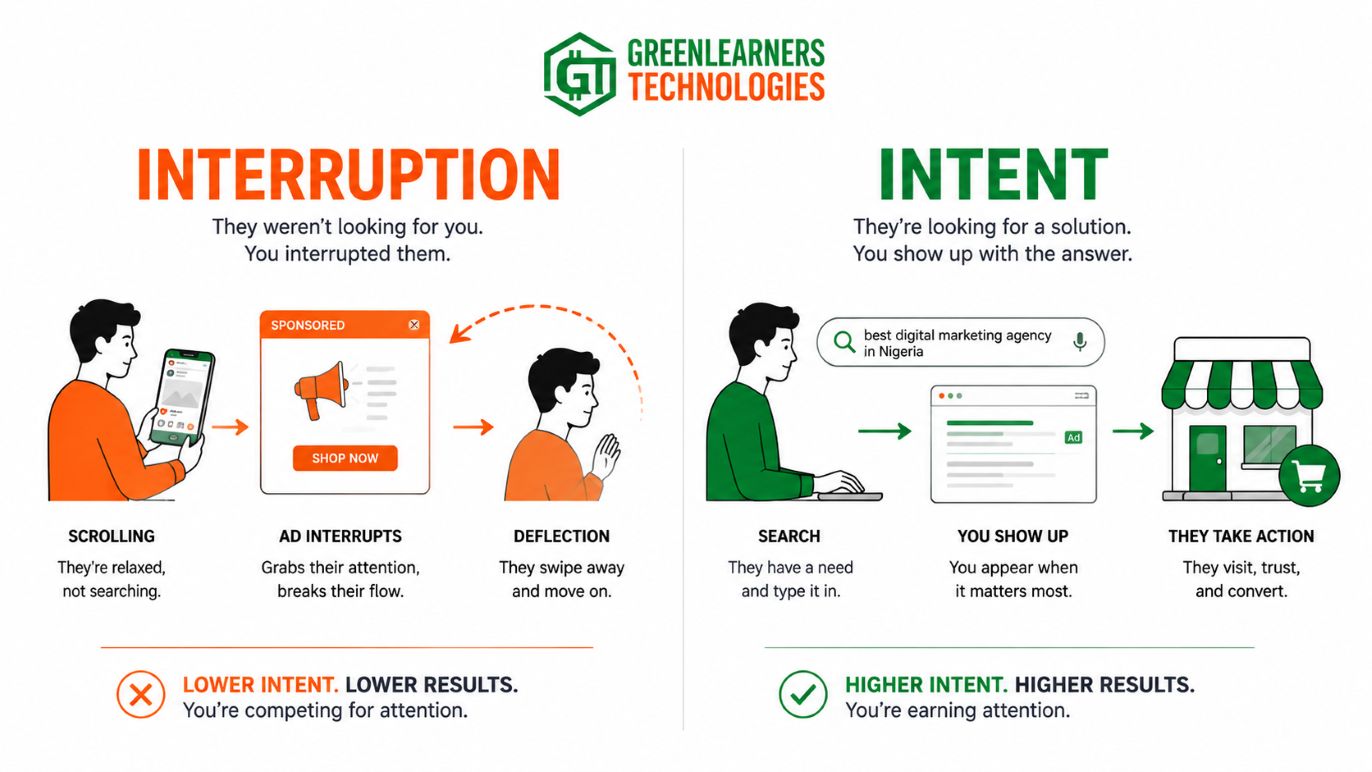
There are two fundamentally different ways to reach a human being, and they are not variations of the same thing.
| Interruption Marketing | Intent Marketing | |
|---|---|---|
| Where | Instagram, TikTok, Facebook, YouTube ads, billboards, radio | Google Search, Google Maps, marketplace search, AI assistants |
| What the person was doing | Something else entirely. Watching, scrolling, relaxing | Actively looking for what you sell |
| Your job | Stop them, then create the desire | Show up and be credible |
| Typical conversion | Usually lower, because the need must be created first | Usually higher, because the need already exists |
| Cost per sale | Often higher, and rising as competition increases | Often lower, and can compound downward over time |
| Best for | Discovery, new categories, impulse products, brand building | Anything a person would think to search for |
Here is the insight almost nobody states plainly.
Google’s genuine innovation was not search. It was working out how to monetise the highest-intent moment in commerce.
When I typed “24/7 workspace near me,” I was as close to a purchase as a human being gets. Google did not have to convince me of anything. It just had to hand me a business.
Meta and TikTok are extraordinary at interruption. They can put your product in front of someone who did not know it existed, and for many Nigerian businesses that is exactly the right move.
But interruption and intent are different jobs, and the mistake is treating them as interchangeable.
Intent marketing captures it.
A business that only interrupts keeps paying to reach new audiences. A business that only waits for intent never grows beyond the people already looking. The strategic frame behind everything in this guide
You need both.
And one qualification that matters, because it is where this argument is usually taken too far.
The highest-intent channel is not automatically the highest-growth channel.
If almost nobody searches for what you sell, because the category is new or the product is a discovery purchase, then search has very little demand to capture and social will grow you faster.
The full picture looks like this: search captures demand, social creates it, retargeting recaptures it, content compounds trust, and email or WhatsApp monetises what you already have.
But if your budget is small and there is existing demand to capture, capture it before you spend money manufacturing new demand.
It is cheaper, it converts better, and it is the single most common thing Nigerian businesses get backwards.
Before You Scale Marketing: Four Things To Fix First
I am going to say something that will cost me work, and say it anyway.
You can absolutely test whether demand exists before all four of these are in place.
Post in a group, message your network, run a tiny ad, see whether anybody bites. That is sensible, and waiting for perfect paperwork before validating an idea has killed more businesses than moving too fast ever has.
But once you are ready to spend real money on advertising, these four need to exist.
Otherwise you will burn the budget and conclude that digital marketing does not work, when what actually happened is that you drove traffic into a building with no doors.
A registered business, and a business bank account
Register with the Corporate Affairs Commission, Nigeria’s official business registry.
A Business Name registration suits a sole proprietorship or freelancer.
A private limited company creates a separate legal entity with limited liability under Nigerian company law, which eases access to business finance and carries the credibility larger clients quietly require.
It is broadly comparable to an LLC or corporation elsewhere, though the rules differ.
Then open a corporate business bank account in that name, which most Nigerian banks now process directly from your CAC documents.
This is not bureaucracy. It is marketing infrastructure.
In a market where most surveyed internet users worry about fake content, asking a customer to pay into an account bearing a personal name is a conversion problem, not just a compliance one.
For diaspora buyers and larger corporate clients especially, a registered name and corporate payment details visibly reduce the perceived risk of sending money to someone they have never met.
- Reserve your business name on the CAC portal
- Register as a Business Name or limited company depending on your ambition
- Open the corporate account with your CAC documents
- Put the registered name on every invoice, receipt and payment request
Somewhere to send people that actually converts
A website, a landing page, or at minimum a properly built WhatsApp Business profile with a catalogue.
Most Nigerian business websites are brochures. They describe the company, list services, and give no one a reason to act.
A page that converts does four things: states plainly what you do and who for, shows proof, removes the specific fear stopping the buyer, and makes the next step obvious and easy.
Build it before you buy traffic, not after.
Sending paid clicks to a page that cannot convert is the fastest way to lose money in this market.
That is why we build websites and funnels as part of campaign work rather than as a separate product.
A way to capture people who are not ready yet
Most visitors will not buy today. If you have no way to stay in contact, you paid for a visit and kept nothing.
Capture something you own: a WhatsApp contact, an email address, a phone number.
Social followers are borrowed.
An algorithm change can cut your reach overnight and there is no appeal process.
A permission-based list you built yourself is far more durable, though consent rules, deliverability and platform policies still apply. Build it properly and protect it.
Numbers you can actually make decisions with
Before any campaign, you must know three figures.
What a customer is worth to you. Average order value.
What you keep from it. Gross margin.
What you can afford to pay to acquire one. Which follows from the first two.
Without these, “₦2,000 per lead” is a meaningless number. It is excellent for a furniture business and ruinous for a business selling ₦3,000 products.
- Average order value × gross margin % = gross profit per sale
- Gross profit per sale ÷ 3 = a starting ceiling for customer acquisition cost. This is our rule of thumb, not a financial law. Raise it if customers buy repeatedly, lower it if cash is tight or refunds are common
- If leads convert at 20%, your maximum cost per lead is that ceiling × 0.20
A business coach will tell you that marketing multiplies what already exists.
That is exactly right, and it cuts both ways.
Marketing multiplies a good business. It also multiplies the speed at which a broken one runs out of money.
Not sure whether your foundations are ready?
We will look at your setup honestly and tell you what to fix before you spend anything on ads. Sometimes the answer is that you are not ready yet.
Get An Honest Assessment →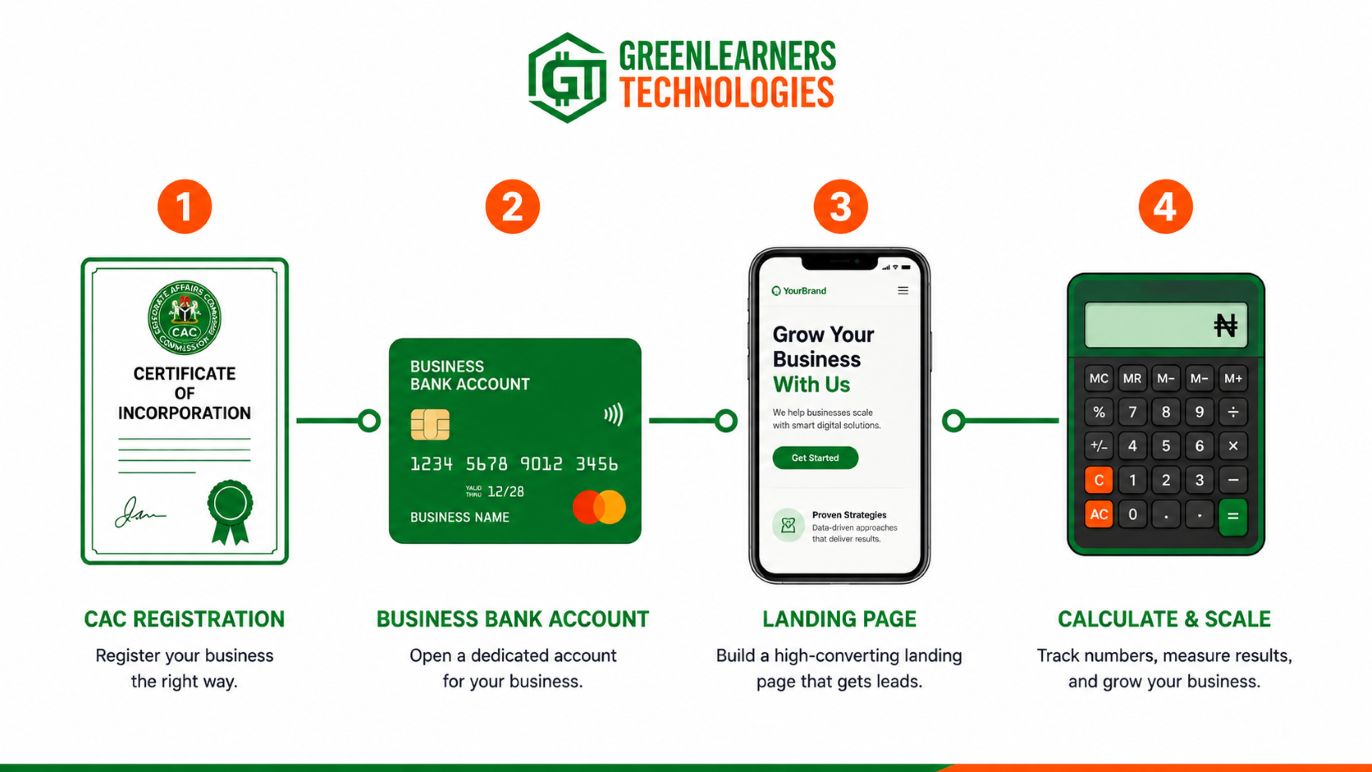
What Has Not Changed Since Before The Word “Digital”
Something worth understanding before we get to tactics.
Almost nothing about business growth is new. Only the distribution changed.
In 1872, Aaron Montgomery Ward posted a single-sheet price list to farmers in rural America who were being overcharged by local stores.
He was not doing “content marketing.”
He was solving a trust problem at distance, and he added the line that changed retail forever: satisfaction guaranteed or your money back.
He removed the buyer’s fear. That is all a guarantee has ever been.
John Wanamaker, running department stores in the same era, is remembered for the complaint that half his advertising budget was wasted and he did not know which half.
The reason digital marketing matters is that we can now answer Wanamaker’s question. Not perfectly, but far better than he could.
And closer to home, Nigerian commerce has run on the same three forces for as long as there has been a market square.
| The Timeless Force | How It Worked Before | What It Is Called Now |
|---|---|---|
| Reputation | Everyone in the market knew who sold good cloth and who sold rubbish | Reviews, ratings, social proof, case studies |
| Referral | A satisfied customer brought her sister the following week | Word of mouth, community, referral programmes, WhatsApp shares |
| Position | The stall at the market entrance sold more than the stall at the back | Search rankings, the Google local pack, algorithmic reach |
| Trust at distance | Trade credit, guarantors, family name, being “known” | Pay-on-delivery, escrow, verified profiles, reviews |
| Frequency | The trader who greeted you every morning got the sale | Retargeting, email sequences, WhatsApp broadcasts |
Think about how you have actually bought things.
I have bought from people I had never heard of, with no website and no reviews, simply because a friend I trusted said “this person is good.”
That is still the most powerful marketing force in Nigeria, and no amount of ad spend replaces it.
What digital does is make it measurable, repeatable and larger.
A referral used to reach one sister. Now it reaches a WhatsApp group of two hundred people, and it stays searchable for years.
The trader who kept her freshest tomatoes at the front of the stall was doing conversion rate optimisation.
Nobody taught them the vocabulary. They just understood buyers. Why Nigerian business instincts translate directly into digital marketing
The Nigerian Market You Are Actually Selling Into
Four facts about the Nigerian market shape every decision in this guide.
Get these wrong and the rest of your strategy is built on sand.
Four facts shape every decision about digital marketing in Nigeria that follows.
One. Google is more dominant here than almost anywhere.
At the time of writing, StatCounter’s Nigeria data puts Google at roughly 98% of measured search engine share across devices, higher than the United States.
Debates about “diversifying away from Google” are largely solving an American problem.
For conventional web search in Nigeria, Google is effectively the whole game. Discovery also happens inside marketplaces, social apps, Maps, YouTube and increasingly AI tools, which is why this guide covers those too.
Two. This is a mobile economy, not a desktop one. Mordor Intelligence reports 82.3% of Nigerian online orders come from mobile. Your site is a phone experience first and everything else second.
Three. Trust is the binding constraint, not awareness. Krestel Digital reports 81.1% of surveyed Nigerian internet users worry about distinguishing real from fake content. Awareness is cheap here. Belief is expensive.
Four. Half the country is still offline.
DataReportal counts 130 million Nigerians not using the internet.
Radio, billboards, market presence and word of mouth still move real money, and pretending otherwise is a Lagos-bubble mistake.
- Social media identities number far fewer than internet users. DataReportal counts 47.8 million social media identities against 109 million internet users, and identities are not the same as unique people. The practical takeaway is that an Instagram-only strategy is inherently narrower than one combining search, messaging, a website and offline channels.
- Mobile internet speed rose sharply, it did not fall. Ookla’s Speedtest data put Nigeria’s median mobile download speed in the mid-40s Mbps range through 2025 and 2026, roughly double the previous year. Plenty of local advice still quotes an outdated figure showing a decline. Your creative can be richer than that advice assumes, though roughly a third of connections still are not broadband, so keep a lightweight path.
The Greenlearners Growth Engine: How The Channels Compound
Individual tactics do not grow businesses. Systems do, and this is the system behind effective digital marketing in Nigeria.
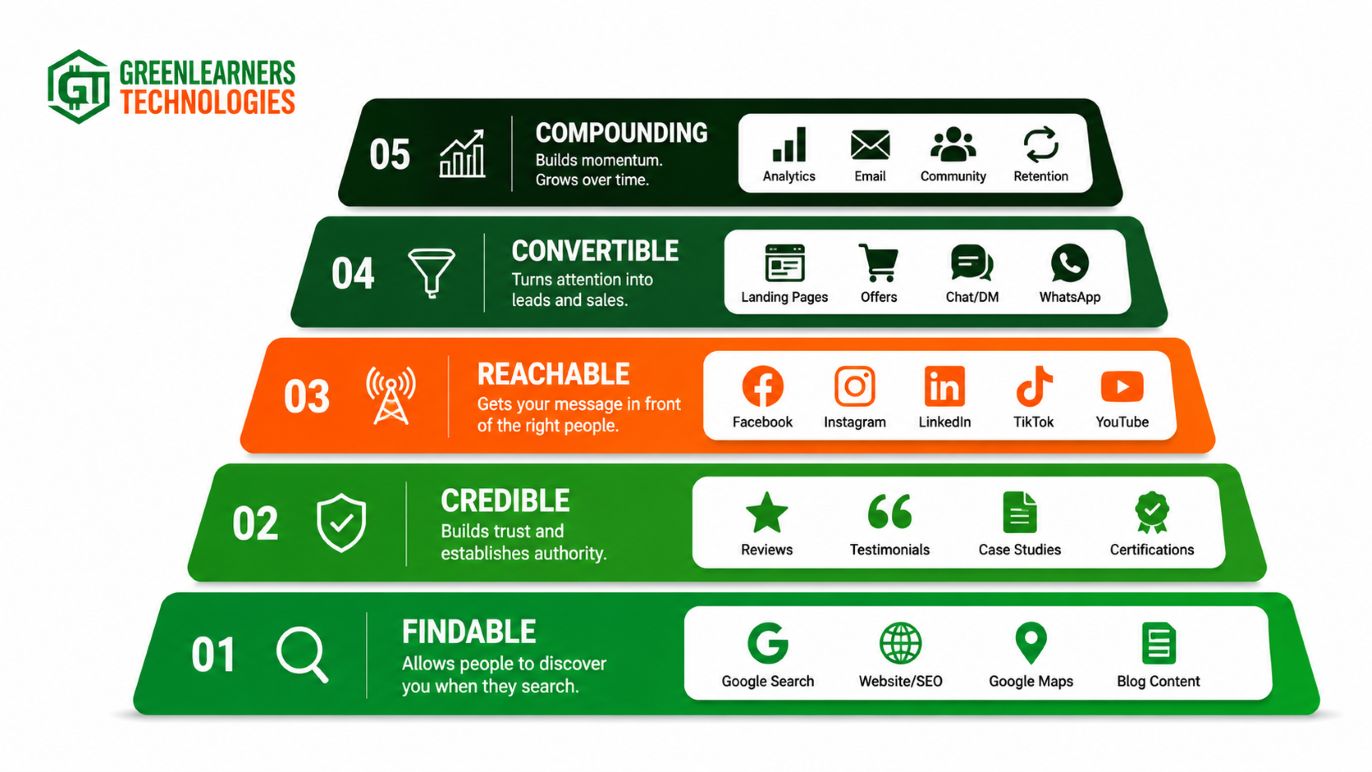
We call it the Greenlearners Growth Engine, and it is the framework we use to diagnose and plan most client engagements. The order matters more than the components.
| Layer | Job | Channels | Time To Effect |
|---|---|---|---|
| 1. Findable | Exist when someone looks for you | Google Business Profile, local SEO, website, WhatsApp Business | Days to weeks |
| 2. Credible | Survive the trust check that follows | Reviews, case studies, content, real photos, registered business | Weeks to months |
| 3. Reachable | Create demand among people not yet looking | Meta Ads, TikTok, video, influencers, radio, billboards | Days |
| 4. Convertible | Turn attention into money | Landing pages, WhatsApp funnels, CRO, retargeting, SMS | Immediate on existing traffic |
| 5. Compounding | Make next month cheaper than this month | SEO, content, email, automation, referral systems | 3 to 12 months |
Most struggling Nigerian businesses are running Layer 3 with no Layer 1, 2 or 4.
They are buying attention, sending it to a page that cannot convert, for a business that looks unverifiable the moment somebody checks.
That is not a budget problem.
That is a sequencing problem, and more ad spend rarely fixes it until the foundations are repaired.
Not louder. More. The only growth principle that has never failed
Local SEO: The Free Channel Most Nigerian Businesses Ignore
This is the section I most want you to act on, because the gap is enormous and the fix costs nothing.
Remember Seb’s Hub.
They did not outspend anybody. They existed at the moment I searched, and four competitors did not.
The data here is remarkably consistent across the local search industry.
One honest caveat before you read it: several of these figures circulate widely across research compilations rather than tracing back to a single primary study, and most were measured outside Nigeria.
Treat them as strong directional consensus rather than Nigerian benchmarks.
Roughly 46% of all Google searches carry local intent, according to widely cited BrightLocal and Google-sourced research.
About 76% of people who run a local search on mobile visit a business within 24 hours, and roughly a quarter of local searches end in a purchase.
The local pack sits at the very top for most local-intent queries, and Google itself confirms that complete, accurate profiles are more likely to appear in relevant searches.
Meanwhile, roughly 41% of local businesses still operate with incomplete profile information, about 34% have never posted an update, and nearly 29% have no business description at all.
Read those two paragraphs together and the opportunity is almost embarrassing.
For many Nigerian businesses with a location or a service area, one of the highest-intent and lowest-cost opportunities available is free, and a large share of competitors have not finished setting it up.
Who This Applies To
Not just restaurants.
A tailor in Ibadan. A mechanic in Ikeja. A furniture workshop in Aba.
A dentist in Wuse. A school in Enugu. A hotel in Port Harcourt.
A law firm in Victoria Island. A hospital in Owerri. A hair salon in Kano. A generator repair business anywhere.
If somebody could plausibly type “[what you do] near me”, this is your highest-return work this month.
Claim and verify your business on Google
Go to Google Business Profile and claim your listing.
If someone searches “verify my business on Google,” this is what they are looking for. Verification is usually by postcard, phone or video, and it is the step that unlocks everything else.
One eligibility note: Business Profiles are intended for businesses that interact with customers in person, whether from a storefront or across a defined service area. A purely online business may not qualify and should build presence through its website and other channels instead.
- Use your exact registered business name, matching your CAC documents
- Use a dedicated business phone line, not a personal number
- Choose a specific primary category, not a vague one. “Furniture manufacturer” beats “shop”
- Add secondary categories for everything else you genuinely do
Complete every single field, then add real photos
Hours including holiday hours, service areas, attributes, products and services.
Write a description that actually tells a customer what you do, who you serve and what to expect, rather than chasing a character count.
Then photograph your actual business. Your workshop. Your team. Your finished work. Your shop front so people can recognise it from the road.
For a local business, real photographs almost always build more trust than polished stock images, particularly in a market where most surveyed buyers already worry about being deceived.
Build reviews deliberately, and answer every one
BrightLocal’s 2026 survey found 97% of consumers read reviews for local businesses. Review signals are widely estimated to drive a meaningful share of local pack ranking.
Ask every satisfied customer, on the day they are happiest, in person, and make it easy by sending the direct link on WhatsApp.
Then reply to every review, positive and negative. Businesses that respond quickly see materially more engagement, and a calm reply to a bad review persuades more buyers than ten five-star ratings.
Post weekly, and keep NAP identical everywhere
Google states that local ranking rests on relevance, distance and prominence, and recommends keeping your information complete and current.
It does not publish a “post weekly and rank higher” rule, so treat posting as a way to keep customers informed rather than a guaranteed ranking tactic.
Post new work, offers, seasonal hours, anything genuinely useful.
Name, Address, Phone must match exactly across your website, your profile and every Nigerian directory you appear in. Inconsistent NAP is one of the most common and most invisible local ranking problems.
Suppose your local pack listing brings you just two extra customers a month.
If your average sale is ₦40,000, that is ₦80,000 monthly, or ₦960,000 a year, from an asset that cost you nothing but an afternoon.
Seb’s Hub earned considerably more than that from one listing and one phone call answered promptly.
This is the work we do through local SEO, and it is almost always the fastest measurable win available to a business with a location or service area.
Is your business showing up when someone nearby searches?
Most Nigerian businesses have never claimed their profile properly. It is free, it takes an afternoon, and it is usually the quickest win available.
Fix Our Local Visibility →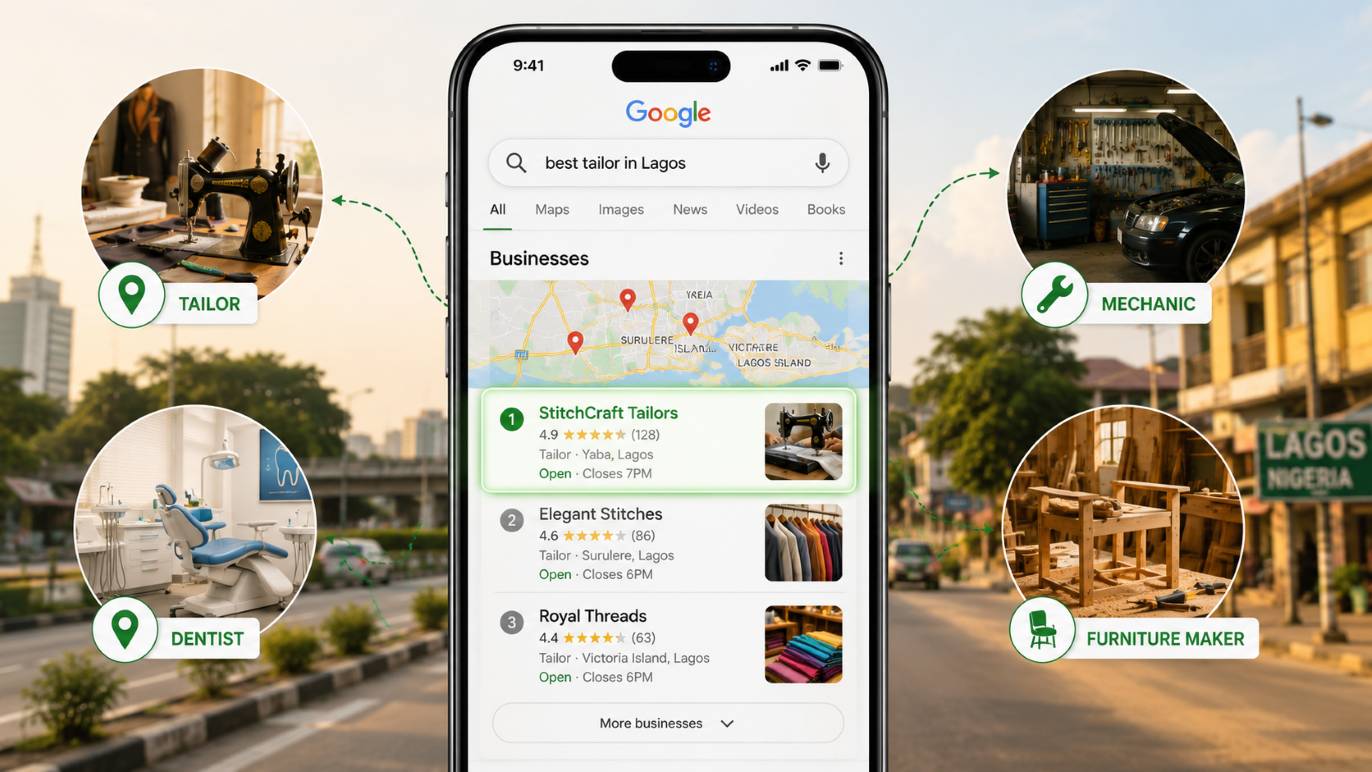
Offline To Online, Which Is How Business Actually Works Here
The Seb’s Hub story had an online ending, but look at how it started.
I had already physically visited several workspaces around Ibadan before I ever searched.
The search was not the beginning of the journey. It was the moment the journey resolved.
In Nigeria, the line between offline and online marketing is largely imaginary, and businesses that treat them as separate budgets lose money at the seam.
Here is the pattern I see constantly.
| Offline Trigger | What Happens Next | Where The Sale Is Won Or Lost |
|---|---|---|
| Sees your billboard on a busy road | Searches your name later, when the need arises | Whether you rank for your own name and look credible |
| Hears your radio jingle in Ibadan or Kano | Checks Instagram or Google at the next opportunity | Whether your last post was this week or in 2023 |
| A friend recommends you | Searches you, checks reviews, asks in a WhatsApp group | Whether what they find matches the recommendation |
| Walks past your shop | Looks you up before committing to a large purchase | Whether your Google profile exists and has photos |
| Collects your flyer at an event | Types your business name into Google that evening | Whether you appear at all |
Notice the pattern in the right-hand column.
Offline creates the awareness. Online closes it. And the close fails silently.
You never get told that a customer heard your radio advert, searched your name, found a dead Facebook page from 2023, and bought from someone else instead.
That loss does not show up in any report.
Radio, Billboards And Word Of Mouth Still Work
Especially outside Lagos, and this is where Lagos-centric marketing advice fails badly.
Radio remains one of Nigeria’s most widely consumed media, and in many rural and semi-urban areas it is still the primary source of information.
Across the South-West, the North and much of the South-East and South-South, FM listenership stays high among exactly the buyers most digital campaigns never reach.
The move is not choosing between them. It is connecting them.
- Put one memorable instruction in every offline placement. “Search [your exact business name] on Google” beats a long URL nobody will remember
- Make sure you actually rank for your own business name before you spend on offline awareness
- Use a dedicated phone number for offline campaigns so you can attribute the calls
- Ask every walk-in customer where they heard about you, and write it down
- Turn word of mouth into a system: give existing customers a reason and an easy way to refer
Word of mouth is the original marketing channel and it still outperforms everything.
Digital does not replace it. Digital is what happens in the ninety seconds after the recommendation. Why your online presence exists to confirm what someone already heard
Every Channel, What It Is For, And When To Use It
Now the practical map of every channel available for digital marketing in Nigeria.
Each of these has a specific job. Using the wrong one for the job is how budgets disappear.
| Channel | Its Actual Job | Start Here If | Speed |
|---|---|---|---|
| Local SEO / Google Business Profile | Capture “near me” intent | You have a location or service area | 2-6 weeks |
| SEO | Capture national search intent, compounding | People search for what you sell | 3-6 months |
| Google Ads | Buy the intent you have not earned yet | You need leads now and margins allow it | Days |
| Meta Ads | Create demand, retarget, reach broadly | Your product is visual or impulse-driven | Days |
| Close sales and hold the relationship | Almost always, in Nigeria | Immediate | |
| Content | Build trust before the buying moment | Your sale needs education first | 3-6 months |
| Video / TikTok | Discovery at scale, cheaply | You can show the product working | Weeks |
| Nurture, repeat sales, an audience you own | Your buying cycle is longer than a day | Weeks | |
| SMS | Reach people with no data connection | Time-sensitive offers, reminders | Immediate |
| CRO | Make every other channel more profitable | You already have traffic that does not convert | Weeks |
| AI search optimisation | Be cited when buyers ask an AI assistant. See the section below | You are already producing good content | Months |
Our full breakdown of how to execute each one sits in the guide to marketing strategies that work in Nigeria.
And if you are choosing who should run it, our guide to finding the best digital marketer in Nigeria gives you seven tests to apply to anybody, including us.
If This Is You, Start Here
The channel map above is general. Your business is not.
Here is where I would start for the most common Nigerian business types, based on the reach and intent data in this guide rather than on preference.
| If you run… | Start with | Then add | Why this order |
|---|---|---|---|
| Fashion, beauty or e-commerce | TikTok or Meta Ads | WhatsApp, then Instagram retargeting | Typically visual and impulse-driven, and beauty is among Nigeria’s fastest-growing e-commerce categories |
| A clinic, hospital or dental practice | Local SEO and reviews | Content, then Google Ads | Medical trust usually builds through proximity and evidence rather than interruption |
| Professional services: law, accounting, consulting | Google Ads on high-intent terms | SEO, then LinkedIn | Someone searching “corporate lawyer Lagos” is not browsing |
| A restaurant, hotel or event venue | Google Business Profile and photos | Instagram, then reviews at scale | Local pack visibility and visible reviews usually matter more here than anywhere else |
| A school or training business | SEO and content | Email, then Meta Ads | Parents and learners research heavily before committing money |
| Logistics, manufacturing or B2B supply | SEO and Google Ads | LinkedIn, then WhatsApp for accounts | Long consideration cycles, searchable problems, relationship-led close |
| A trade business: tailor, mechanic, electrician | Google Business Profile | WhatsApp, then referral system | Most demand is “near me,” and few competitors have finished this properly |
| Selling from Nigeria to clients abroad | SEO plus LinkedIn | Content, then email | Foreign buyers verify you through search and credentials before they ever message |
Google Business Profile + reviews. Reviews build the trust that makes a listing worth clicking.
Meta Ads + WhatsApp. Meta creates the interest, WhatsApp closes it. This pairing outperforms almost everything else for Nigerian product businesses.
SEO + content. Content gives search something worth ranking, search gives content someone to find it.
Any paid channel + CRO. Raising conversion 1% to 2% doubles the return on every naira already being spent.
Radio or billboard + a searchable name. Offline plants it, search harvests it.
Notice the shape: one channel creates attention, the other converts it. Most businesses build only half of a pair and then wonder why results feel random.
Being The Answer When Someone Asks An AI
This section did not need to exist two years ago.
It does now, and the data behind it is the most striking thing I found while researching this guide.
BrightLocal’s Local Consumer Review Survey 2026, based on 1,002 consumers, found that the share using ChatGPT or a similar AI tool to find local businesses rose from 6% to 45% in a single year.
That makes AI the third most-used discovery channel for local businesses, ahead of Yelp and Tripadvisor, behind only Google and Facebook.
Over the same twelve months, Google’s own share of local business discovery fell from 83% to 71%.
That survey is US-based, so treat the exact percentages as a signal of direction rather than a measurement of Nigerian behaviour. But the direction is unambiguous, and Nigerian buyers use the same tools.
The Part Most Advice Gets Wrong
You will read a great deal of confident advice about “optimising for AI” that mostly amounts to adding structured data to your website.
I want to be honest with you, because being wrong here is expensive.
An Ahrefs study across 1,885 tracked pages in 2026 found that adding JSON-LD schema produced no measurable change in AI citations.
None of the five major AI systems they examined actually read JSON-LD when fetching a page live.
Schema is still worth having. It helps Google understand your page, it powers rich results, and this article ships a full graph of it.
But it is not the lever for AI visibility, and anyone selling it to you as one is guessing.
What Actually Appears To Work
Here is the finding that matters, and notice how neatly it agrees with everything else in this guide.
Multiple 2026 studies of AI citation behaviour agree on one thing, even while disagreeing on the exact number.
The majority of sources an AI draws on when discussing a brand sit somewhere other than that brand’s own website: directories, review platforms, forums, video and third-party coverage.
Published estimates range widely, from roughly two-thirds to over 90%, and at least one vendor study argues the opposite. So treat the direction as reliable and the precise figure as unsettled.
Read that again if you run a business.
The way to be recommended by an AI assistant is largely the same as the way to be trusted by a human being.
- Your Google Business Profile and reviews matter more, not less. They are exactly the off-page sources AI systems draw on
- Get listed accurately in real Nigerian directories, with identical name, address and phone details everywhere
- Answer real questions in plain, complete sentences on your own site. Content written to be quotable gets quoted
- Earn mentions on sites that are not yours. Press, partner sites, industry listings, genuine community participation
- Keep everything consistent. Contradictory information across platforms makes you a risky thing for a machine to recommend
Every serious channel in this guide points the same direction.
Be genuinely findable. Be verifiably credible. Be consistent everywhere.
Humans reward it, Google rewards it, and it now turns out that AI assistants reward it too, because they are reading the same signals.
We treat this as its own discipline through AI search optimisation, but the honest summary is that it rewards businesses that were already doing the fundamentals properly.
Why Most Small Businesses Fail At Digital Marketing In Nigeria
Let me address the question directly, because it is the one I get asked most.
Here the sourcing needs honesty, because the headline number depends entirely on who you ask.
Reporting citing a 2023 SMEDAN report puts small business failure at around 80% within five years. Moniepoint’s compilation of SMEDAN and NBS findings puts it at more than 95%.
Both figures circulate widely and both trace back to SMEDAN, measured differently.
I am not going to pick the scarier one to make a point.
Somewhere between four and nine in every ten Nigerian small businesses will not see their fifth birthday. That range is wide, and it is still terrifying enough to act on.
MSMEs make up about 96% of all Nigerian businesses and account for roughly 84% of employment.
And SMEDAN and NBS findings compiled by Moniepoint show that 64.5% of Nigerian micro-enterprises turn over less than ₦50,000 a month.
Sit with that last number.
For a very large share of Nigerian business owners, a ₦300,000 marketing mistake is not a line item. It is six months of revenue.
The Five Reasons, In The Order They Actually Happen
Note that these are different from why funded startups fail, which I cover next.
Startups usually die from too much money and too little discipline.
Small businesses usually die from too little margin for error.
- 1. They buy attention before they can convert it. Ads run to a slow page, an unanswered WhatsApp line, or a business that looks unverifiable the moment someone checks. The money leaves and nothing comes back. This is the single most common failure and it is a sequencing problem, not a budget one.
- 2. They never worked out what a customer is worth. Without average order value and margin, no cost per lead can be judged. So a good campaign gets killed and a losing one gets scaled, both for the same reason: nobody knew which was which.
- 3. They quit at week six. SEO and content need three to six months. Paid ads need enough conversions to learn from. Stopping early guarantees you pay the full cost of starting and collect none of the return.
- 4. They hired on price rather than proof. The cheapest quote usually means an inexperienced operator or a much smaller scope than expected. The fee is rarely the biggest loss. The wasted months and the burned ad spend are.
- 5. They confused activity with progress. Posting daily, boosting posts, growing followers, all while revenue stays flat. Activity feels like work. Only measured outcomes are.
Notice what is missing from that list.
Not one of those five failures is about lacking money, talent or a good product.
Every one of them is about sequence, measurement or patience, and all three are free.
And How To Succeed Instead
The encouraging part is that the fix for each is specific and none of them requires a bigger budget.
| The Failure | What To Do Instead | Where In This Guide |
|---|---|---|
| Buying attention too early | Build findability and credibility first, then buy reach | The Growth Engine |
| Not knowing customer value | Calculate average order value, margin and affordable acquisition cost before any campaign | Foundations, step 4 |
| Quitting at week six | Commit to the 90-day sequence and judge it at day 90, not day 40 | The 90-day plan |
| Hiring on price | Ask for a live dashboard with dates before you pay anybody | The seven hiring tests |
| Confusing activity with progress | Report in leads, cost per sale and revenue. Never in followers | The honest summary |
Do those five things and you will already be operating better than most businesses in your market.
Not because you spent more. Because you sequenced properly and stayed the course.
What Failed Nigerian Startups Teach A Small Business Owner
Most business advice studies winners.
That is a mistake, because winners survive for reasons they themselves frequently misunderstand.
Failure is a better teacher, and Nigeria has just run an extremely expensive experiment on your behalf.
Between 2023 and 2026, a wave of well-funded Nigerian startups collapsed. These were not amateurs. They raised tens of millions of dollars from Y Combinator, the Gates Foundation and global venture funds.
Here is what actually killed them, and what each lesson means for a business owner in Aba or Abuja who has never raised a naira from anybody.
These are not digital marketing failure case studies, and I am not going to pretend they were.
54gene and Jumia Food failed for reasons involving governance, capital markets and operations far beyond advertising.
I am extracting the business-system lesson underneath each one, because marketing sits on top of those systems and cannot survive without them.
54gene: $45 Million, And It Still Ended
Founded in 2019 by Dr Abasi Ene-Obong, 54gene set out to correct a genuine injustice: less than 3% of genetic material used in global pharmaceutical research came from Africa.
The idea was excellent. The funding was extraordinary, over $45 million, including backing from the Bill & Melinda Gates Foundation and Y Combinator.
By July 2023 it had wound down, after three CEO changes in a single year and reported financial mismanagement.
The lesson for your business: money does not fix a business without systems.
A great idea with weak financial control fails faster with funding than without it, because capital lets you scale the disorder.
If you cannot say what your marketing spent and returned last month, adding budget will not help you.
Jumia Food: A Decade Of Operations, Never Profitable
Jumia Food operated in Nigeria for roughly a decade and shut down across seven African markets in December 2023.
It had brand recognition, capital and infrastructure that no local competitor could match.
What it never had was unit economics.
It lost money on individual deliveries and used discounting to hide weak operations.
Meanwhile Chowdeck, far smaller and far less funded, refused to subsidise orders and built for profitability per delivery.
Its founder’s public position was blunt: they do not subsidise orders, because profitability per delivery is the only way to survive in Nigeria.
The lesson for your business: if you lose money on each customer, scale simply makes you lose money faster.
Discounting to buy growth is a strategy with an expiry date.
Before you spend on marketing, know your margin on a single sale.
The Pattern Across All Of Them
Analysis of the shutdown wave keeps surfacing the same causes, and they are strikingly ordinary.
- No product-market fit. JumiaFood and BuyCoins Pro both launched new services, found no demand, and retreated to their core. Building something nobody specifically asked for is expensive at any scale.
- Unit economics that never worked. High delivery costs, low average order values and customer churn destroyed margins that looked fine on a slide.
- Dependence on the next funding round. Operations were built assuming more capital would arrive. When it did not, there was no plan B. Nigerian startup funding fell from a $1.2 billion peak in 2022 to $589 million in 2024.
- Growth before sustainability. As one analyst put it, startups are frequently pushed to build for scale before building for survival.
- Weak governance. Money spent without checks, until there was nothing left to run the business with.
Every one of those failures was a business problem, not a marketing problem.
No campaign saves a business that loses money on every customer.
Marketing is an amplifier. Check what you are amplifying before you turn up the volume.
The Translation For A Nigerian Small Business Owner
| What Killed Them | What It Looks Like In Your Business | The Fix |
|---|---|---|
| No product-market fit | Adding services because a competitor has them | Sell more of what already sells before adding anything |
| Broken unit economics | Discounting to win customers who never return | Know your margin per sale before any campaign |
| Funding dependence | Marketing spend that assumes next month will be better | Reach profitability at your current size first |
| Growth before systems | More customers than you can serve well | Fix delivery before increasing demand |
| Weak financial control | Not knowing what marketing returned last month | Track cost per lead and cost per sale monthly |
Here is the encouraging part, and I mean it sincerely.
You have an advantage those companies did not have.
You are not spending someone else’s money against a fundraising clock. You can build slowly, profitably, and at a size you actually control.
That is not a weaker position. In this market it has repeatedly proven to be the stronger one.
Want the numbers behind the Nigerian market?
We published 147 source-audited statistics on digital marketing in Nigeria, with every figure traced to a named source and contradictory data openly flagged.
See The Full Data Report →What This Costs At Every Stage
Almost nobody publishes what digital marketing in Nigeria honestly costs, which keeps the market confusing and makes overcharging easy.
| Stage | Which One Are You? | Monthly Investment | What It Should Cover |
|---|---|---|---|
| Foundation | 1 active channel. No dedicated marketing person. Doing it yourself | ₦0 – ₦150,000 | Google Business Profile, WhatsApp Business, reviews, basic site |
| Small business | 2 to 3 active channels. One person part-time on marketing, or a freelancer | ₦250,000 – ₦3,500,000 | Local SEO, social, foundational SEO, small ad tests |
| Growing SME | 4 or more channels running together. A marketing lead plus specialists or an agency | ₦500,000 – ₦15,000,000 | SEO, paid ads, email, content and retargeting connected |
| Enterprise | Multi-region or multi-product. An internal team plus external partners | ₦1,500,000 – ₦50,000,000 | Full-funnel strategy across every channel |
Illustrative 2026 planning ranges, not market-standard fees. These cover strategy and management only. Ad spend, creative production, website build and software sit on top and should always be quoted separately.
The naira ranges deliberately overlap, because spend alone does not define your stage. Use the second column to place yourself: how many channels you are genuinely running, and who is running them.
The first row starts at ₦0 because the highest-return work available to most businesses costs nothing but time.
Two honest warnings about this table.
Quotes far below these bands usually mean an inexperienced operator, a plan to subcontract your work cheaply, or a scope much smaller than you imagine.
And spending at the top of a band does not buy you results from the next one up.
A business investing ₦300,000 monthly while expecting enterprise outcomes will be disappointed, and will probably blame digital marketing rather than the arithmetic.
If you are curious what the people running these campaigns actually earn, we broke that down by country and experience level in our digital marketing salary guide.
Want the campaigns run properly, without hiring a team?
We build and run the full stack, from Google Business Profile to paid ads to WhatsApp funnels, and report monthly in revenue terms.
See How We Work →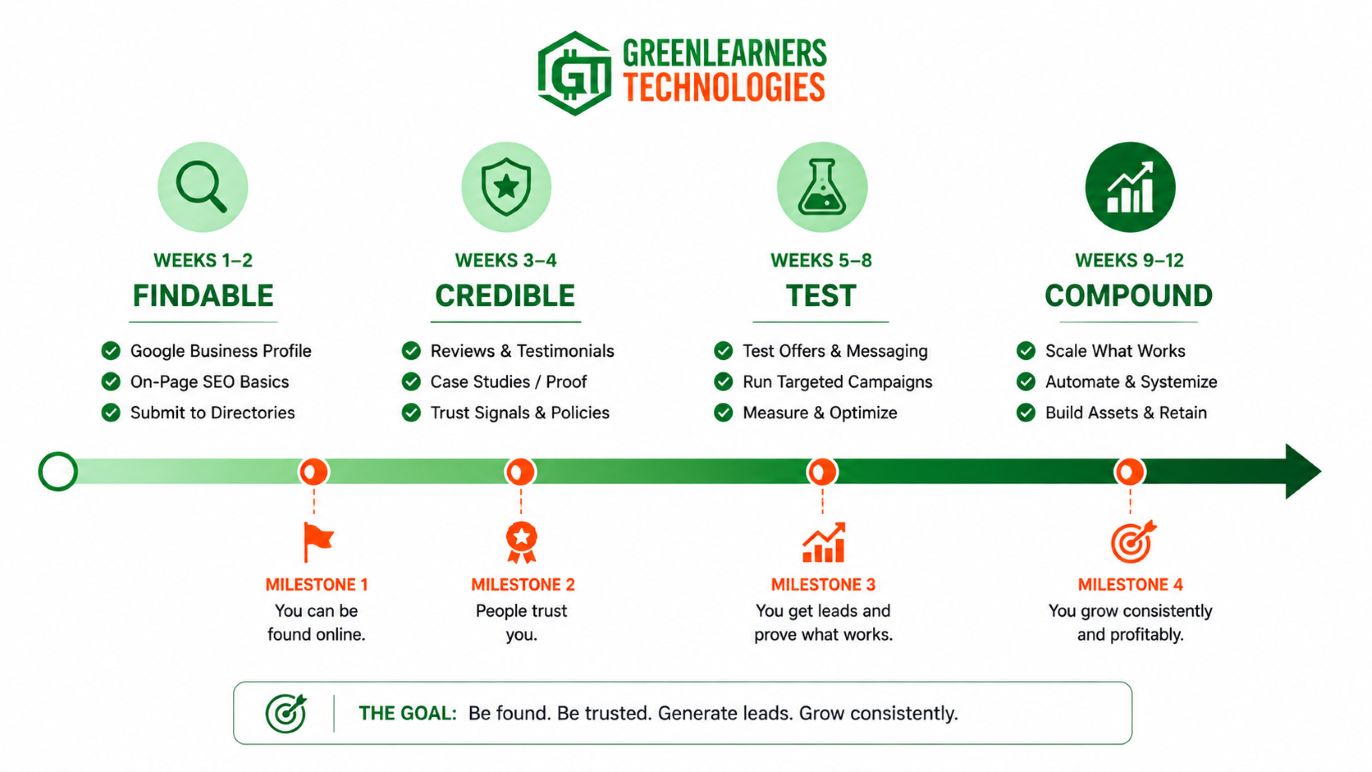
Your First 90 Days, Week By Week
Everything above is understanding. This is execution, the ninety-day sequence I would run for any business starting digital marketing in Nigeria today.
If you did nothing else in this guide except follow this schedule, you would be ahead of most businesses in your market.
Weeks 1 to 2: Become findable
- Claim and fully verify your Google Business Profile, every field completed
- Upload real photographs of your premises, team and work. Ten is a practical starting point, not a Google requirement
- Set up WhatsApp Business properly: catalogue, away message, quick replies, business hours
- Check how your site performs on PageSpeed Insights and note your Core Web Vitals score
- Confirm your CAC registration and corporate bank account are in order
- Ask your ten happiest past customers for a Google review, individually, by WhatsApp
Platform cost: ₦0. It still costs you time, and possibly photography. This fortnight has the highest return of anything in this guide.
Weeks 3 to 4: Become credible
- Build or fix one page that sells one thing clearly, and test it on mobile data rather than office WiFi
- Write down your average order value, gross margin and maximum affordable cost per sale
- Install the Meta Pixel and Google Analytics tag now, before you need them, so data starts collecting
- Reply to every existing review, including any bad ones, calmly
- Publish your first article answering the question customers ask you most, and verify your site in Google Search Console
Weeks 5 to 8: Test paid demand carefully
- Run a small, focused Meta or Google Ads test. Enough to learn from, not enough to hurt
- Route leads to WhatsApp rather than a contact form wherever the offer allows
- Start with placements you can measure properly. If any placement produces cheap leads that never qualify, exclude it and judge the change against sales, not cost per lead
- Give a campaign enough time and enough conversions to say something meaningful before you change it. Reacting to one bad day is how good campaigns get killed
- Track cost per lead daily and cost per sale weekly. They are different numbers
For reference, a documented five-day Meta Ads test we ran for a Nigerian B2B marketplace produced 474 website leads at ₦41.30 each from ₦19,574.88 in spend.
Your numbers will differ by industry and margin.
But that is the kind of figure a properly structured test should be able to report.
Weeks 9 to 12: Build the compounding layer
- Publish weekly content answering real customer questions
- Start a WhatsApp broadcast list and an email capture, so every visitor becomes a contact you own
- Set up retargeting for people who visited but did not buy
- Build one referral mechanism, because word of mouth is your cheapest channel and it deserves a system
- Review what worked, cut what did not, and reinvest into the winners
An SEO engagement we documented took a client from 244 to 25,900 monthly clicks over 16 months. That is a large multiple, and it is worth saying why it was possible: the site started from an almost non-existent base in a niche where competitors had published very little. A crowded market moves in smaller steps. The point is the shape of the curve, not the multiple.
It also does not start in month one. It starts with the boring work you do in weeks nine to twelve.
These are illustrative examples, not our best work.
A meaningful share of what we have delivered sits under non-disclosure agreements and cannot appear on a public page. Some of it involves campaigns and revenue considerably larger than anything shown here. Other accounts have since changed hands, so we no longer hold dashboard access even where the client would happily consent.
What is published is simply what we are contractually free to publish. Every figure cited comes from our own platform records rather than an independent audit, and we will open those dashboards on a call.
It will make you findable, credible and measurable, which is more than most of your competitors will ever be. What to realistically expect
The Mistakes That Quietly Kill Nigerian Businesses
Most Nigerian businesses that conclude digital marketing does not work made one of a handful of recurring mistakes.
Every one of them is avoidable, and none is about budget size.
- Buying attention before you can convert it. Traffic to a page that cannot sell is the most expensive mistake in this guide, and the most common.
- Ignoring the free channel. Roughly a third of businesses have never completed their Google Business Profile. Every month you delay is measurable money handed to a competitor.
- Building only on rented land. If your entire business lives on Instagram, one algorithm change or one account suspension can end it. Own your list.
- Treating all of Nigeria as one market. A campaign that wins in Lekki frequently needs different language, proof and payment options before it works in Kano.
- Switching strategies at week six. SEO and content take months. Quitting early is the single most common reason business owners conclude that digital marketing in Nigeria does not work.
- Not asking new customers how they found you. It costs one sentence and it is the cheapest attribution system in existence.
- Chasing online money making schemes instead of building an asset. Whether you run a registered company or an online business from your phone, a customer list, a ranking and a reputation are worth something. A viral month is not.
- Letting the phone ring. Mr Francis picked up immediately, and that is why he got my ₦40,000. Marketing brings the call. Answering it is still your job.
That last one is not a small point.
I have watched businesses spend hundreds of thousands of naira driving enquiries, then take three days to reply to a WhatsApp message.
In a market where the buyer can message four competitors in ninety seconds, response speed is a marketing channel.
The Honest Summary
Let me compress eight years of digital marketing in Nigeria into a few lines.
Get findable first. Claim the free things. Google Business Profile, WhatsApp Business, reviews. Most of your competitors have not finished this.
Be credible when they check. Because they will check, and 81.1% of them are already worried about being deceived.
Capture intent before you manufacture it. The person searching is closer to paying than the person scrolling.
Connect offline to online. The billboard, the radio spot and the friend’s recommendation all end at a search bar.
Know your numbers. Average order value, margin, cost per sale. Without them you are not managing a budget, you are spending one.
Own your audience. Followers are borrowed. A phone number is yours.
Then compound. Do the boring work monthly for a year and you will pass competitors who are better funded and less patient.
Business growth in Nigeria is not a secret. It is a sequence, done consistently, by someone who refuses to stop after six weeks.
If you want more than everybody else in your market, you have to be willing to do more than everybody else in your market.
Not louder. More.
Want this built for you, properly?
We run exactly this system for Nigerian and international businesses, report monthly in revenue terms, and you own every account and asset from day one.
Talk To Us On WhatsAppI still think about that search.
“24/7 workspace near me,” typed by a tired person who had already given up on four other businesses.
Somewhere in Ibadan that night, a handful of workspace owners were sitting on empty desks, generators fuelled, wondering why business was slow.
They were not beaten by a better competitor. They were beaten by a free listing nobody had finished.
Your customers are searching right now.
The only question is whether you exist when they do.
Frequently Asked Questions
Start with what costs nothing. Claim and fully complete your Google Business Profile, set up WhatsApp Business with a catalogue, and ask your happiest past customers for reviews. Roughly 46% of Google searches carry local intent and 76% of mobile local searchers visit a business within 24 hours, yet many businesses never finish this free setup.
Only after that should you spend on advertising, because paid traffic sent to a business that looks unverifiable simply wastes money.
Yes, and frequently it is the cheapest growth channel available, since 109 million Nigerians are online and a Google Business Profile costs nothing. Local search in particular lets you earn visibility without paying for every single click.
The problem is rarely the channel and usually the execution or the sequence. Businesses that buy advertising before fixing their conversion path routinely conclude that digital marketing does not work, when what failed was the order of operations.
They do different jobs. Google captures people already searching for what you sell, so intent is high and conversion is usually stronger. Meta and TikTok interrupt people doing something else, which is excellent for discovery, visual products and creating demand that did not exist.
If your budget is limited, capture existing demand first through search and your Google Business Profile, then spend on creating new demand once your conversion path is proven.
Not necessarily before you test whether demand exists. But registration becomes increasingly important as you formalise, transact at scale, work with corporate clients, employ people or sell to diaspora buyers. Registration with the Corporate Affairs Commission lets you open a corporate business bank account, protects your business name and improves trust.
A Business Name registration suits a sole proprietorship or freelancer, while a private limited company gives limited liability and easier access to business finance. In a market where most buyers worry about fraud, asking people to pay into a personal account is a conversion problem as much as a compliance one.
Foundation work costs between nothing and about ₦150,000. Small businesses typically invest ₦250,000 to ₦3,500,000 monthly for strategy and management, growing SMEs ₦500,000 to ₦15,000,000, and enterprise campaigns ₦1,500,000 to ₦50,000,000. Ad spend sits on top of those figures and should always be quoted separately.
More important than the amount is knowing your average order value and gross margin first, because those determine what you can afford to pay to acquire a customer.
It depends entirely on the channel. A completed Google Business Profile can produce enquiries within weeks. Paid advertising and WhatsApp campaigns can produce measurable leads within days. SEO and content marketing generally take three to six months before meaningful movement, but they compound and become cheaper over time.
Abandoning a strategy at week six is the single most common reason Nigerian business owners conclude digital marketing does not work for their business.
Yes, and it works best when connected to your online presence. Around 130 million Nigerians remain offline, and radio in particular remains widely consumed outside Lagos, in the North, and across many rural and semi-urban areas.
The critical point is that offline usually creates awareness while the sale is closed online. Someone hears your radio advert, then searches your name later. If nothing credible appears, that sale is lost silently and you never find out it happened.
A fully completed and verified Google Business Profile, combined with a deliberate effort to collect reviews. It costs nothing to claim and maintain, and Google states that complete, accurate profiles are more likely to appear in relevant searches.
Pair it with WhatsApp Business set up properly and a request to every satisfied customer to refer one person, since word of mouth remains the strongest force in Nigerian commerce.
Yes. We deliver campaigns from Nigeria for clients in the United Kingdom, United States, Canada and the Netherlands, including an SEO engagement that grew a UK client from 244 to 25,900 monthly clicks over sixteen months.
It requires positioning for the buyer’s market rather than your own, targeting international search terms, building credibility on LinkedIn where foreign buyers verify you, and setting up compliant international payment infrastructure before you land the client rather than after.
Five reasons, in the order they usually happen: buying advertising before anything can convert it, never calculating what a customer is worth, quitting at week six before SEO or ad learning has had time to work, hiring on price rather than proof, and confusing activity like daily posting with measurable progress.
None of those are money problems. With roughly 80% of Nigerian SMEs not surviving five years and 64.5% of micro-enterprises turning over under ₦50,000 monthly, the margin for a sequencing error is very thin, which is why order of operations matters more here than budget size.
There is no single best channel, only the best channel for a specific job. Google and your Google Business Profile capture people already searching. Meta and TikTok create demand among people who were not looking. WhatsApp closes the sale and holds the relationship, which is why it appears in almost every Nigerian funnel that works.
For a business with a physical location or service area, local search is usually the fastest starting point. For a visual or impulse product, paid social paired with WhatsApp typically performs better.
This guide is published for educational and informational purposes only.
It is not business, financial, investment, tax or legal advice, and it should not be relied upon as a substitute for guidance from a qualified professional who understands your specific circumstances. Business registration and tax obligations in particular should be confirmed with the Corporate Affairs Commission or a qualified professional.
No result described here is promised or guaranteed. Marketing outcomes depend on your product, market, budget, timing, execution and competitive conditions. Two businesses following identical steps routinely get very different results.
Where results from Greenlearners Technologies client work are cited, those are documented outcomes for specific clients under specific conditions, drawn from our own platform records rather than an independent audit. They are examples rather than typical results.
Budget ranges and market statistics are general observations at the time of writing and will change. Please verify any third-party figure against its original source before making a commercial decision.
- DataReportal (2026). Digital 2026: Nigeria. datareportal.com
- Nigerian Communications Commission. Industry Statistics. ncc.gov.ng
- StatCounter Global Stats. Search engine market share, Nigeria. gs.statcounter.com
- Ookla. Speedtest Global Index, Nigeria. speedtest.net
- Mordor Intelligence. Nigeria E-commerce Market. mordorintelligence.com
- SMEDAN. Small and Medium Enterprises Development Agency of Nigeria. smedan.gov.ng
- National Bureau of Statistics. National Survey of Micro, Small and Medium Enterprises. nigerianstat.gov.ng
- Moniepoint (2026). Small Business Statistics In Nigeria. moniepoint.com
- Corporate Affairs Commission Nigeria. Business registration. cac.gov.ng
- Google Business Profile. Get listed on Google. business.google.com
- BrightLocal. Local Consumer Review Survey 2026. brightlocal.com
- BizIQ (2026). Local SEO Statistics: 85 Data Points. biziq.com
- SQ Magazine (2026). Google My Business Statistics: Local SEO Insights & Benchmarks. sqmagazine.co.uk
- New Media (2026). 100+ Google Business Profile Statistics. newmedia.com
- Searchlab (2026). Google Business Profile Statistics. searchlab.nl
- Guardian Nigeria (2025). Unicorn graveyards: How market realities expose weak business models. guardian.ng
- BusinessDay NG (2023). Despite $45m funding, Nigerian biotech startup 54gene folds after 4 years. businessday.ng
- Techpoint Africa (2025). African startups that shut down. techpoint.africa
- Nairametrics (2025). Lack of funding major cause of African startups’ shutdowns in 2024. nairametrics.com
- Rest of World (2024). Jumia Food’s shutdown left hundreds of drivers jobless. restofworld.org
- Technext24 (2025). The truth about tech startup failures in Nigeria. technext24.com
- Afridigest. African tech startups that shut down: why they did it. afridigest.com
- BrightLocal (2026). Half of consumers are asking AI for business recommendations. brightlocal.com
- Ahrefs (2026). Research on JSON-LD schema and AI citations. ahrefs.com
- Krestel Digital. Nigeria’s Digital Marketing Data Report. kresteldigital.com
- Statista. Leading social media platforms in Nigeria. statista.com
- Greenlearners Technologies (2026). Verified first-party campaign data from LearnWithPride, Study With FM and Arya Marketplace. greenlearnerstechnologies.com/
[…] behind the campaigns these salaries pay for, with local SEO, real budgets and a 90-day plan. Read the growth guide → Blog · Data Report 147 Digital Marketing Statistics In Nigeria Every figure traced to a named […]
[…] The complete playbook: local SEO, real budgets, five case studies and a 90-day execution plan. Read the growth guide → Blog · Hiring Guide Who Is The Best Digital Marketer In Nigeria? Ten named Nigerian […]
[…] full 90-day version of this sequence, with budgets and weekly tasks, sits in our national growth […]
[…] The complete playbook: local SEO, real budgets, five case studies and a 90-day execution plan. Read the growth guide → Blog · Data Report 147 Digital Marketing Statistics In Nigeria Every figure traced to a named […]