Web Development for businesses that want a website that SELLS while they SLEEP.
Your website should do more than look good. It should build trust, answer buyers’ questions and make it easy to enquire or buy, even when you’re offline. We build websites like that for businesses in Nigeria, the UK, the USA and anywhere in the world.
These are Google’s own “good” scores for Core Web Vitals. We test our builds against them before anything goes live.
One guide. Four ways to use it. Pick yours.
Web development means something different to a shop owner with no website, a founder whose website brings nothing, and a marketing manager comparing web design agencies in their country. Jump straight to the part written for you, or read it top to bottom like a course.
I don’t have a website yet
For business owners starting out. See why you need a website for your business in 2026, and what it must do for you.
Show Me WhyMy website doesn’t bring customers
For owners whose website just sits there. See exactly what a website that sells looks like.
Fix My WebsiteWix, WordPress or custom code?
For anyone choosing how to build. The honest comparison, and why we recommend WordPress.
Compare The OptionsI’m comparing web developers
For buyers. Use our checklist to judge any web design company, including us, before you pay anyone.
Read The ChecklistWhat is web development? Think of your website as your best salesperson
Forget the code for a minute. If you have ever hired a salesperson, you already understand what web development is supposed to deliver.
Let us use two caterers in Lagos selling the same food at the same prices and the same quality.
A bride in London is planning her wedding in Lekki for December. It is 11pm in London and midnight in Lagos when she finally sits down to find a caterer. She searches “wedding caterer Lekki”.
The first caterer has a beautiful Instagram page. No prices. No menu. Just “DM for price” in the bio. She sends a message. Nobody answers. Everybody is asleep.
The second caterer has a website. Packages and starting prices on one page. Photos from real weddings. Forty Google reviews. A WhatsApp button that says “Check my date”. She checks, sends her guest list and goes to bed happy.
At 8am the first caterer replies to the DM. Too late. The bride has already chosen. Not because the food was better, but because the second caterer’s website answered her questions, earned her trust and took her order at midnight.
That is what a website is for. It is a salesperson that never sleeps, never calls in sick, never has a bad day, and answers the same question perfectly for the thousandth time. The caterers are an illustration. The pattern is one we see in real client enquiries every week.
“Hi, how much for 300 guests on 14 December?”
Message seen by nobody. The whole team is asleep.
“Good morning ma, so sorry for the late reply…” Too late.
Reads the packages page. Sees prices from the start.
Scrolls real wedding photos and forty Google reviews.
Taps Check my date and sends her guest list on WhatsApp.
Caterer wakes up to a booking. Deposit paid by 10am.
An illustration. The pattern is real: buyers decide when they are ready, not when you are awake.
Greenlearners Technologies gets clients exactly this way. People find our website on Google at every hour of the day and night, read what we do, and message us on WhatsApp. Everything on this page is what we built for our own business first, then for our clients.
Web development (web dev, or website development, the names mean the same thing) is the work of planning, designing, building and looking after a website or web application, so that it loads fast, works on every screen, stays secure, gets found on Google and turns visitors into customers. Web design is how it looks and feels. Web development is how it works. A website that sells needs both.
The 4 jobs every business website must do
Be found, load fast, earn trust, make buying easy. Miss one and the other three stop working.
Be found
If customers cannot find your website on Google, Maps and AI answers, it is a billboard in your bedroom. That is the job of search engine optimization.
SEOLoad fast, everywhere
Most of your customers are on a phone, often on mobile data. A slow or broken mobile website loses them before they read a word.
Speed and mobileEarn trust
Real photos, reviews, prices, names and a padlock. People do not send money to websites they do not trust.
Proof and securityMake buying easy
One clear next step on every page: WhatsApp, call, book or buy. This is where conversion rate optimization and a proper sales funnel take over.
ConversionA website is not a digital business card. It is a salesperson, and you should judge it by the sales it brings.
Web development has two halves. The front end is everything visitors see and touch: layout, buttons, forms. The back end is the server, database and logic behind it: bookings, payments, logins. Both are explained in plain English in chapter 03 and in the glossary. And if you came here looking for a web development course rather than a web development company, the do-it-yourself path and the questions at the end are written for you.
Web development packages and prices, fixed before we start
Four packages. One standard. Every website we build is custom designed, fast, secure, mobile first, tracked and in your name, with the words written to sell. They differ in how many pages, products, features and months of growth work you get, not in how seriously we build your business.
Launch
Get found and contacted.
For small businesses with one location: clinics, consultants, law firms, schools, salons, restaurants, estate agents and shops that need customers to find them, trust them and call.
See everything included · 20 items
- A planning call, then a written brief, sitemap and page plan you approve before we build
- 20 pages, written and designed to sell: home, about, services, contact, legal pages and more
- The words on every page drafted by our content team, from your knowledge of your customers
- A custom design in your brand colours and fonts, with your real photos, not a template look
- 3 blog posts researched, written and built to rank on Google
- Basic SEO: titles, meta descriptions, schema, sitemap, Google Search Console and Bing Webmaster Tools
- Google Business Profile set up and optimised, with your first 4 posts and review replies
- Social media accounts created and branded: Facebook, Instagram, LinkedIn, X and TikTok, as they fit
- WhatsApp and call buttons on every page, with source codes so you know which page brought the chat
- Contact and quote forms that email you and land on your WhatsApp
- Mobile first, tested from small phones to TVs
- Speed built in: Core Web Vitals, image compression, caching and Cloudflare
- Security: SSL, firewall, login protection and daily backups
- Tracking: Google Analytics 4, Meta pixel and Search Console connected
- Professional email set up, like [email protected], on your hosting
- Privacy policy, terms and cookie notice pages
- Hosting and domain set up for you, in your name, paid to the providers at cost
- A training video and written handover, with every login in your name
- 30 days of fixes and support after launch
- The first month of your care plan free
Sell
Take orders and payments 24/7.
For stores and brands that want to sell online in Nigeria and abroad: fashion, beauty, food, gadgets, books, courses and wholesale.
See everything included · 17 items
- Everything in Launch
- 30 pages, plus 20 product pages uploaded with photos, prices, variations and descriptions written
- A WooCommerce store built around how your customers actually buy
- Paystack, Flutterwave or Stripe checkout, plus bank transfer and pay on delivery where you need them
- Prices shown in dollars, naira, pounds and euros, with the right one picked for each visitor
- A WhatsApp order flow: order-on-WhatsApp buttons, order updates and delivery messages
- Abandoned-cart recovery emails and order, shipping and invoice emails
- Shipping zones and rates, tax, coupons and discounts set up
- Customer accounts, wishlists and product reviews
- Product SEO: categories, schema and search-friendly product pages
- 5 blog posts built to rank on Google
- Email marketing set up in SendPulse, with welcome and abandoned-cart automations
- Google Merchant Center and your Facebook and Instagram shop catalog connected
- Stock management with low-stock alerts
- Training for your team on adding products and handling orders
- 45 days of fixes and support after launch
- The first 2 months of your care plan free
Grow
A website that keeps growing after launch.
For growing businesses that need bookings, courses, listings, a CRM or a members area, and want SEO and ads working from day one.
See everything included · 15 items
- Everything in Sell
- Up to 50 pages, with custom-coded sections where templates will not do
- Two custom features of your choice: online booking with payments, a CRM and lead pipeline, online courses, property or product listings with search, a members area, or calculators and tools
- 12 blog posts built to rank on Google
- 3 months of SEO after launch: keyword research, on-page SEO and 10 backlinks a month
- 3 landing pages for your ads, with lead forms and WhatsApp
- Conversion tracking from the first click to the payment, with a live dashboard
- 5 email automations: welcome, follow-up, abandoned cart, reorder and win-back
- WhatsApp automation: greeting, quick replies and FAQs, with a handoff to your team
- A second language, if your customers need one
- A speed and accessibility audit before launch
- A monthly review call for the first 3 months
- Priority support with a named project manager
- 60 days of fixes and support after launch
- The first 3 months of your care plan free
Enterprise
A platform your whole company runs on.
For corporations, groups and multi-country businesses that need a custom platform, integrations with the systems they already use, and a team on call.
See everything included · 15 items
- Everything in Grow
- Up to 150 pages, or up to 3 websites or brands on one platform
- Custom web application features: customer portals, dashboards, staff tools and workflows built to your process
- Integrations with the systems you already use: ERP, CRM, accounting, payments and logistics, through their APIs
- Multilingual and multi-currency, with regional pages for each market
- A staging website and version control, so changes are tested before anyone sees them
- A security audit, penetration-style testing and load testing for traffic spikes
- Accessibility to WCAG 2.2 AA, so every customer can use it
- 24 blog posts, plus 6 months of SEO and 4 digital PR features after launch
- 6 landing pages for ads and campaigns, with a full conversion programme
- Written documentation and 2 training sessions for your team
- A dedicated project manager, weekly calls and direct access to the founder
- A service agreement with a 4-hour response time
- 90 days of fixes and support after launch
- The first 6 months of your care plan free
Every package is scoped and staffed to reach the outcome on its card, and we commit to every item listed. Nobody can promise exact sales from a website alone, which is why Grow and Enterprise include the SEO and ads work that brings the visitors, and why every package tracks what visitors do from the first day.
| What you get | Launch | Sell | Grow | Enterprise |
|---|---|---|---|---|
| Price, one-off | ₦930,000$700£530€625 | ₦2,460,000$1,850£1,400€1,650 | ₦4,650,000$3,500£2,650€3,125 | ₦9,980,000$7,500£5,680€6,700 |
| Pages | 20 | 30 | Up to 50 | Up to 150, or 3 brands |
| Product pages | – | 20 | 20 | Unlimited within scope |
| Blog posts built to rank | 3 | 5 | 12 | 24 |
| Custom features | – | Store and payments | 2 of your choice | Custom web app and integrations |
| Payments | – | Paystack, Flutterwave or Stripe | All, plus bookings and courses | All, plus your own systems |
| Buttons on every page | Order flow and updates | Automation with handoff | Automation, team inbox and CRM | |
| Email automations | – | 2 | 5 | Full programme |
| Languages | 1 | 1 | 2 | Multilingual |
| SEO after launch | Basic SEO built in | Product SEO built in | 3 months | 6 months, plus digital PR |
| Landing pages for ads | – | – | 3 | 6 |
| Care plan included | 1 month | 2 months | 3 months | 6 months |
| Support after launch | 30 days | 45 days | 60 days | 90 days, 4-hour response |
| Delivery | 2 to 3 weeks | 4 to 6 weeks | 6 to 10 weeks | 10 to 16 weeks |
| Who you talk to | Your project lead | Your project lead | Named project manager | Dedicated team and the founder |
How we count what is in each package
A price only means something when you know what counts. This is ours, in writing.
A page
One page with its own purpose, words, design and call to action, written and built by us. A home page, a service page, a location page or a legal page each count as one. Blog posts and product pages are counted separately.
A blog post built to rank
A researched article of about 1,200 to 2,000 words, written for a real search your customers make, edited by people and approved by you, with its images, schema and internal links. Not AI filler.
A product page
One product uploaded with its photos, price, variations, stock, shipping class and a description written to sell, plus the schema that lets it show in Google Shopping.
Basic SEO
Titles and descriptions on every page, schema, a sitemap, redirects, Search Console and Bing set up, and a page structure Google can read. Monthly SEO work is a separate service, and Grow and Enterprise include the first months of it.
Hosting and your domain
You pay the providers directly, so the website is yours from day one. We recommend hosting that fits your package, set it up and connect everything. If you already have hosting, we use it.
A care plan
Updates, backups, security checks, uptime monitoring and small changes every month. Every package includes the first months free. After that, care plans start from ₦65,000, $49, £39 or €44 a month.
Not sure which package fits? Use the free 60-second website planner further down, or message us and we will tell you honestly, even if the answer is the cheaper one.
Why you need a website for your business in 2026, with the data
There is no need to define a website for you again. You most probably know. If you do not, type “what is a website” into Google and you will get a million answers. For marketing purposes, a website is simpler than that: it is the one place online that you own, where every road your customer takes ends, and where they decide whether to pay you. You might be thinking: I already have Instagram, WhatsApp and a shop. Why do I need a website? Fair question. Here is the honest answer, with numbers.
“I have Instagram. I don’t need a website.”
Instagram is rented land. You do not own the account, the algorithm decides who sees your posts, and an account can be hacked or disabled overnight, taking years of followers with it.
In Clutch’s 2025 survey, over a third of the businesses without a website said they rely on social media or marketplaces instead. Use social media to start conversations. Use your website to finish them.
“My customers know me. They don’t search online.”
Even referrals check you online. In BrightLocal’s 2026 survey of 1,002 US consumers, 97% read reviews for local businesses, and 68% will only use one rated four stars or more. Nigerian buyers do the same thing on Google Maps, Instagram and WhatsApp groups.
DataReportal estimates that Nigeria had about 109 million internet users in October 2025, 45.5% of the population. When someone recommends you, the next thing their friend does is search your name. What do they find? More numbers in our guide to digital marketing statistics in Nigeria.
“A free website builder is good enough.”
For a hobby or a quick test, yes. A free website builder usually puts its own brand and adverts on your site, gives you an address like yourname.wixsite.com, and limits what you can change.
In Clutch’s 2025 US survey, 41% of small business websites were built with DIY builders like Wix and Squarespace. Putting a page online was never the hard part. Getting it to sell is.
“Websites are expensive.”
A good website costs money. A bad one costs more. Marks & Spencer’s £150 million website was followed by an 8.1% fall in online sales (chapter 09).
Whether a website pays for itself depends on what one customer is worth to you, your margin and what the website costs to run. Put your own numbers into the calculator in chapter 11 and see your break-even.
“Once it’s built, it’s done.”
A website is a living thing. Software needs updates, content goes stale, prices change, and bots probe every website on the internet, every day.
Most websites we are asked to fix were not badly built. They were built, and then abandoned.
“Nobody buys from websites in Nigeria.”
Nigerians buy land, flights, courses, gadgets and insurance online every day. Jumia and Jiji are websites.
Whether people pay on your website or on WhatsApp, your website is where they decide you are real. In our experience with real buyers, most people will not send ₦2 million to a business they cannot find online.
The verdict: websites are not dead. Lazy websites are.
Website builders, WordPress or custom code? The honest comparison
There are three ways to do website development in 2026. None of them is wrong. Each one fits a different business. Here is how they really compare, from people who build with all three.
WordPress runs 4 in every 10 websites on earth
W3Techs tracks the technology behind millions of websites. On 14 October 2026, WordPress powered 40.0% of all websites, and 58.5% of the websites built on a content management system it could detect. Shopify, the next biggest, powered 5.4% of all websites.
Popularity does not make WordPress right for every project. It matters to you for one simple reason: you will never be stuck. Whoever builds your WordPress website, there are developers all over the world who can look after it if they ever disappear.
Big numbers alone do not make a platform right for you, though. So here is each option, honestly.
No code website builders: quick to start, hard to leave
Website builders let you drag and drop a website together from website templates, with hosting included. Wix website design, Squarespace and Webflow websites are quick to launch. Shopify stores are built for selling products online.
The trade-off is control. You rent the platform. You pay every month for as long as the website exists, you can only do what the builder allows, and moving away later often means rebuilding from scratch.
WordPress: the website you own
WordPress is free, open source software that runs on your own hosting. With the domain, hosting and logins in your name, the website, the content and the data are yours to take anywhere. A visual editor makes everyday changes easy, and the official directory lists over 75,000 free plugins (October 2026) that add almost any feature you can think of: booking, payments, courses, property listings and memberships.
Strictly speaking, WordPress is neither no code nor code. It is both. You can build without writing code, and a developer can change anything when your business needs it. It is what we recommend for most businesses, and chapter 04 explains why.
Custom code: anything is possible, at a price
Custom websites and web applications are written from scratch by front end and back end developers, using tools such as React, Next.js or Laravel. Nothing is off the shelf, so anything is possible.
It is also the slowest and most expensive route, and only developers can change it. That is fine when the software is the product. It is a costly mistake for a website whose job is to tell people what you sell and get them to call.
| COMPARE | Website builders | Custom code | WordPress |
|---|---|---|---|
| Cost to start | Low, a monthly plan | High | Low to medium |
| Cost over time | A subscription, forever | Developers for every change | Hosting and care, you choose who |
| Who owns it | The platform | You do | You do |
| SEO control | Basic to good | Full, if built right | Full control |
| Speed | Limited by the platform | Excellent, if built right | Excellent with good hosting |
| Design freedom | Templates and limits | Anything | Anything |
| Time to launch | Days | Months | Weeks |
| Everyday updates | Easy | Developer needed | Easy |
| Depends on one supplier? | Yes, the platform | Often, the developer | No, any WordPress developer |
| Moving away later | Hard, often a rebuild | Depends on the code | Easy, take it anywhere |
| Best for | Testing and simple sites | Unique software | Most businesses |
How to decide in one minute. Testing an idea or need one simple page? A builder. Want customers from Google, bookings, payments, content and room to grow? WordPress. Is the software itself your product, with custom logic and systems that must talk to each other? Custom code. Custom code is not automatically better, and WordPress is not automatically the cheapest over the life of a project. Shopify or WooCommerce? If you only sell products and want everything under one subscription, Shopify is a fine choice. If you also want content, courses, bookings or full control of your costs, WooCommerce on WordPress gives you more. Our ecommerce marketing team grows stores on both.
Why our web development starts with WordPress for most businesses
We will tell you plainly when WordPress is the wrong choice. For most businesses that want customers from the internet, it gives the strongest balance of search control, speed, design freedom and ownership. The right choice still depends on what your business needs, which is why the review comes before the quote.
Built for SEO
Full control of titles, descriptions, web addresses, headings, schema and sitemaps. With an SEO plugin like Rank Math, every page can be shaped for the exact search it should win.
Fast, when built right
Lean pages, caching, compressed images and good hosting give WordPress websites excellent scores in Google PageSpeed Insights. Speed is a build decision, not a platform limit.
Any design, no limits
Your brand, your layout, your colours. Not a template that a thousand other businesses are already using.
75,000+ free plugins
Bookings, payments, WhatsApp chat, courses, property listings, memberships and many languages. If your business needs it, someone has probably built it.
Ecommerce built in
WooCommerce turns WordPress into a full online store with your own checkout and payment providers such as Paystack, Flutterwave and Stripe. WooCommerce itself charges no platform percentage on each sale. Your payment provider still charges its normal fee, and hosting and paid extensions cost money, but there is no extra platform cut on top.
You own everything
WordPress is free, open source software. With the domain, hosting and logins in your name, your website, content and customer data are yours. Change hosts, change developers or redesign, without starting again. The ownership checklist in chapter 05 shows what to insist on.
Easy to update yourself
Change a price, add photos or publish a blog post in minutes, even from your phone. No developer needed for everyday changes.
Grows with your business
Start with five pages. Add a shop, a blog, courses or a client portal later, on the same website. Ours runs courses, certificates, a shop and a blog.
You are never stuck
WordPress powers 40% of all websites, so people who can look after it are everywhere. If we ever disappeared, another developer could pick up your website tomorrow.
J Artistry Clinic in Coventry moved from Wix to a WordPress website we rebuilt from scratch. Traffic rose 1,028% in the two weeks after launch. Same treatments, same team. The website and the Google Business Profile were rebuilt. The full story, with how it was measured, is in chapter 09.
Choose WordPress when
Choose a builder when
Choose custom code when
The honest downside of WordPress: it needs looking after. The software and its plugins must be updated, and a cheap, neglected WordPress website is a security risk. That is why every website we build has security, backups and updates planned in from the start (chapter 07).
Web hosting, explained: where your website lives
Every website needs a domain name, hosting and the website itself. Most businesses do best with a .com, because customers anywhere in the world recognise and trust it. Your country’s version, such as .co.uk or .com.ng, is worth buying too, so nobody else can take your name. Mix them up, or let someone else hold them, and you can lose your website. Here is the simplest way to understand them.
Domain name
yourbusiness.com. The name people type to find you. You rent it every year from a registrar.
It must be: registered in your name, with your own login.Hosting
A powerful computer that stays on day and night and serves your website to the world. Cheap hosting is like building on swampy land.
It must be: fast, secure and backed up.Website
The pages, design, words and features your customers see. Built with WordPress, a website builder or code.
It must be: fast, clear and easy to buy from.Business email
[email protected] instead of [email protected]. A small detail that makes you look established.
It must be: on your own domain name.Which web hosting company should you use?
There are hundreds. Namecheap, Bluehost, GoDaddy, HostGator, SiteGround, Hostinger and many more host millions of websites between them, and most are fine for a small business.
The differences that matter are speed, security tools, backups, support when something breaks at night, and the price after the first year. Always check the renewal price, not just the first-year offer.
For high-traffic stores and web applications we use cloud servers. And if a client is already happy with a good host, we usually stay. Moving for the sake of moving helps nobody.
Why most of our client websites live on Hostinger
We have tried many hosts. For most business websites, Hostinger gives the best mix of speed, security and value. According to Hostinger’s own WordPress hosting page:
Hostinger says it is trusted by more than 5 million website owners. We pair it with Cloudflare and our own security setup (chapter 07).
Some of the saddest calls we get start with “my developer stopped picking up, and I can’t get into my website”. Whoever builds your website, including us, make sure the domain, hosting and admin accounts are registered to you, with your email address, and that you have every password. It is your business. Hold the keys.
The ownership checklist: what must be in your name
The handover checklist: what you should be given
We put every item on both lists in writing at handover. Any web developer who will not is a red flag.
Every second your website makes them wait, they leave
Speed is where web development meets money. Nobody waits for a slow website. They don’t complain and they don’t call. They press back and tap your competitor, and you never even find out they came.
Google’s three speed tests, in plain English
Google measures every website with three Core Web Vitals, using real visits from real phones and computers. These are the scores it calls “good”.
The biggest thing on the screen, usually your main photo or headline, should appear within 2.5 seconds.
When someone taps a button or a menu, the page should react within a fifth of a second.
Nothing should jump around while the page loads, so nobody taps the wrong button by accident.
Google counts a page as passing when at least 75% of real visits meet all three, on mobile and desktop separately. Source: web.dev, Web Vitals. You can check any website free in Google PageSpeed Insights, or use the speed checker in our toolkit. One honest note: a fast page keeps people. It does not sell on its own, and a green score is not a ranking guarantee. Relevance, proof and clear next steps still do the selling.
Responsive web design: from a small Nokia to a smart TV
Responsive web design means one website that rearranges itself to fit every screen: a small Nokia, an iPhone, a tablet, a laptop and a 65 inch smart TV in a hotel lobby.
Worldwide, 58.99% of web traffic is on phones. In Nigeria it is 75.22%. If your website was designed on a big laptop and only ever checked there, most of your customers have never seen it the way you have.
In Contentsquare’s 2026 benchmark, desktop visits converted at 3.4% and mobile visits at 2.0%, averaged across many industries. Part of that gap is how people shop. A lot of it is websites that are simply harder to use on a phone. Those are averages, not targets for your business, but the gap is money.
We test our web development on screens from 240 pixels wide, narrower than most phones, up to 4K televisions, before anything goes live. A small Nokia in Ibadan, an iPhone in London and a smart TV in a Lagos hotel lobby should all get the same clear message.

The usual speed killers we find
Website security: lock the doors before anyone tries them
Imagine waking up to messages from customers asking why your website is showing casino adverts, or why Google is warning them that your website is dangerous. It happens to small businesses every week, and almost always to websites that nobody was looking after.
SSL and https everywhere
The padlock in the browser. Every page loads over an encrypted connection, so forms, logins and payments are protected.
Cloudflare in front
Cloudflare sits between your website and the internet, filtering out attacks and bad bots and serving pages faster from servers around the world. 26.8% of all websites use it.
Firewall and malware scans
A web application firewall blocks known attacks, and regular malware scans catch problems early. We use tools like Wordfence alongside the host’s own scanner.
Strong logins and two-factor
Two-factor authentication, limited login attempts, no “admin” usernames, and each person gets only the access their job needs.
Updates, done carefully
WordPress, plugins and themes kept up to date, because outdated software is one of the commonest ways attackers get in. We test updates before they reach your live website.
Backups you can restore
Automatic backups stored away from the website itself, so a bad day costs you minutes, not your business.
Security is not a feature you add at the end. It is how a website is built, and how it is looked after every month.
Built for everyone to use
We test against the WCAG web accessibility guidelines. Accessible websites are easier for everybody, including the customer on a cracked phone in bright sunlight.
Built to recover when something fails
A business website is infrastructure. We plan for the bad day on the first day.
Already hacked, or flagged by Google? Don’t panic, and don’t pay the first person who promises a quick fix. We clean infected WordPress websites, close the hole the attacker used, harden the website and ask Google to review it.
Get Help On WhatsAppAnatomy of a website that sells, even while you sleep
Beautiful is not the goal. Selling is. Good web development puts the same six building blocks into every website that brings in customers. Tap a number to see what each one does, then check your own website against it.
A website is not a brochure. It is part of your sales process.
At every one of those six steps a website can remove a reason to leave. What it cannot do is rescue a poor offer, an uncompetitive price or a business that never follows up. The six building blocks below are how it does its part.
Count them. Not one of them is about looking pretty. All six are about selling.
SEO built in from day one
A website nobody finds cannot sell. See our search engine optimization and local SEO services. And for AI answers: Google’s own guide to its AI features says the same SEO fundamentals apply and no special markup is needed. Clear pages, real proof and consistent business details are what get you understood by people, Google and AI alike.
Conversion built in from day one
Traffic is only half the job. See our conversion rate optimization and analytics and tracking services.
Businesses that won, and lost, because of their websites
Here are real stories, with sources. One small clinic. One garage start-up that became a billion pound brand. Two famous companies that lost millions. The lesson is the same in every one of them.

A clinic that went from invisible to page one, with a new website
J Artistry Clinic · Aesthetics and wellness · Coventry, UKA Wix website that said very little, and close to zero search visibility. Good treatments that almost nobody could find.
Moved the website to WordPress and rebuilt it from scratch: clear treatment pages with prices, online booking, WhatsApp on every page, fast mobile pages and SEO built in. Then we rebuilt the Google Business Profile.
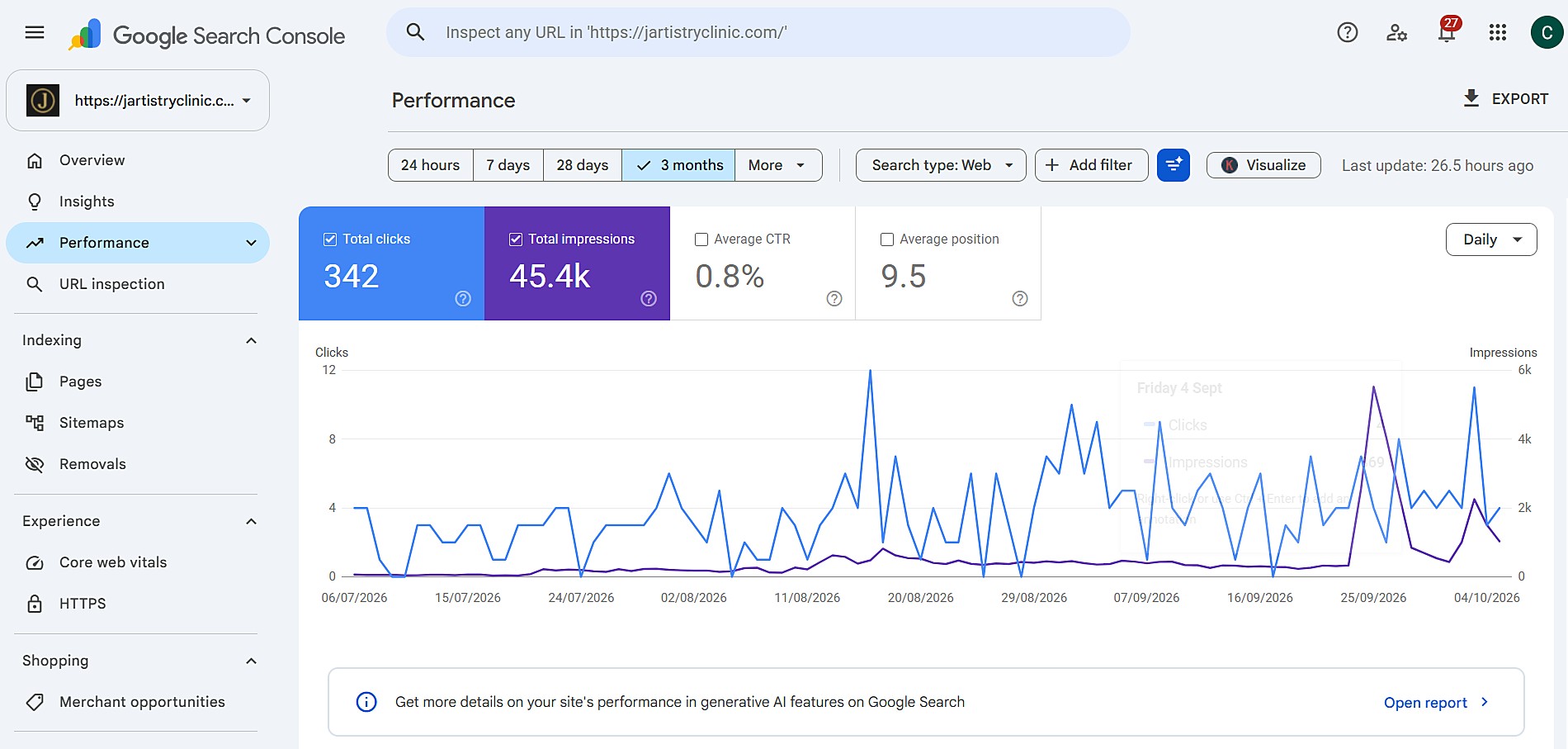
+1,028% traffic in the 14 days after launch, compared with the 14 days before. In the last three months: 45.4K search impressions, 342 clicks and an average position of 9.5, which is page one. Bookings hit a record in the weeks that followed.
How it was measured, and what else changed. The traffic comparison is the clinic’s own dashboard, 14 days after launch against the 14 days before. The search figures are Google Search Console for the last three months. The Google Business Profile was rebuilt at the same time, so not every gain is the website alone. The treatments, prices and team did not change.
The website that built a billion pound brand
And the day that same website nearly cost it everything.
Gymshark: from a garage to a £1 billion online brand
In 2012, two 20-year-old university students started selling online through a website. Ben Francis made the first clothes in his parents’ garage with a sewing machine and screen printer bought with £1,000 of savings. In its first year the website made about £500 a day. In August 2020, General Atlantic bought 21% of the company for £275 million, valuing Gymshark at over £1 billion.
Then the website crashed on its biggest day
On Black Friday, Gymshark’s busiest day of the year, one bug in one app crashed the entire website. It was offline for eight hours, with an estimated $143,000 in lost sales, by the company’s own account. The team wrote more than 2,500 handwritten apology letters, then moved to a platform built to handle the rush. The website was the business. When it went down, so did the sales.
Two giants that lost millions on their websites
Big brands. Big budgets. Big mistakes. Both are public record.
Marks & Spencer: the £150 million website customers found “tricky”
On 18 February 2014, Marks & Spencer launched a new website that took three years and £150 million to build. Every customer had to register again, and only about half of its 6 million registered customers did. Shoppers called the new website tricky to use. In the quarter that followed, online sales fell 8.1%. The website was not the whole company story, but it was the part customers felt first.
Hertz: $32 million for a website that never launched
Hertz hired Accenture to rebuild its website and apps, due to go live in December 2017. The launch slipped, then slipped again. In May 2018 Hertz ended the project, and it later sued to recover the $32 million it had paid, claiming, among other things, that the design had no layout for tablets. Accenture said the claims were without merit, and the lawsuit is what is public, not a court finding.
The lesson: a website is judged by the customer, not the owner.
Web development we did, and what the websites do for their owners
A web development portfolio is easy to fake with website templates. These are real businesses, live on the internet, from Ibadan and Lagos to Coventry and California. Open them on your phone and judge for yourself. Descriptions reflect each website at the time of writing.
J Artistry Clinic
A clinic for skin, body and health. Patients see treatments with starting prices from £30, reviews from hundreds of clients, and book or message on WhatsApp in one tap. Moved from Wix to WordPress.
Avillah Homes
A 50 acre estate of 217 plots on Ido Road. Buyers explore an interactive master plan with live plot availability, work out instalments with a payment calculator, and reserve a plot online, at any hour, from anywhere in the world.
Atlantis Utility
A business VoIP company with roots going back to 1984. The new website is built around a pain every business owner feels: a missed call is a missed customer. Reviews up front, clear plans, and a next step on every screen.
Greenlearners Technologies
Our own website, and our hardest-working salesperson. Service pages that rank on Google, a full learning platform with courses and certificates anyone can verify, a shop, a blog and WhatsApp on every page. All on WordPress.
Greenlearners Gadgets
An ecommerce website on WordPress and WooCommerce. Product pages, a cart, a checkout and online payments, built so customers can browse, compare and buy without needing to talk to anyone.
Giggles Properties
A property developer that has been building houses for over five years. Listings for homes in Akobo, Ibadan, with photos, details and a direct line to the sales team, so buyers anywhere can shortlist a home before they visit.
Building for a particular industry? See how we grow real estate, healthcare, education and small businesses online, or browse more case studies.
Web development in Nigeria: what to look for, in Lagos, Ibadan, Abuja or abroad
Search “web developers in Lagos” or “website development company in Nigeria” and you get directories, adverts and a thousand names. Here is what actually matters when the business is Nigerian, or Nigerian-owned from London, Houston or Toronto, from a web development company that builds for both every week.
Built for how Nigerians buy
WhatsApp first, because that is where the conversation happens. Paystack or Flutterwave so people can pay in naira with a bank transfer or card. Prices in naira, in plain sight. Pages that load on mobile data, because 75.22% of web traffic in Nigeria is on a phone.
For Nigerians in the diaspora
Many of our clients run a business in Nigeria from the UK, the USA or Canada: an estate, a school, a clinic, a store. We work across time zones, you pay in pounds, euros or dollars if you prefer, and the website is built for the Nigerian customer, with a trusted local contact on every page.
Lagos, Ibadan, Abuja: location does not limit you
Our office is in Ibadan. Our clients are in Lagos, Abuja, Port Harcourt, Coventry and Ventura, California. Website developers in Lagos and web developers anywhere else in Nigeria do the same work on the same tools. Judge a web development company by its live websites and its handover, not by its postcode. Web development in Nigeria is remote work now, done well or badly from anywhere.
What web development in Nigeria must get right
How to find the best web developer in Nigeria for you
Website design companies in Nigeria are easy to find. A web development company that will show you its results, put everything in your name and tell you the truth about what a website cannot do is rarer. We try to be that company. Judge us by the websites we built.
What is a website worth? Let’s put a number on it.
Building a website is one cost. Running it is another. Put in your own numbers, including your margin and running costs, and see your break-even. An estimate, not a promise.
The website payback calculator
Most websites that were never built to sell turn very few visitors into customers. This estimates what lifting that rate is worth in profit, after running costs, and how long a new website takes to pay for itself. Use your own numbers and change the assumptions.
What decides what a website costs
Anyone who quotes you a price before asking these questions is guessing. These six things decide the real cost of web development, wherever your business is. Five of them are build costs. The sixth is the running cost that cheap quotes leave out.
Pages and content
A five-page business website and a hundred-page service website are different jobs. Who writes the words and takes the photos matters too.
Ecommerce and payments
Products, stock, delivery zones, payment gateways and order emails. An ecommerce website is a shop and a till, not just a shop window.
Custom features
Bookings, calculators, property maps, member areas and portals. Each one is built, tested and looked after.
Design and UI UX
A unique design, built around how your customers think and move, takes longer than adjusting a template. It also sells better.
Integrations
Connecting your website to your CRM, email marketing, payment provider, booking calendar or accounting software.
Care after launch
Hosting, updates, backups, security and small changes every month. The part that cheap quotes usually leave out.
once to build it, and again to rebuild it properly when it brings nobody. See our growth plans and pricing, or message us for a quote built around what your business actually needs. Nothing you don’t.
Your free website toolkit. No sign up.
Four free web development tools you can use right now. No login required. These are some of the first checks we run in every website review.
Google speed test
Type your website address and we open Google PageSpeed Insights, Google’s own free speed test, with your website already filled in. The test and the score are Google’s. It takes about a minute.
Good. Customers are not waiting.
Needs work. You are losing some visitors.
Poor. You are losing customers every day.
Look at the Mobile tab first. That is how most of your customers see you. Then send us a screenshot and we will tell you what to fix first.
Your Website Readiness Score
Answer 12 honest yes or no questions about your website. You get a score out of 100, your level, and your three most urgent fixes. It checks the foundations. It is not a full technical audit, and a good score is not the same as sales: enquiries and revenue are measured in your analytics.
Answer the questions to see your score
Tap Yes or No on each one. Be honest: nobody sees this but you.
The 5 levels of a business website
Your readiness score places you on one of these levels. Most websites we review start at level one or two.
Customers who look for you online find nothing, or find something that hurts you.
The website exists, but it just sits there. Enquiries are rare, and you cannot tell where they come from.
Fast, safe and clear. Some customers find you and some enquire. There is money left on the table.
Found on Google, trusted on sight, easy to buy from. The website brings steady customers.
Your best salesperson. Measured, improved every month, and selling day and night.
Plan your website in 60 seconds. Free.
Tap what you need. We turn it into a clear brief and send it to us on WhatsApp, so your quote is built around your business, not a template.
The 2026 Business Website Checklist. Free, in one click.
Everything on this page, turned into a printable checklist you can work through with your team or your developer in 30 minutes, and again before every launch.
So what should you actually do with all this?
If you want to build it yourself, here is the honest path we would follow. If you want it done properly and quickly, let us review what you have first. You do not need to buy a new website before you know what is wrong with the one you have.
The do-it-yourself path
Plenty of business owners start on their own, and that is fine. If you want to learn web development for beginners, or you are taking a web design course and building your first business website, these seven steps will save you from the mistakes we fix most often.



 Trusted by 143+ businesses in 15+ countries since 2019
Done-for-you web development
Send us your website, or tell us about your business, on WhatsApp. We look at it the way your customers and Google do, and tell you plainly what to fix, keep or rebuild. What you get, free, usually within two working days:
Prefer not to chat? Call +234 802 258 1304 or book a strategy call.
Web development services: how Greenlearners Technologies builds websites that sell
We are not a template factory. We are a web development company in Nigeria, serving the world, that cares about one number: how many customers your website brings you. Every service below serves that number, for businesses in Nigeria, across Africa, in the UK, the USA and beyond.
You do not have to buy everything. Most clients don’t. The review shows what your business actually needs, and we tell you plainly.

Fast, mobile first WordPress websites for services, clinics, schools, real estate and professional firms, wherever your customers are.
WooCommerce stores with your own checkout, Paystack, Flutterwave or Stripe, delivery zones and order tracking.
Single pages built for one offer and one action, for ads, launches and events.
A fresh design and structure that keeps your Google rankings, with every old address redirected properly.
Faster loading and layouts that work on every screen, measured in Google PageSpeed Insights.
Hacked or flagged websites cleaned, hardened and put behind Cloudflare.
Move from a website builder to a website you own, with your content and rankings carried across.
Updates, backups, security checks, uptime monitoring and small changes, every month.
We study your business, customers and competitors, and agree what the website must achieve.
Sitemap, page plans and the words on each page, written to answer, prove and sell.
Your brand, built in WordPress, mobile first, with SEO and tracking in place.
Speed, security, forms, payments and every screen size checked before anyone sees it.
Updates, backups and reports, with improvements based on what visitors actually do.
Honest expectations: a small business website usually takes a few weeks from brief to launch, and a large ecommerce website or web application takes longer. The slowest part is almost always waiting for content and approvals, so we help you with both.
What working with us looks like
What we need from you, and what is quoted separately
What a website cannot do, and who should not hire us
Web development in Nigeria is full of big promises. A great website is powerful. It is not magic. You deserve to hear the limits before you spend a single naira, pound or dollar.
A website cannot
That is why our work does not stop at launch. Visitors come from SEO, paid advertising and social media. The website turns them into customers.
We are probably not right for you if
If you just need something online today, a free website builder may be the right first step. We will tell you honestly if it is.
Custom websites and web application development, built around how you work
Some businesses outgrow a brochure website. A school needs a portal. A developer needs live plot maps and payment plans. A clinic needs bookings that talk to its calendar. That is where web application development comes in: software that runs in the browser, built for your exact process.

Portals and dashboards
Client areas, student portals and staff dashboards, with the right access for each person.
Bookings and payments
Booking engines, instalment plans, invoices and payment links that update your records automatically.
Learning platforms
Courses, quizzes, progress tracking and certificates anyone can verify. We built our own.
Listings and maps
Property and product listings, interactive maps and live availability, like the Avillah Homes master plan.
Integrations
Your website connected to your CRM, email marketing, payment providers and accounting software.
Built to last
Documented, secure, backed up and handed over properly, so you are never held hostage by one developer.
How to choose a web design company without getting burned
Anyone can call themselves a web designer. Searching “web designers near me” or “website developers in Nigeria” gives you hundreds of names and no way to judge them. Use this list on every web development company you speak to. Including us.
Red flags: walk away
Green flags: worth a call
| Ask them | A good answer | A red flag |
|---|---|---|
| Whose name is the domain in? | Yours, with your login | “Ours, it’s easier” |
| Will I get the admin login? | Yes, from day one | “We handle all changes” |
| How will it get customers? | SEO, speed and clear calls to action | “It will look amazing” |
| How fast will it load on a phone? | Tested in PageSpeed Insights | “It’s fast on my laptop” |
| What happens if it gets hacked? | Backups, firewall and a plan | Silence |
| Can I see websites you built? | Live links, real clients | Screenshots only |
| What if we stop working together? | You keep everything | You lose access |
A web designer focuses on how a website looks and feels: layout, colours and UI UX design. A front end developer turns that design into a working website, and a back end developer builds the server side: databases, logins, payments and integrations. A freelancer can be perfect for one small website. A web design agency gives you strategy, design, development, content and care under one roof. Choose based on how much needs doing, not on the label, and judge every web design company with the list above.
Real people do your web development, not a robot
Tools can generate a page. People build a business. These are the people who will work on your website, and you can talk to any of them. Meet the whole team.

Chukwuemeka Maduka
Founder & Chief Growth StrategistLeads every website strategy, from the first review to what each page must sell. Read his story.

Akeem Ola
Full-Stack DeveloperBuilds the front end and back end: speed, security, integrations, migrations and custom features.

Anastasia Orafu
Content Marketing ManagerPlans and writes the words on every page, so they answer, prove and sell.

Ada Catherine
Customer Acquisition SpecialistYour day-to-day contact. Keeps every deadline, approval and launch moving on time.
For us at Greenlearners Technologies, marketing is getting the right product or service to the right person, at the right time, through the right channel, with the right message.
Website terms you will hear everywhere, in plain English
Sixteen words that come up in every web development conversation, whether you are hiring web developers in Lagos or learning web dev yourself. Learn these and nobody can talk over your head again.
- Back end
- The server, database and logic behind a website: logins, bookings, payments.
- Cache
- Saved copies of your pages, served instantly instead of being built again for every visitor.
- CDN
- A network of servers around the world that delivers your website from the one closest to each visitor.
- CMS
- Content management system. Software like WordPress that lets you edit a website without code.
- Core Web Vitals
- Google’s three measures of loading speed, responsiveness and visual stability.
- DNS
- The internet’s address book. It points your domain name to the server where your website lives.
- Domain name
- Your website’s address, like yourbusiness.com. Rented yearly, and it should be in your name.
- Front end
- Everything visitors see and touch: layout, text, images, buttons and forms.
- Hosting
- The computer that stores your website and serves it to visitors, day and night.
- Landing page
- A single page built for one offer and one action, often for ads or a launch.
- Plugin
- An add-on that gives a WordPress website a new feature, like bookings or payments.
- Responsive design
- One website that rearranges itself to fit every screen, from a small phone to a TV.
- SSL certificate
- What gives your website the padlock and https, so information sent to it is encrypted.
- Staging site
- A private copy of your website where changes are tested before they go live.
- UI and UX
- User interface is how it looks. User experience is how easy and pleasant it is to use.
- Uptime
- The share of time your website is online and working. 99.9% still allows a few hours a year offline.
Web development: your questions, answered
What is web development?
Web development is the work of planning, designing, building and looking after websites and web applications. It covers the front end, which is what visitors see and touch, and the back end, which is the server, database and logic behind it. For a business, good web development means a website that loads fast, works on every screen, stays secure, gets found on Google and turns visitors into customers.
What is the difference between web design and web development?
Web design is how a website looks and feels: layout, colours, fonts and UI UX design. Web development is how it works: the code, the content management system, speed, security, forms, payments and integrations. A website that sells needs both, which is why we do both under one roof.
How much does a website cost?
Our website packages are fixed prices, agreed before we start: Launch at $700 (about ₦930,000, £530 or €625) for a 20-page business website, Sell at $1,850 (about ₦2.46 million, £1,400 or €1,650) for an ecommerce website with 20 product pages, Grow at $3,500 (about ₦4.65 million, £2,650 or €3,125) for up to 50 pages with custom features and 3 months of SEO, and Enterprise at $7,500 (about ₦9.98 million, £5,680 or €6,700) for a custom platform with integrations. Hosting and your domain are paid separately, in your name. See the full package details above, or our growth plans and pricing.
How long does it take to build a website?
A small business website usually takes a few weeks from brief to launch. A large ecommerce website or a custom web application takes longer. The biggest delays are usually content and approvals, so we help you with both and agree the dates at the start.
Is Wix or WordPress better for a business website?
For most businesses that want customers from Google, WordPress, because you own it, you control the SEO and speed, and you can grow it into a shop, a blog or a course platform. Wix website design is quick to start and fine for testing an idea or a simple page. Chapter 03 on this page compares them side by side.
Is a free website builder good enough for a business?
For a hobby or a quick test, it can be. For a business, free plans usually show the builder’s brand and adverts, use an address like yourname.wixsite.com and limit what you can change. Customers notice. If you are serious, invest in your own domain name and a website built to sell.
Do I own my website when you build it?
Yes. Your domain, hosting, website, content and admin logins are in your name from day one, and we put it in writing at handover. Paid plugin or theme licences and third-party subscriptions stay in your name too, with the renewal dates listed. If we ever stop working together, you keep everything. Any web developer who will not agree to that is a red flag.
What do I get in the free website review?
A real look at your website on a phone, your path from headline to enquiry, your speed signals and visible SEO basics, and your trust gaps. You get your three highest-impact fixes in plain English, usually within two working days, with no obligation to hire us. It is a review, not a full technical audit. If you do not have a website yet, tell us about the business instead and we will show you what one should do for you.
Can I update the website myself?
Yes. WordPress lets you change text, prices and photos, or publish blog posts, yourself, even from your phone. We show you how at handover. For bigger changes, or if you would rather not, our care plans cover it.
Do you build ecommerce websites?
Yes. We build ecommerce websites on WooCommerce with your own checkout and payment providers such as Paystack, Flutterwave and Stripe, plus delivery zones, stock and order emails. WooCommerce charges no platform percentage on each sale, though your payment provider still charges its normal fee. We also help existing Shopify stores sell more through our ecommerce marketing service.
Will my new website rank on Google?
We build every website with SEO in place: fast mobile pages, proper titles, schema, sitemaps and one page per service. That gives Google everything it needs to understand you. Rankings also depend on competition, content and reputation, which is ongoing search engine optimization work. Nobody can honestly guarantee a #1 position.
Can you redesign my website without losing my Google rankings?
Yes, if it is done carefully. Before we change anything, we record every page Google knows about, keep the pages that bring traffic, and redirect every old address to its new home. Website redesigns go wrong when this step is skipped.
Can you move my website from Wix to WordPress?
Yes. We did exactly that for J Artistry Clinic, whose traffic rose 1,028% within two weeks of the move. We rebuild the design, carry your content across, redirect your old addresses and connect your domain, with as little downtime as possible.
Which web hosting do you recommend?
For most business websites we use Hostinger, for its LiteSpeed servers, caching, free SSL, backups and malware scanning. For busy stores and web applications we use cloud servers. Whatever host you choose, make sure the account is in your name.
Do you build custom web applications?
Yes. We build portals, dashboards, booking and payment systems, learning platforms and integrations, on WordPress where it fits and with custom code where it does not. We start by mapping your process, so you only pay for what earns its place.
Do you build accessible websites?
Yes. Every website we build is tested with a keyboard, checked for readable contrast, and given labelled forms and described images, against the WCAG guidelines. Accessible websites are easier for everyone to use, including customers on small phones in bright sunlight, and they are easier for Google to understand.
What happens after my website goes live?
A website needs care to stay fast, safe and useful. Our care plans cover updates, backups, security checks, uptime monitoring and small changes every month, plus reports on what visitors do, so the website keeps getting better.
Who are the best web developers in Nigeria?
The best web developer in Nigeria for you is the one whose live websites work on your phone, who puts the domain and hosting in your name, who can explain how the website will bring customers, and who shows real results. Directories list hundreds of website developers in Lagos, Abuja and Ibadan. Use the seven questions on this page on every one of them, including us.
Do you do web development in Lagos?
Yes. Our office is in Ibadan and most of our website development in Lagos, Abuja and Port Harcourt is done remotely, alongside clients abroad. Web development is remote work: the brief, design reviews and training happen on WhatsApp and video calls, and we meet in person in Lagos when a project needs it.
Do you offer a web development course or a web design course?
Not yet. Our courses cover SEO, digital marketing, sales funnels, email and WhatsApp marketing, which is what makes a website sell once it is built. If you want to learn web development for beginners, start with the free lessons from freeCodeCamp and MDN for the front end, then build your first real business website using this guide and the free checklist. When our own web development course is ready it will be on the courses page.
Do you work with businesses outside Nigeria?
Yes. We build websites for businesses in the United Kingdom, United States, Canada, Australia, New Zealand, Ireland and the Netherlands, as well as across Nigeria and Africa, and for many Africans in the diaspora. Most of the work is done remotely, on WhatsApp, email and video calls.
Where your website fits in the rest of the system
Get your new website found on Google, Maps and AI answers by the people already searching for you.
Read moreTurn more of the visitors your website gets into enquiries, bookings and sales.
Read moreThe path from stranger to paying customer, with your website at the centre of it.
Read moreThe logo, colours and voice your website carries, so people remember and trust you.
Read moreKnow exactly which pages bring enquiries and sales, instead of guessing.
Read moreThe full growth system your website sits inside, and how every piece connects.
Read moreTonight, while you sleep, someone will look for WHAT YOU SELL. Make sure your website is awake.
Send us your website on WhatsApp, or tell us about your business if you don’t have one yet. Wherever you are, Lagos, London, Toronto or Los Angeles, the review is the same, because good web development should end in the same place everywhere: a website that sells. We’ll show you what is costing you customers, what to fix first, and what a website that sells would look like for you.