
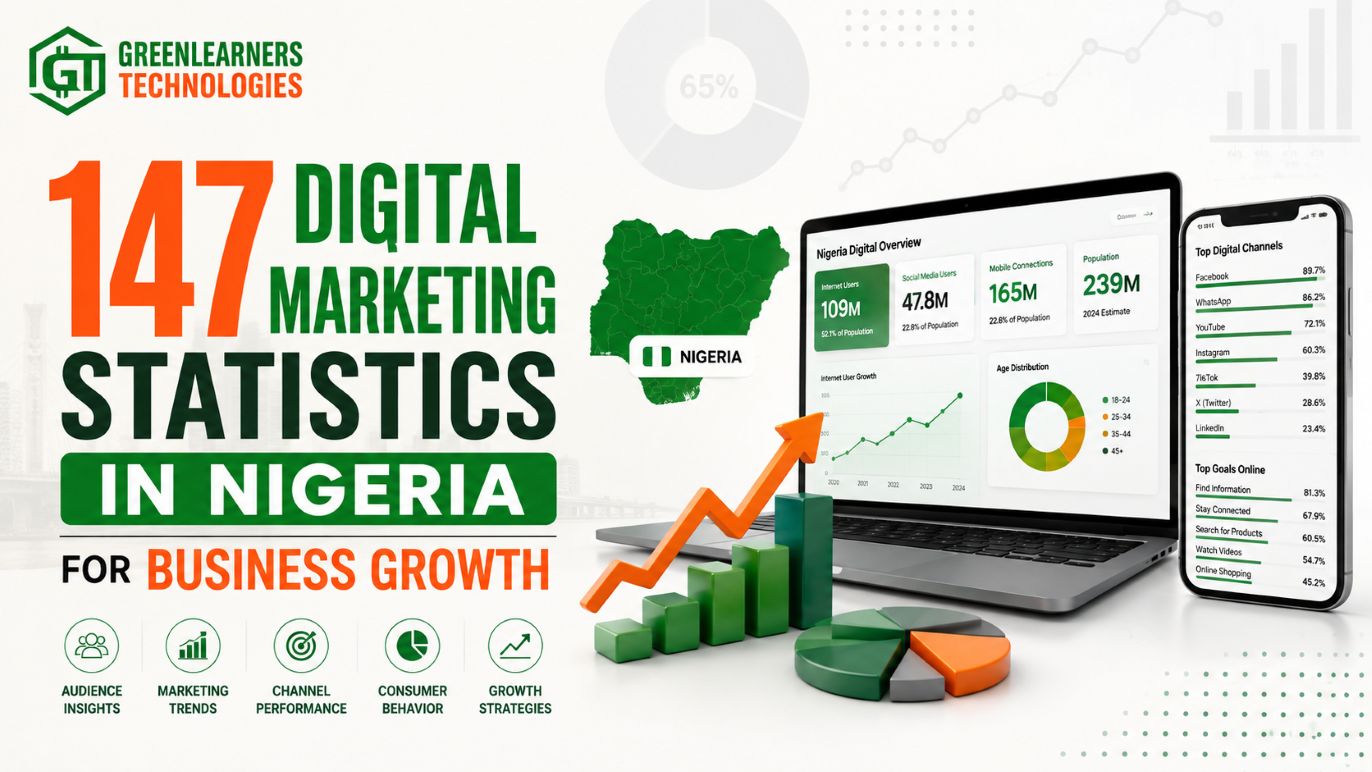


Published August 20, 2026 · Data last verified August 20, 2026 · Next scheduled review: January 2027
- “2026” is the edition year, not the measurement date. Nigeria’s most authoritative digital dataset, DataReportal’s Digital 2026 Nigeria report, was published in November 2025 and most of its figures measure October 2025. That is the freshest available data, not stale data, but it is not August 2026 data. Every statistic below states its own measurement period where the source provides one, and forecasts are labelled as forecasts rather than presented as observed fact.
- Why these numbers matter more than you think
- How to read these numbers without being misled
- Population & demographics (statistics 1-10)
- Internet & mobile adoption (11-25)
- Social media usage (26-35)
- Platform by platform (36-70)
- Advertising & ad spend (71-84)
- Consumer behaviour & brand discovery (85-96)
- E-commerce & mobile commerce (97-110)
- Search & SEO (111-118)
- Email & messaging (119-125)
- Global & African data that applies here (126-147)
- What Nigerian and global businesses built on this data
- Our own campaign data, in full
- Data quality audit: numbers that contradict each other
- How to actually apply this data
- Which channels your business type should prioritise
- The Truth About Digital Marketing In Nigeria
- Frequently asked questions
In August 2024, I sat in a meeting with a business owner who had burned ₦2.3 million on digital ads with nothing to show for it.
Zero leads.
When I asked to see his strategy, he pulled out screenshots of random Instagram posts and a Google Ads dashboard he did not fully understand.
Here is what struck me about that conversation.
He had not been careless.
He had spent real money, hired people, and worked hard at it.
What he had never done was check a single number before deciding where that money should go.
He assumed his customers were on Instagram.
They were not, at least not in the numbers he imagined, and you will see exactly why in statistic 63.
That is the pattern I keep meeting.
Most Nigerian businesses are not failing at digital marketing because they lack money, products or ambition.
They are failing because the decision about where to spend was made on instinct, and instinct in this market is frequently wrong.
Not because Nigerian business owners lack sense.
Because the Nigerian digital market has moved faster in three years than most people have had time to notice, and much of the advice circulating locally is quietly built on figures that were true in 2023.
So here is what I have put together.
147 digital marketing statistics for Nigeria, the diaspora, Africa and the wider world, each one traced to a named, dated, linked source you can verify yourself.
Whether you are a startup founder in Lekki, a manufacturer in Aba, a retailer in Kano, or a diaspora business owner trying to crack the Nigerian market from London or Houston, these numbers should change how you spend your next naira.
- 109 million Nigerians use the internet, but 130 million (54.5%) are still offline. This market is half-connected, and that shapes everything.
- TikTok’s reported advertising reach among Nigerian adults (47.8 million, 18+) now exceeds Facebook’s reported reach (38.0 million). If your media plan still treats TikTok as secondary, it is working from older data.
- Nigeria’s median mobile internet speed more than doubled, rising 123% to 44.96 Mbps. The “build for 2G” era is ending faster than most marketers realise.
- Instagram’s Nigerian reach fell 6.1% to 10.0 million, while Snapchat grew 30.2% to 23.0 million. Instagram is now a precision channel here, not a reach channel.
- 98.2% of surveyed Nigerian internet users research brands on social media before buying, among the highest rates in the cited research.
- 81.1% of surveyed Nigerian internet users worry about fake content online, which is why verifiable proof outperforms persuasive copy in this market.
- Digital is 34.2% of Nigerian ad spend today but is projected to reach 84% by 2029, ahead of South Africa (74%) and Kenya (64%) on PwC’s forecast.
- Google holds roughly 98.7% of Nigerian search, one of the highest concentrations on earth, against about 85.5% in the United States.
- 46% of all Google searches carry local intent and 76% of “near me” mobile searchers visit a business within 24 hours, yet roughly 58% of businesses never optimise for local search at all.
- Nigerian e-commerce estimates range from $2.92 billion to $19 billion for the same year, depending entirely on what each researcher counts. Knowing which definition you are quoting matters more than the number itself.
Why Digital Marketing Statistics In Nigeria Matter More Than You Think
Before the numbers, something most marketers here learn the expensive way.
The Nigerian digital market does not behave like the American or UK market.
Copy-paste strategies from Silicon Valley crash and burn here, and I have watched it happen to well-funded businesses.
Nigerian consumer behaviour, internet patterns, payment preferences and platform usage are structurally different.
The data is different.
The trust barriers are different.
The purchasing psychology is entirely different.
That is why understanding digital marketing statistics in Nigeria is not a nice-to-have.
It is survival.
These statistics will help you do six things:
- Know where your audience actually spends time online, not where you assume they do
- Understand which platforms deliver real reach in Nigeria versus which ones simply feel busy
- Stop paying for channels that structurally cannot reach your buyer
- Make budget decisions from evidence instead of emotion
- Spot the gaps your competitors have not noticed yet
- Recognise when a statistic someone quotes at you is not real
How To Read These Numbers Without Being Misled
Nigerian market data is genuinely messy, and estimates for the same metric can differ by 500% between reputable firms.
Understanding why is the difference between using data and being fooled by it.
Nigerian market data is genuinely messy.
Estimates for the same metric can differ by 500% between reputable firms, not because anyone is lying, but because they are measuring different things.
Understanding why is the difference between using data and being fooled by it.
Here is a real example from the research behind this article.
Nigeria’s e-commerce market size in 2025 was reported as $2.92 billion by ECDB, $8.53 billion by Data Insights Market, $9.35 billion by Mordor Intelligence, $14.54 billion by Research and Markets, and $19 billion by Worldpay.
Those are not small differences.
That is a range wide enough to justify completely opposite business decisions.
So why does it happen?
Because “e-commerce” means different things to different researchers.
Some count only formal online retail.
Some include B2B transactions, which are enormous in Nigeria.
Some include informal social commerce, the WhatsApp and Instagram selling that powers a huge share of real Nigerian trade.
Some count gross merchandise value, others count net revenue.
How Every Statistic In This Report Is Labelled
To make this usable rather than confusing, every statistic below carries two labels.
| Label | What It Means |
|---|---|
| 🇳🇬 NG | Nigeria-specific data, measured in or about Nigeria |
| 🌍 Global | A global benchmark, included because it is relevant, not because it is Nigerian |
| Our Data | First-party campaign data from Greenlearners Technologies client work |
| Tier A | Regulator, government body, or the platform’s own reported data |
| Tier B | Established research organisation with published methodology |
| Tier C | Industry publication or secondary reporting, used for context |
| Internal | Our own verified campaign records, shown as case evidence |
Before you use any figure in this report, or anywhere else, ask three questions.
- What exactly is being counted? “Users” can mean unique people, accounts, or advertising reach, and those are wildly different numbers.
- When was it measured? A 2023 figure quoted in 2026 as current can be badly wrong in a market moving this fast.
- Who benefits from the number being large? Platform-reported ad reach is a sales estimate, not an audience census.
- Do not calculate year-on-year change by comparing two annual reports. DataReportal states this explicitly, because they changed their publication cycle and because source platforms regularly revise and correct historical figures. Every change figure in this report is the one the source itself published, not one I calculated by subtracting last year’s report from this year’s. A surprising number of Nigerian statistics articles get this wrong, which is how impossible growth rates end up circulating.
Nigeria Population & Demographics Statistics (1-10)
Every marketing decision starts with who is actually here.
- 1Nigeria’s population stood at 239 million in October 2025, according to United Nations data.Source: DataReportal, Digital 2026 Nigeria (UN data)
- 2The population increased by 4.9 million (+2.1%) between the end of 2024 and the end of 2025.Source: DataReportal, Digital 2026 Nigeria
- 355.9% of Nigerians live in urban centres, while 44.1% live in rural areas.Source: DataReportal, Digital 2026 Nigeria
- 450.6% of the population is male and 49.4% female, an almost even national split.Source: DataReportal, Digital 2026 Nigeria
- 5The median age in Nigeria is 18.1 years, meaning half the country is younger than that.Source: DataReportal, Digital 2026 Nigeria
- 647.5% of Nigeria’s population is under 18, combining the 0-4 (14.4%), 5-12 (21.2%) and 13-17 (11.9%) age bands.Source: calculated from DataReportal, Digital 2026 Nigeria
- 713.9% of Nigerians are aged 18 to 24, the entry point of the working consumer market.Source: DataReportal, Digital 2026 Nigeria
- 814.1% of Nigerians are aged 25 to 34, the largest single adult age band by population share.Source: DataReportal, Digital 2026 Nigeria
- 910.2% of Nigerians are aged 35 to 44, a band that typically combines established income with active family purchasing decisions.Source: DataReportal, Digital 2026 Nigeria
- 1014.4% of Nigerians are aged 45 and above, combining the 45-54 (7.1%), 55-64 (4.2%) and 65+ (3.1%) bands. This group is smaller in number but frequently holds disproportionate purchasing authority.Source: calculated from DataReportal, Digital 2026 Nigeria
A median age of 18.1 is the most under-used number in Nigerian marketing.
Median age tells you the population is young; it does not by itself tell you what people buy or which platforms they trust.
But it does mean campaigns built around an older, legacy-media consumer will miss a very large share of the country, and that assumption should be tested against your own customer data rather than inherited from a Western playbook.
If your brand voice, imagery and channel mix assume an older consumer by default, validate that against who actually buys from you before spending another naira on media.
Nigeria Internet & Mobile Adoption Statistics (11-25)
You cannot market digitally to people who are not online, and you cannot reach the ones who are if you ignore how they connect.
- 11There were 109 million individuals using the internet in Nigeria in October 2025, with penetration at 45.5% of the population.Source: DataReportal, Digital 2026 Nigeria
- 12Internet users increased by 2.5 million (+2.3%) between October 2024 and October 2025.Source: DataReportal, Digital 2026 Nigeria
- 13130 million Nigerians did not use the internet at the end of 2025, meaning 54.5% of the population remained offline.Source: DataReportal, Digital 2026 Nigeria
- 14Nigeria recorded 142,631,825 active internet subscribers as at October 2025, up from 140,949,570 in September 2025.Source: Nigerian Communications Commission
- 15Of those, 142,004,662 subscribers connect via Mobile GSM, making it overwhelmingly the dominant access technology.Source: Nigerian Communications Commission
- 16The NCC’s 142.6 million subscriber figure counts subscriptions, not people, which is why it sits well above DataReportal’s 109 million individual internet users.Source: NCC and DataReportal
- 17165 million cellular mobile connections were active in Nigeria in late 2025, equivalent to 69.2% of the population.Source: GSMA Intelligence, via DataReportal
- 18Mobile connections increased by 16 million (+10.6%) between the end of 2024 and the end of 2025.Source: DataReportal, Digital 2026 Nigeria
- 1969.0% of mobile connections in Nigeria are broadband (3G, 4G or 5G), meaning nearly a third still are not.Source: GSMA Intelligence, via DataReportal
- 20DataReportal warns that broadband connection share should not be treated as a proxy for mobile internet use, since some plans include only voice and SMS.Source: DataReportal, Digital 2026 Nigeria
- 21Nigeria’s median mobile internet download speed was 44.96 Mbps at the end of 2025.Source: Ookla Speedtest Global Index, via DataReportal
- 22Median mobile download speed increased by 24.77 Mbps (+123%) in the twelve months to August 2025.Source: Ookla, via DataReportal
- 23Nigeria’s median fixed internet download speed was 28.90 Mbps, having risen 7.31 Mbps (+33.9%) over the same period.Source: Ookla, via DataReportal
- 24Smartphone users in Nigeria are forecast to grow by 48.7 million (+94.5%) between 2024 and 2029, reaching roughly 100.21 million.Source: Statista
- 25Nigeria remains Africa’s largest internet market by absolute user numbers, ahead of Egypt, South Africa and Kenya.Source: DataReportal, Digital 2026 Nigeria
Two of these numbers overturn advice you have probably read on other Nigerian marketing blogs.
First, mobile speeds did not fall, they more than doubled, rising 123% in a year. Plenty of articles still quote an outdated 18.91 Mbps figure showing a decline. Nigeria can now carry video, richer creative and heavier pages than the old advice assumes.
Second, only 69.0% of mobile connections are broadband, not the 94.4% widely repeated online. Roughly a third of connections still cannot carry a modern web experience at all.
The practical rule: design for the fast half, but keep a lightweight path, SMS and WhatsApp included, for the rest. Our guide to marketing strategies that work in Nigeria covers how to run both together.
Want these numbers turned into an actual strategy?
See how Greenlearners Technologies builds data-driven growth systems for Nigerian and diaspora businesses.
See How We Work →Nigeria Social Media Usage Statistics (26-35)
Social media is where Nigerians spend their attention, but the headline numbers are frequently misunderstood.
- 26Nigeria was home to 47.8 million social media user identities in October 2025, equating to 20.0% of the total population.Source: DataReportal, Digital 2026 Nigeria
- 27Social media identities increased by 12 million (+34.7%) between late 2024 and the end of 2025.Source: DataReportal, Digital 2026 Nigeria
- 2844.0% of Nigeria’s internet users used at least one social media platform in October 2025, meaning more than half of Nigerians online do not.Source: DataReportal, Digital 2026 Nigeria
- 29There were 47.8 million social media identities aged 18 and above, equivalent to 38.2% of Nigeria’s adult population.Source: DataReportal, Digital 2026 Nigeria
- 3067.3% of Nigeria’s social media identities are male and 32.7% female, despite an almost even national gender split.Source: DataReportal, Digital 2026 Nigeria
- 31DataReportal states that social media user identities may not represent unique individuals, because one person can hold accounts across several platforms.Source: DataReportal notes on data
- 32DataReportal advises against calculating social media growth by comparing its own annual reports, since platforms regularly correct historical data.Source: DataReportal, Digital 2026 Nigeria
- 33Nigerian internet users engage with an average of roughly 7 social platforms monthly, up from about 5 the previous year.Source: Krestel Digital, 2025 Report
- 34Young adults aged 18 to 34 make up the largest share of social media users in Nigeria across every major platform.Source: Statista
- 35Mordor Intelligence reports that Nigerian social media users spend close to four hours daily on platforms that increasingly embed direct checkout. We have not been able to trace a primary audience survey behind the widely-quoted “3 hours 49 minutes” figure, so we cite the broader range instead.Source: Mordor Intelligence
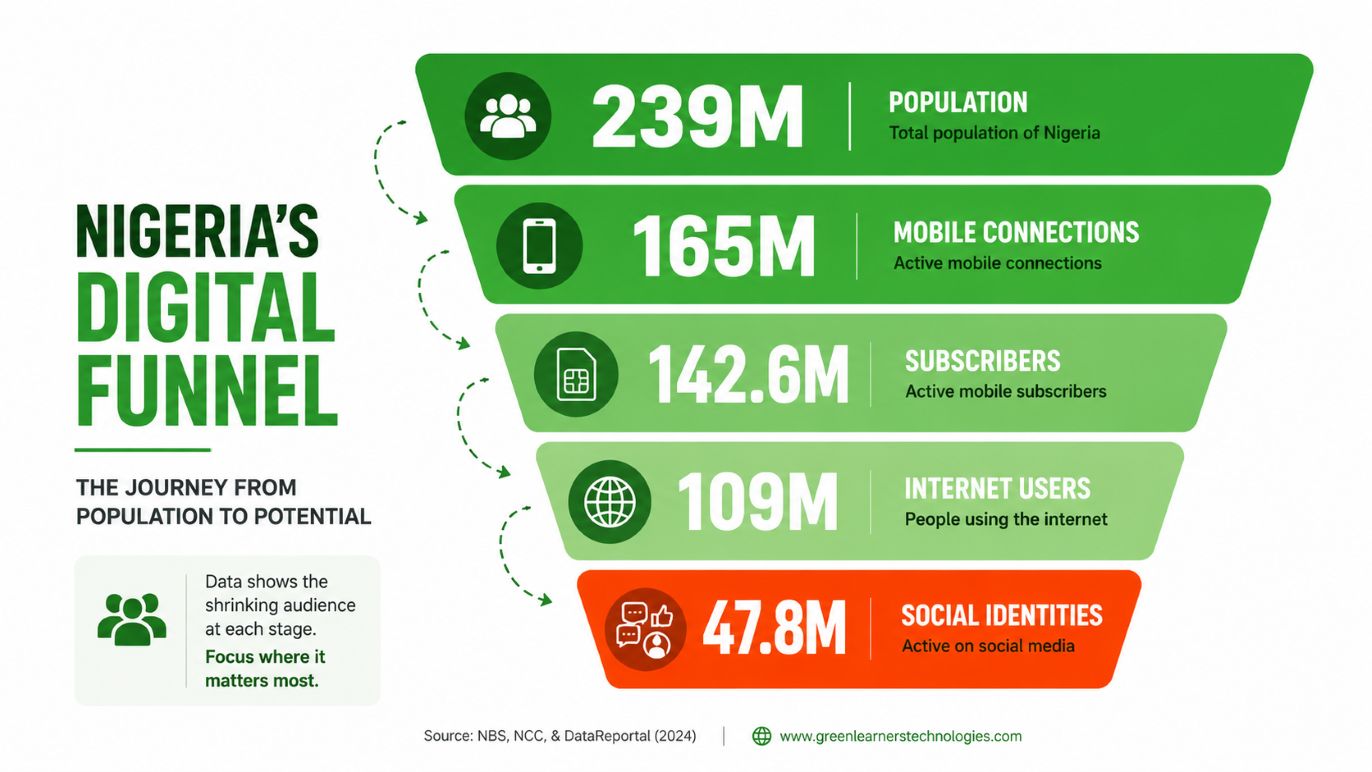
Look at the bottom two bars carefully.
109 million Nigerians are online, but only 47.8 million social identities exist, and only 44% of internet users touch social media at all.
That gap is the single most misunderstood fact in Nigerian marketing.
Well over half of the Nigerians you can reach online are reachable through search, WhatsApp, email and direct channels rather than social feeds.
Nigeria Social Media Statistics: Platform By Platform (36-70)
This is where most marketing decisions are actually made, and where most of them go wrong.
- Advertising reach is not the same as active users. Meta states plainly in its own ad tools that estimated audience size “is not a proxy for monthly or daily active users, or for engagement.” Every platform figure below is ad reach unless stated otherwise, and it should be read as a media planning estimate, not a population count.
- LinkedIn reports registered members, not active users, so its figure is not directly comparable with the others.
- TikTok’s ad tools only publish data for users aged 18 and above, so its figure excludes teenage users that other platforms include.
TikTok Statistics In Nigeria
- 36TikTok reached 47.8 million users aged 18 and above in Nigeria in late 2025, the largest adult ad reach of any platform in the country.Source: TikTok advertising resources, via DataReportal
- 37TikTok’s potential ad reach in Nigeria increased by 14.5 million (+43.4%) between the end of 2024 and late 2025.Source: TikTok ad planning tools, via DataReportal
- 38On a quarterly basis, TikTok’s Nigerian ad reach grew by 3.00 million (+6.7%) between July 2025 and October 2025 alone.Source: TikTok ad planning tools, via DataReportal
- 39TikTok ads reached 38.2% of all Nigerian adults aged 18 and above at the end of 2025.Source: TikTok advertising resources, via DataReportal
- 40TikTok’s ad reach was equivalent to 44.0% of Nigeria’s entire internet user base, regardless of age.Source: TikTok advertising resources, via DataReportal
- 4168.1% of TikTok’s adult ad audience in Nigeria is male, and 31.9% female, one of the widest gender skews of any platform here.Source: TikTok advertising resources, via DataReportal
Facebook Statistics In Nigeria
- 42Facebook had 38.0 million users in Nigeria in late 2025, according to Meta’s advertising resources.Source: Meta advertising resources, via DataReportal
- 43Facebook’s potential ad reach in Nigeria increased by 2.45 million (+6.9%) between October 2024 and October 2025.Source: Meta ad planning tools, via DataReportal
- 44However, Facebook’s Nigerian ad reach decreased by 3.20 million (-7.8%) in the single quarter between July and October 2025.Source: Meta ad planning tools, via DataReportal
- 45Facebook’s ad reach was equivalent to 15.9% of Nigeria’s total population at the end of 2025.Source: Meta advertising resources, via DataReportal
- 46Facebook reached 34.9% of Nigeria’s internet user base, regardless of age.Source: Meta advertising resources, via DataReportal
- 4730.0% of Nigerian adults aged 18 and above used Facebook, alongside 24.7% of the total eligible audience aged 13 and above.Source: Meta advertising resources, via DataReportal
- 4858.3% of Facebook’s adult ad audience in Nigeria is male, and 41.7% female.Source: Meta advertising resources, via DataReportal
YouTube Statistics In Nigeria
- 49YouTube had 30.5 million users in Nigeria in late 2025, per Google’s own advertising resources.Source: Google advertising resources, via DataReportal
- 50YouTube’s potential ad reach in Nigeria increased by 3.50 million (+13.0%) between the end of 2024 and late 2025.Source: Google ad planning tools, via DataReportal
- 51YouTube’s ad reach was equivalent to 12.8% of Nigeria’s total population.Source: Google advertising resources, via DataReportal
- 52YouTube ads reached 28.1% of Nigeria’s total internet user base in October 2025.Source: Google advertising resources, via DataReportal
- 5355.5% of YouTube’s adult ad audience in Nigeria is male, and 44.5% female, the most gender-balanced of the large platforms.Source: Google advertising resources, via DataReportal
Snapchat Statistics In Nigeria
- 54Snapchat had 23.0 million users in Nigeria in late 2025, more than double Instagram’s reach.Source: Snap advertising resources, via DataReportal
- 55Snapchat’s Nigerian ad reach increased by 5.33 million (+30.2%) between the end of 2024 and late 2025.Source: Snap ad planning tools, via DataReportal
- 56Snapchat’s ad reach was equivalent to 9.6% of Nigeria’s total population and 14.9% of the eligible audience aged 13 and above.Source: Snap advertising resources, via DataReportal
- 57Snapchat reached 16.5% of Nigerian adults and 21.1% of Nigeria’s internet users at the end of 2025.Source: Snap advertising resources, via DataReportal
- 5853.8% of Snapchat’s adult ad audience in Nigeria is male, and 44.5% female.Source: Snap advertising resources, via DataReportal
LinkedIn Statistics In Nigeria
- 59LinkedIn had 13.0 million registered members in Nigeria in late 2025.Source: LinkedIn advertising resources, via DataReportal
- 60LinkedIn’s Nigerian audience increased by 2.00 million (+18.2%) between the end of 2024 and the end of 2025.Source: LinkedIn ad planning tools, via DataReportal
- 61LinkedIn reached 10.4% of Nigerian adults and 12.0% of the country’s internet users.Source: LinkedIn advertising resources, via DataReportal
- 62LinkedIn’s figures are based on total registered members rather than monthly active users, so they are not directly comparable with other platforms in this list.Source: DataReportal, Digital 2026 Nigeria
Instagram Statistics In Nigeria
- 63Instagram had 10.0 million users in Nigeria in late 2025, roughly a fifth of TikTok’s adult reach.Source: Meta advertising resources, via DataReportal
- 64Instagram’s potential ad reach in Nigeria decreased by 650,000 (-6.1%) between October 2024 and October 2025.Source: Meta ad planning tools, via DataReportal
- 65Instagram’s ad reach was equivalent to 4.2% of the population, 9.2% of internet users and 7.8% of adults.Source: Meta advertising resources, via DataReportal
- 6654.1% of Instagram’s adult ad audience in Nigeria is male, and 44.4% female.Source: Meta advertising resources, via DataReportal
X, WhatsApp, Messenger, Threads & Reddit In Nigeria
- 67X (formerly Twitter) had 6.95 million users in Nigeria in late 2025, equivalent to 2.9% of the population.Source: X advertising resources, via DataReportal
- 68X’s Nigerian ad reach decreased by 831,000 (-10.7%) between the end of 2024 and late 2025.Source: X ad planning tools, via DataReportal
- 69WhatsApp is the most-used platform in Nigeria, named by over 95% of internet users aged 16 and above in survey research, though this is a self-reported usage measure rather than an ad reach figure.Source: Statista, Q3 2024
- 70Among smaller platforms, Messenger reached 5.65 million Nigerians, Threads 945,000, and Reddit 811,000, with Reddit growing 95.1% year on year from a very small base.Source: Meta and Reddit advertising resources, via DataReportal
Three shifts here should change media plans immediately.
TikTok’s reported 18+ advertising reach in Nigeria (47.8 million) exceeded Facebook’s reported advertising reach (38.0 million) in the late-2025 platform data, and TikTok grew 43.4% against Facebook’s 6.9%. Note the two figures are not measured on an identical age basis, so treat this as a directional shift rather than a precise like-for-like comparison. Either way, if TikTok is still a “youth experiment” in your plan, that plan is working from older data.
Snapchat is the most under-discussed platform in Nigeria. At 23.0 million reach and 30.2% growth, it is more than twice Instagram’s size, yet almost no Nigerian brand budgets for it.
Instagram’s reported reach declined 6.1% to 10.0 million. Our interpretation, not a statistic: at roughly a fifth of TikTok’s adult reach, Instagram in Nigeria now works better as a precision and retargeting channel than as a primary reach buy. Budgets should reflect that, though your own audience data should override any national average.
One caution worth keeping: reported declines can result from platforms purging duplicate or inauthentic accounts, so a falling number does not always mean real people left.
Reading these platform shifts correctly, and moving budget before your competitors do, is the core of what we handle through social media marketing and Meta Ads management.
Not sure which platform deserves your budget?
We plan channel mix from data like this, then run the campaigns and report against revenue, not impressions.
See Our Social Media Service →Nigeria Advertising & Ad Spend Statistics (71-84)
Nigerian advertising spend reached $996 million in 2025, of which digital took 34.2%.
These fourteen statistics cover where that money goes and where it is heading.
- 71Total advertising spend in Nigeria increased by 7.7% to $996 million in the 2025 reporting period.Source: Krestel Digital, 2025 Report
- 72Digital advertising grew by 8.5% to $340 million, representing 34.2% of measured Nigerian ad spend.Source: Krestel Digital, 2025 Report
- 73Non-digital advertising still accounts for 65.8% of measured Nigerian ad spend, but is growing more slowly than digital.Source: Krestel Digital, 2025 Report
- 74Video advertising saw the largest single increase of any format, up $53 million (+49.1%) year on year.Source: Krestel Digital, 2025 Report
- 75Digital advertising is projected to account for 84% of Nigeria’s total ad spend by 2029.Source: PwC Africa Entertainment & Media Outlook 2025-2029, via Nairametrics
- 76That projected 84% share puts Nigeria ahead of South Africa (74%) and Kenya (64%), and above the global average.Source: PwC, via Nairametrics
- 77Internet advertising in Nigeria is projected to grow at a 16% compound annual rate, among the fastest rates of any market tracked.Source: PwC Africa Entertainment & Media Outlook
- 78Retail display and paid search are among the fastest-growing digital ad formats in Nigeria, including ads on marketplaces such as Jumia.Source: PwC, via Nairametrics
- 79Nigeria’s broader online advertising and digital media market is valued at approximately $1.2 billion in 2025, a wider scope than measured ad spend alone.Source: Ken Research
- 80That market is projected to reach $2,511 million by 2031, at a 13.10% compound annual growth rate.Source: Ken Research
- 81Mobile advertising is projected to account for around 70% of total digital ad spending in Nigeria as the market matures.Source: Ken Research
- 82Nigeria’s entertainment and media sector as a whole recorded 11.2% growth in 2024.Source: PwC Africa Entertainment & Media Outlook
- 83Over-the-top streaming services in Nigeria are growing at an 8% compound annual rate, opening newer and less crowded ad inventory.Source: PwC Africa Entertainment & Media Outlook
- 84Lagos, Abuja and Port Harcourt dominate Nigeria’s digital advertising economy by both spend and agency concentration.Source: Ken Research
Digital is about a third of Nigerian ad spend today but is projected to reach 84% by 2029.
That is one of the steepest shifts forecast for any market on earth.
Translated into plain business terms: the cost of digital attention in Nigeria is likely to rise substantially as that money moves.
Businesses that build owned audiences now, email lists, WhatsApp communities and subscriber bases, will be buying attention at today’s prices while competitors pay 2029 prices.
That is a timing decision, not a budget decision.
We build exactly this combination for clients through Google Ads, email marketing and WhatsApp marketing.
Nigeria Consumer Behaviour & Brand Discovery Statistics (85-96)
This section contains two of the most striking numbers in the entire report.
- 8566.9% of surveyed Nigerian internet users said they discover new brands through social media, among the highest rates recorded in the cited research.Source: Krestel Digital, 2025 Report
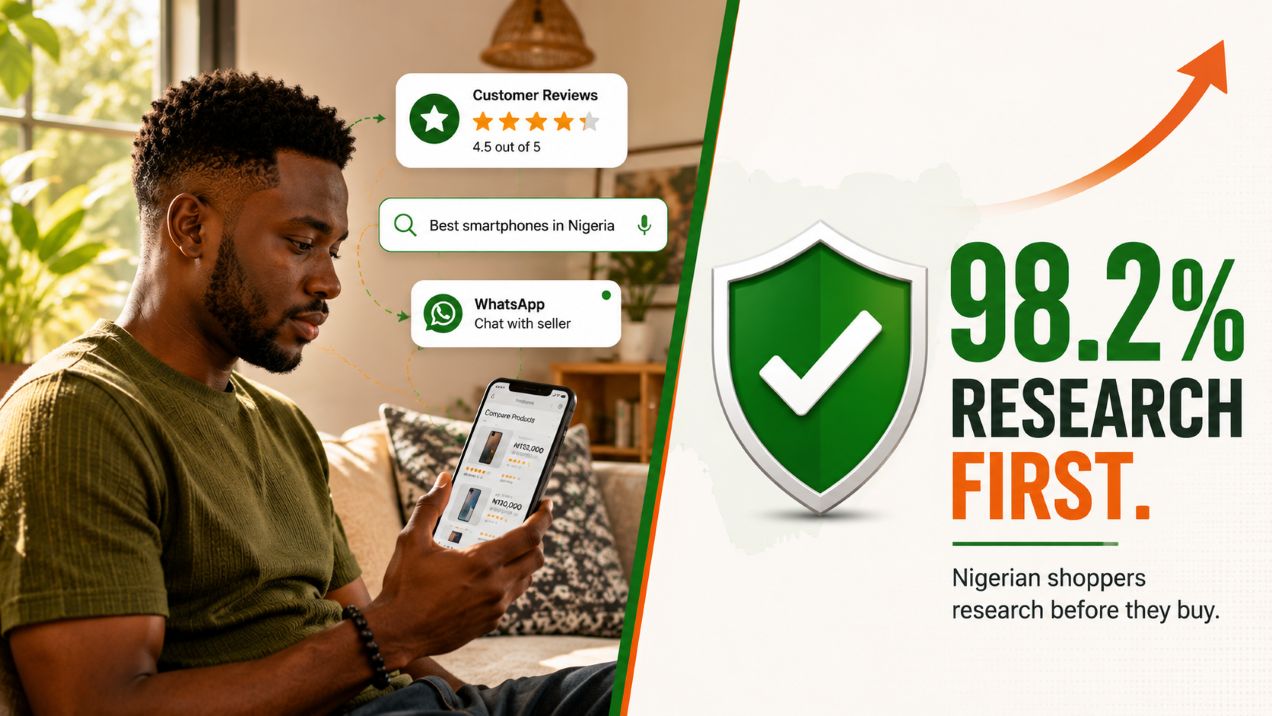
- 8698.2% of surveyed Nigerian internet users said they use social media to research brands or products before purchase, among the highest rates recorded in the cited research.Source: Krestel Digital, 2025 Report
- 8786.2% of surveyed Nigerian internet users use social networks as a brand research channel.Source: Krestel Digital, 2025 Report
- 8885.6% of surveyed Nigerian internet users use search engines for brand research, almost level with social networks.Source: Krestel Digital, 2025 Report
- 89Traditional advertising still leads initial brand discovery at 70.2%, driven largely by TV, radio and outdoor.Source: Krestel Digital, 2025 Report
- 9081.1% of surveyed Nigerian internet users expressed concern about distinguishing real from fake content online.Source: Krestel Digital, 2025 Report
- 91Social commerce is shifting from a supplementary marketing tool into a priority sales channel for Nigerian merchants.Source: Mordor Intelligence
- 92Real-time messaging builds consumer trust by enabling product verification before payment, making response speed a direct conversion factor in Nigeria.Source: Mordor Intelligence
- 93Micro and nano-influencers with 2,000 to 50,000 followers are emerging as the strongest performers in Nigerian influencer marketing.Source: Oxgital, Nigerian digital advertising trends
- 94Users click through to a website on just 8% of searches where an AI summary appears, versus 15% without one.Source: Pew Research Center, based on 68,879 real searches
- 95Roughly 26% of users end their browsing session entirely after reading an AI-generated search summary.Source: Pew Research Center
- 96With a median age of 18.1, Nigeria’s buying population is younger than almost any comparable market, which shapes platform preference more than income alone.Source: DataReportal, Digital 2026 Nigeria
98.2% product research and 66.9% social brand discovery are both reported as world-leading figures.
Nigerians research harder than almost any comparable market before spending money.
Combine that with 81.1% concern about fake content, and one strategic conclusion follows.
In this market, verifiable proof does more work than persuasive copy.
Screenshots, named clients, real reviews and cited figures answer the exact doubt a Nigerian buyer arrives with. That is precisely why this report links every statistic to its source.
Building that proof into pages that actually rank is what our content marketing and AI search optimisation services are designed to do.
Nigeria E-commerce & Mobile Commerce Statistics (97-110)
Nigerian e-commerce is estimated at $9.35 billion in 2025, with 82.3% of orders placed on mobile.
These fourteen statistics cover market size, category growth and the payment behaviour underneath it.
- 97Nigeria’s e-commerce market is estimated at $9.35 billion in 2025.Source: Mordor Intelligence, 2026 update
- 98The market is expected to reach $10.49 billion in 2026.Source: Mordor Intelligence
- 99It is forecast to reach $18.68 billion by 2031, at a 12.23% compound annual growth rate.Source: Mordor Intelligence
- 100Mobile commerce accounts for 82.3% of online orders in Nigeria, more than four-fifths of all transactions.Source: Mordor Intelligence
- 101Social commerce transaction value is projected to nearly double from $2.04 billion in 2025 to $3.96 billion by 2030, outpacing overall e-commerce growth.Source: Mordor Intelligence
- 102Consumer electronics commanded 27.60% of Nigerian B2C e-commerce revenue in 2025, the largest single category.Source: Mordor Intelligence
- 103Beauty and personal care is the fastest-growing category, advancing at a 16.46% compound annual rate to 2031.Source: Mordor Intelligence
- 104Buy-now-pay-later solutions in Nigeria are expected to surpass $1.78 billion in 2026.Source: Mordor Intelligence
- 105Formal retail e-commerce sales in Nigeria expanded 29% to ₦492 billion in 2025, well ahead of underlying economic growth.Source: Euromonitor International
- 106Total Nigerian retail sales reached ₦25.4 trillion in 2025.Source: Euromonitor International
- 107Those two figures together mean formal retail e-commerce is still under 2% of all Nigerian retail sales.Source: calculated from Euromonitor International
- 108That e-commerce growth happened despite 23% inflation and modest 4% real GDP growth, indicating genuine behavioural change rather than price effects alone.Source: Euromonitor International
- 109Nigeria’s digital transformation market is valued at $13.96 billion in 2026, up from $11.86 billion in 2025, and is projected to reach $31.58 billion by 2031.Source: Mordor Intelligence
- 110Nigeria’s fintech ecosystem already routes approximately ₦600 trillion (about $390 billion) in annual payments, the infrastructure layer beneath all e-commerce here.Source: Mordor Intelligence
Read statistics 105, 106 and 107 together, because that comparison explains this market better than any growth projection.
On Euromonitor’s definition, which counts formal retail e-commerce only, online sales are a small fraction of total Nigerian retail.
That definition deliberately excludes the WhatsApp, Instagram and marketplace selling that other researchers do count, which is precisely why estimates for this market diverge so widely.
The practical conclusion holds either way: a large share of Nigerian commerce happens in conversations, not checkouts, which is why social commerce is growing faster than e-commerce overall.
If your entire sales process assumes a website checkout, you are ignoring where much of that trade actually takes place.
The fix is usually a shorter path from attention to conversation, which we build through web and funnel development and conversion rate optimisation.
Nigeria Search & SEO Statistics (111-118)
A note on this section, because honesty matters more than volume here.
Most reliable SEO benchmarks are global rather than Nigeria-specific, and I have labelled every one accordingly rather than dressing global data as local.
The Nigeria-specific evidence in this section comes from our own verified client campaigns.
- 111Google holds approximately 98.7% of Nigeria’s search engine market, one of the highest concentrations of any country on earth, making it effectively the only search channel that matters at scale here.Source: StatCounter Global Stats, Nigeria
- 112Google’s AI Overviews and AI Mode draw on the same core ranking systems as traditional Search, meaning there is no separate technical trick for AI visibility.Source: Google Search Central
- 113E-E-A-T is not a direct ranking factor, but describes qualities Google’s ranking systems are designed to reward.Source: Google Search Central
- 114ChatGPT crossed 900 million weekly active users in February 2026, establishing AI assistants as a genuine discovery channel alongside search.Source: OpenAI
- 11548% of mobile origins and 56% of desktop origins pass all three Core Web Vitals, meaning more than half the mobile web still fails Google’s page experience thresholds.Source: HTTP Archive Web Almanac 2025 (July 2025 CrUX data)
- 116In a documented Greenlearners Technologies SEO engagement, a client site grew from 244 to 25,900 monthly clicks over 16 months.Source: Greenlearners Technologies client data, LearnWithPride, verified in Google Search Console
- 117That same engagement reached 3.48 million monthly search impressions over the 16-month period.Source: Greenlearners Technologies client data, LearnWithPride, verified in Google Search Console
- 118In a second engagement, a client site reached 2,140 clicks and 175,000 impressions within 6 months from a near-flat baseline.Source: Greenlearners Technologies client data, Study With FM, verified in Google Search Console
Nigerian search is an opportunity precisely because most local sites are technically weak.
If 52% of the mobile web still fails Core Web Vitals globally, and Nigerian sites face additional network variability on top of that, then fixing your site speed alone can move you past competitors who outspend you.
Our full breakdown of how to execute this sits in the SEO services guide.
Want results like the ones in statistics 116 to 118?
244 to 25,900 monthly clicks in 16 months was not luck. It was a documented SEO process we can run for your business.
See How Our SEO Works →Nigeria Email & Messaging Statistics (119-125)
Email accounts for roughly 3% of Nigerian digital ad spend despite being a channel you own outright.
These seven statistics explain why that gap is an opportunity rather than a verdict.
- 119Email ties with organic social as the second most-used marketing channel across businesses of all sizes.Source: HubSpot State of Marketing
- 12022% of marketers rank email among their top five ROI-driving channels.Source: HubSpot State of Marketing
- 121Nigeria’s email advertising market was forecast at $11.06 million in 2024.Source: Statista Advertising Outlook, Nigeria
- 122Nigerian email ad spend is projected to reach $13.66 million by 2029, at a 4.31% compound annual growth rate, far slower than social or video.Source: Statista Advertising Outlook, Nigeria
- 123That means email accounts for roughly 3% of Nigeria’s measured digital ad spend, despite being a fully owned channel.Source: calculated from Statista and Krestel Digital
- 124In a documented Greenlearners Technologies campaign, a single email send reached 34,643 recipients for an EdTech client.Source: Greenlearners Technologies client data, LearnWithPride, 2026
- 125Across that client’s campaign series, open rates consistently held between 30% and 35%, above common published industry averages.Source: Greenlearners Technologies client data, LearnWithPride, 2026
Nigeria spends about $11 million a year on email advertising, against $340 million on digital advertising overall.
That is roughly 3% of digital spend going to a channel you fully own.
Read that as a competitive gap rather than a verdict on the channel.
Your competitors are very likely not building an email list properly, which is exactly why doing so is cheap right now.
If you want that set up and running without hiring for it, that is our email marketing service.
Global & African Statistics That Apply To Nigerian Businesses (126-147)
Everything above this point is Nigeria-specific.
This section is different, and I want to be clear about why it is here.
Some of the most useful benchmarks in marketing are measured globally, not nationally, because the platforms themselves operate globally.
Google’s ranking systems do not behave differently in Lagos than in London.
A “near me” search works the same way for a mechanic in Ikeja as for one in Manchester.
So these figures are labelled 🌍 Global or 🌍 Africa, never disguised as Nigerian data, and each one is followed by what it actually means for a business operating here or selling from here to the world.
Search & Google Statistics
- 126Google held 90.04% of the global search market across all devices in January 2026, with 94.6% on mobile and 79.1% on desktop.Source: StatCounter Global Stats
- 127Google’s search share across Africa is approximately 95.7%, the highest of any continent, compared with 85.7% in North America.Source: StatCounter Global Stats, May 2026
- 128Google’s desktop search share has fallen to its lowest level in over two decades, while AI-powered search platforms grew sharply year on year.Source: StatCounter, January 2026
- 129AI search referrals reached roughly 0.9% of total website visits in March 2026, up around fivefold year on year but still a small fraction of search traffic.Source: Similarweb / Datos analysis, 2026
Read statistics 111, 126 and 127 together and the strategic point becomes obvious.
Google’s grip is tighter in Nigeria and Africa than almost anywhere on earth, at roughly 98.7% and 95.7% respectively, against about 85.5% in the United States.
Nigerian businesses debating whether to “diversify away from Google” are solving an American problem.
Here, ranking on Google is close to the whole game for search.
Local Search & Google Business Profile Statistics
- 130Approximately 46% of all Google searches carry local intent, meaning nearly half of everything typed into Google is looking for something nearby.Source: BrightLocal and Google data, compiled in 2026 local SEO research
- 13176% of people who perform a “near me” mobile search visit a business within 24 hours.Source: Google / Think with Google
- 132Around 28% of local searches result in a purchase, one of the highest conversion rates of any search category.Source: Google / Think with Google, cited in 2026 local SEO research
- 133Consumers are 2.7 times more likely to consider a business trustworthy when it has a complete Google Business Profile.Source: Google Business Profile
- 134Customers are 70% more likely to visit a business with a complete and optimised Google Business Profile.Source: Google Business Profile
- 135Roughly 86% of Google Business Profile views come from discovery searches rather than people typing the business name, meaning most viewers did not know the business existed.Source: Birdeye Google Business Profile research, 2025
- 136Around 71% of Google Business Profile interactions come from mobile devices, which matters enormously in a mobile-first market like Nigeria.Source: Google Business Profile insights research, 2025
- 13797% of consumers read online reviews for local businesses, and 68% will only consider businesses rated 4 stars or above.Source: BrightLocal Local Consumer Review Survey
- 138Roughly 58% of businesses do not optimise for local search at all, and only about 30% have a documented local SEO plan.Source: 2026 local SEO industry research, compiled from BrightLocal and Moz data
This is the section I most want Nigerian business owners to act on, because the gap here is enormous and the fix is free.
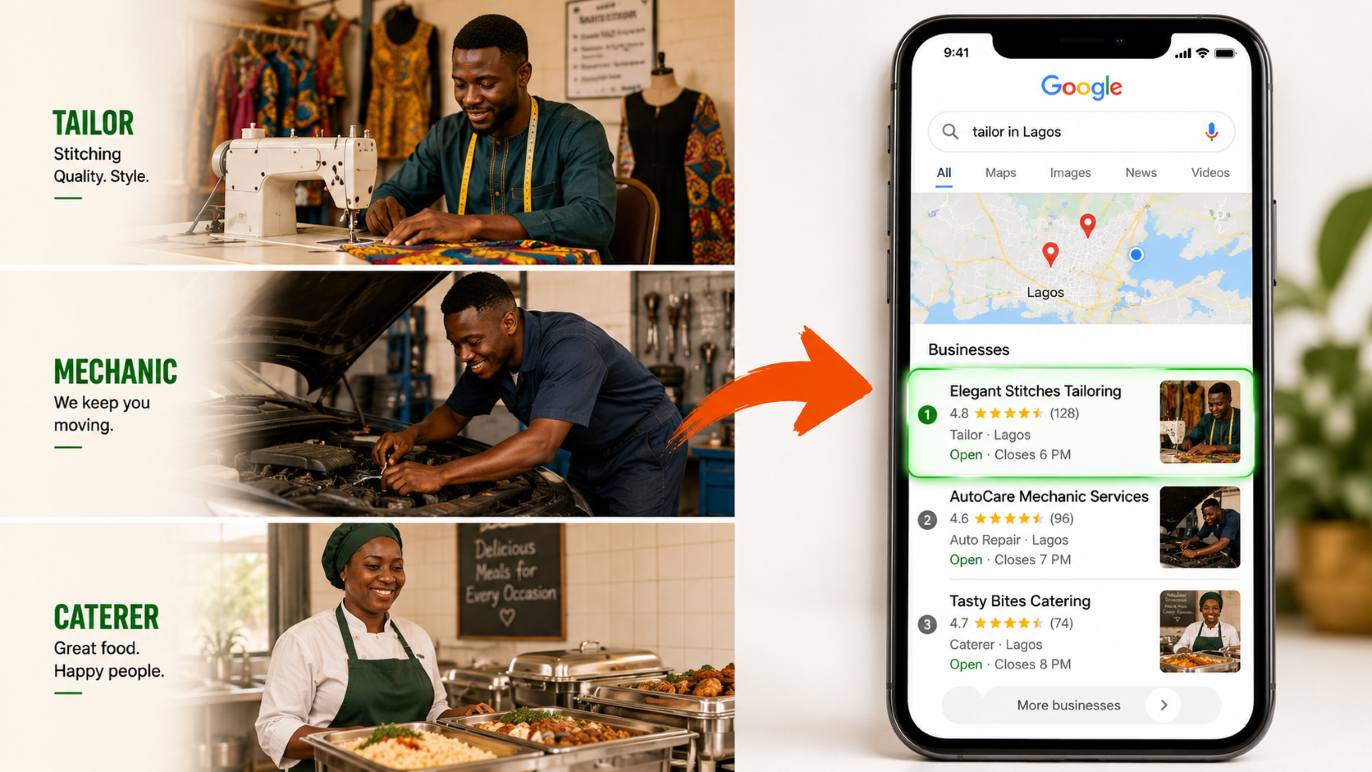
Think about a tailor in Ibadan, a mechanic in Ikeja, a furniture maker in Aba, a dentist in Wuse, or a caterer in Port Harcourt.
Almost half of Google searches are local, 76% of “near me” mobile searchers visit a business the same day, and 86% of profile views come from people who did not know that business existed.
Yet roughly 58% of businesses never optimise for local search.
A complete Google Business Profile costs nothing and takes an afternoon.
Photos of your actual workshop. Accurate opening hours. Your real phone number. Reviews from customers you already served well. Posts when something changes.
Most Nigerian businesses have either never claimed their profile or set it up once in 2021 and abandoned it, which is exactly why a competitor with a maintained profile appears above them in Maps.
Setting these up properly is part of what we do at Greenlearners Technologies through our Local SEO service, and it is usually the fastest measurable win available to any business with a physical location or service area.
Is your business showing up when someone nearby searches?
Most Nigerian businesses have never claimed their Google Business Profile properly. It is free, it is fast, and it is usually the quickest win available.
Fix Our Local Visibility →Web Performance & Mobile Experience Statistics
- 139On mobile, only 62% of origins record a good Largest Contentful Paint score, against 77% for INP and 81% for CLS, making load speed the main reason sites fail Core Web Vitals.Source: HTTP Archive Web Almanac 2025
- 140Mobile Core Web Vitals pass rates rose from 36% in 2023 to 44% in 2024 and 48% in 2025, meaning the bar for “acceptable” is rising every year.Source: HTTP Archive Web Almanac
- 14153% of mobile visitors abandon a site that takes longer than three seconds to load, a threshold most Nigerian business websites miss.Source: Google mobile performance research
AI Search & Discovery Statistics
- 142An estimated 40% of local business queries now trigger a Google AI Overview, up sharply through 2025 and 2026.Source: 2026 local search industry research
- 143Around 45% of consumers report using ChatGPT or a similar AI tool to get local business recommendations, a discovery channel that did not meaningfully exist three years ago.Source: 2026 local search industry research
- 144Google states that its AI features rely on the same foundational SEO principles as traditional Search: crawlability, useful content, internal linking, page experience and accurate structured data.Source: Google Search Central, AI Features and Your Website
Diaspora & Cross-Border Statistics
- 145Nigeria received approximately $20.93 billion in diaspora remittances in 2024, one of the largest remittance inflows of any country in Africa.Source: Central Bank of Nigeria / World Bank remittance data
- 146Over 60% of Africa’s e-commerce transactions originate from mobile devices, with Nigeria above that continental average at 82.3%.Source: GSMA Mobile Economy and Mordor Intelligence
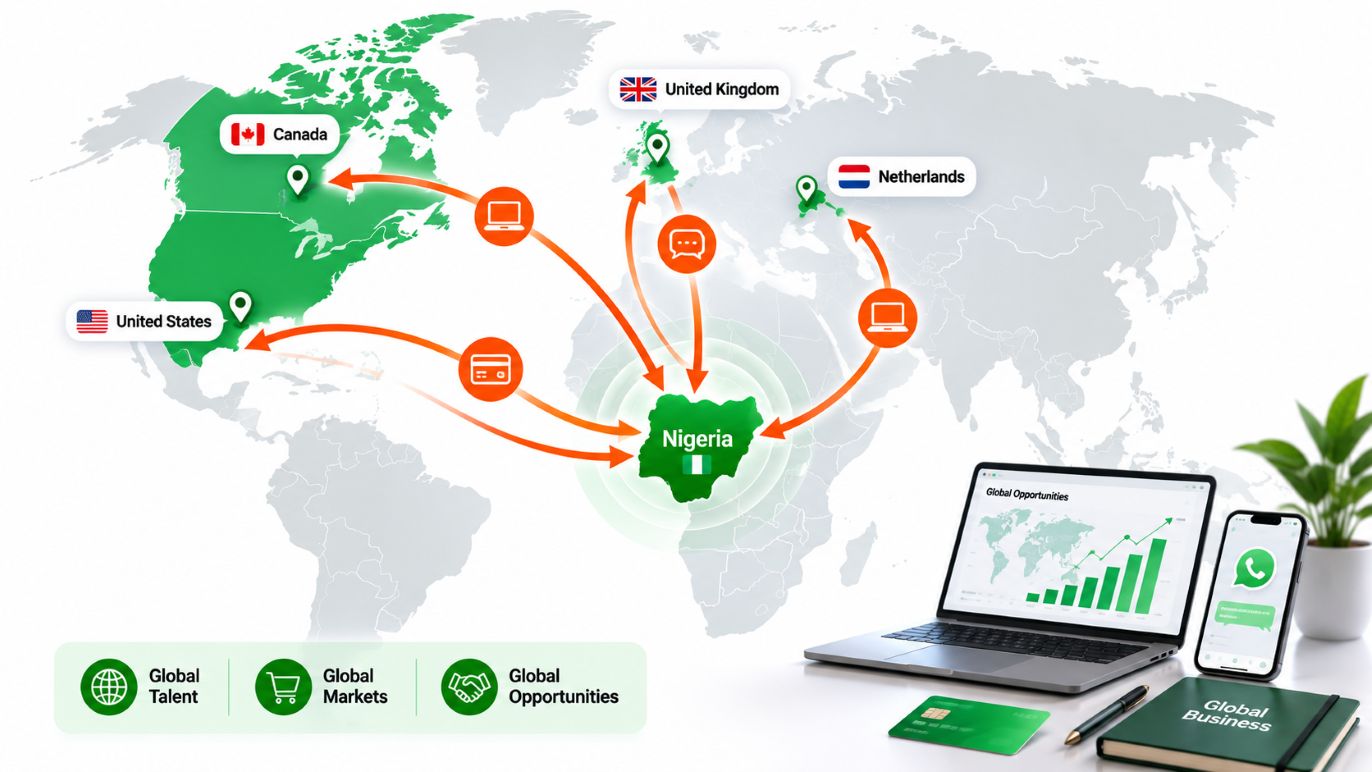
- 147Greenlearners Technologies has delivered campaigns from Nigeria for clients in the United Kingdom, United States, Canada and the Netherlands, including the SEO results cited at statistics 116 to 118, demonstrating that Nigerian-executed digital marketing competes at international standard.Source: Greenlearners Technologies client records, 2026
Two audiences should read statistics 145 to 147 closely.
If you are in Nigeria selling services: nearly $21 billion flows into this country annually from Nigerians abroad, and a meaningful share of it funds businesses, property and family ventures back home. Diaspora buyers research in the UK, US and Canada, then buy in Nigeria. Your website and Google presence need to satisfy a buyer sitting in Houston at 2am.
If you are in Nigeria selling to the world: the SEO results in this report were produced from Nigeria for clients abroad. Geography is no longer the constraint it once was. Positioning, proof and payment infrastructure are.
We break down exactly how to run this in our guide to marketing strategies that work in Nigeria and the diaspora.
What Nigerian And Global Businesses Built On This Data
Statistics are only worth something if somebody acts on them.
Here are four businesses, three Nigerian and one global, that made a specific decision the data supported, and what happened next.
Jumia: Pay-On-Delivery Solved The Trust Number
When Jumia launched in 2012, the barrier was not internet access.
It was trust.
Nigerians would not enter card details for goods that might never arrive from a company they had never heard of, and that is the same instinct visible today in the 81.1% of surveyed Nigerian internet users who worry about fake content online.
Jumia’s answer was pay-on-delivery, which was expensive and absorbed years of returns and rejected orders.
Strategically it was the decision that made Nigerian e-commerce possible, because it removed the exact fear stopping the purchase.
The lesson for your business: find the single objection blocking your sale and remove it structurally, even if removing it costs you margin at first.
Sources: Rest of World · SimplVest · WeeTracker
Moniepoint: Distribution Beat Advertising
Moniepoint began as TeamApt in 2015, building software for banks.
The pivot came from a field visit to Sangotedo market in Lagos, where every agent named the same problem: reconciliation.
Not branding. Not an app. Reconciliation.
Moniepoint built for that and then did something most fintechs avoided, deploying physical field teams who could visit a merchant and train someone in person.
That strategy was validated during Nigeria’s 2023 cash crisis, when its agent network kept transactions moving while bank queues stretched around buildings.
By October 2024 it had raised $110 million at a valuation above $1 billion.
The lesson for your business: in a market where 130 million people are still offline and trust is scarce, physical distribution and human support are marketing, not overhead.
Sources: Moniepoint · Monocle · Business Elites Africa
Chowdeck: Depth In One City Before Breadth Across Ten
Founded in October 2021, Chowdeck concentrated on Lagos, and within Lagos on specific high-density neighbourhoods, optimising delivery times before widening the map.
Its operating rule, described publicly by CEO Femi Aluko, was that a city should become profitable, typically within three to four months, before the next one opened.
An exclusive Chicken Republic delivery partnership across Lagos and Ibadan in August 2024 accelerated that.
By its $9 million Series A in August 2025, Chowdeck was serving 1.5 million customers across 11 cities and was profitable, which is rare in food delivery anywhere.
The lesson for your business: the 46% local-intent statistic is a national average, but businesses win locally first. Dominate one area before spreading a thin budget across six.
Sources: TechCrunch · Semafor · BusinessDay NG
Airbnb: A Global Example Of Reading One Number Correctly
In its early years, Airbnb noticed that listings in New York were underperforming, and the data pointed at photography quality rather than pricing or demand.
Rather than build a feature, the founders travelled to New York and photographed listings themselves with a rented camera.
Revenue in that market responded, and professional photography became a core part of the product.
The lesson for your business: the statistic that matters is rarely the one everybody is quoting. For Nigerian businesses today, the equivalent unglamorous fix is usually a Google Business Profile with real photographs, a site that loads in under three seconds, and a WhatsApp number somebody actually answers.
Source: Paul Graham, “Do Things That Don’t Scale”, which documents the Airbnb photography decision
Every business in this section acted on a specific number rather than a general feeling.
That is the entire difference between marketing that compounds and marketing that drains a budget.
Our Own Campaign Data, In Full
Everything above this point is third-party research.
This section is different.
These are results from campaigns I personally managed at Greenlearners Technologies, verified in the platform dashboards themselves, across Nigerian and international clients.
| Channel | Result | Period | Client | Verified In |
|---|---|---|---|---|
| SEO | 244 → 25,900 monthly clicks; 3.48M impressions | 16 months | LearnWithPride | Google Search Console |
| SEO | 2,140 clicks; 175,000 impressions | 6 months | Study With FM | Google Search Console |
| Meta Ads | 474 website leads at ₦41.30 per lead, from ₦19,574.88 spend | 5 days | Arya Marketplace | Meta Ads Manager |
| 230,930 views; 91,673 viewers; 95.4% non-followers | 90 days | Arya Marketplace | Instagram Professional Dashboard | |
| 68,593 views; 19,020 accounts reached; 74.2% non-followers | 90 days | LearnWithPride | Instagram Professional Dashboard | |
| 34,643 recipients; 30-35% open rates | Campaign series | LearnWithPride | Brevo | |
| 5,000+ verified wholesale buyers in community | Ongoing | Arya Marketplace | WhatsApp Business |
Two observations from this data that no public dataset will give you.
First, on the Arya Marketplace Instagram account, Reels drove 71.9% of all views despite representing a minority of posts published.
Second, 95.4% of those views came from non-followers, which tells you Nigerian Instagram discovery is now almost entirely algorithmic rather than follower-driven.
Chasing follower counts in this market is close to obsolete.
What produces those numbers is consistent short-form video, which we produce for clients through video marketing.
Data Quality Audit: The Numbers That Contradict Each Other
This is the section no other Nigerian statistics roundup will give you.
During this research I found figures that contradict each other, figures that cannot be traced to any primary source, and figures circulating widely on Nigerian marketing blogs that are simply wrong.
Here they are, openly.
| Metric | Conflicting Figures | Why They Differ | What To Use |
|---|---|---|---|
| Internet users | 109M vs 142.6M | DataReportal counts individuals; NCC counts subscriptions | 109M for people, 142.6M for connections |
| E-commerce market | $2.92B to $19B | Formal retail only vs including B2B, informal and social commerce; GMV vs revenue | No single figure is defensible without first defining scope. State which definition you are using |
| WhatsApp usage | 95% vs ~15M users | Survey self-report vs modelled user count. Different questions entirely | Never place side by side without explaining |
| Mobile internet speed | 18.91 vs 44.96 Mbps | The lower figure is from the 2025 report and is now outdated | 44.96 Mbps (late 2025) |
| Mobile broadband share | 94.4% vs 69.0% | The 94.4% figure is widely repeated but not what the current source says | 69.0% |
| Digital ad spend | $300M vs $340M vs $1.2B | Programmatic only vs measured ad spend vs full digital media economy | Match the scope to your question |
| Mobile traffic share | 84% vs 79% | StatCounter data moves month to month; both are quoted as “Statista” | “Roughly four-fifths” is the safe claim |
| Daily social media time | “3hr 49min” | Extremely widely quoted but I could not trace it to a primary source with stated methodology | Use “close to four hours” (Mordor), which is traceable |
- I had this wrong too. An earlier version of this report stated that Nigeria’s mobile internet speed had fallen 28.6% to 18.91 Mbps, which is what most Nigerian marketing articles currently say. Checking DataReportal’s Digital 2026 report directly showed the opposite: speeds rose 123% to 44.96 Mbps. I also corrected the broadband share from 94.4% to 69.0%, YouTube’s growth from a 9.8% decline to a 13.0% increase, and X’s from a 31.7% rise to a 10.7% fall. Every one of those errors came from using an older report as though it were current. It is the single easiest mistake to make with Nigerian data, and the reason this report now carries a verification date.
None of this means the data is useless.
It means you must know exactly what you are quoting before you build a budget on it.
How To Actually Apply This Data
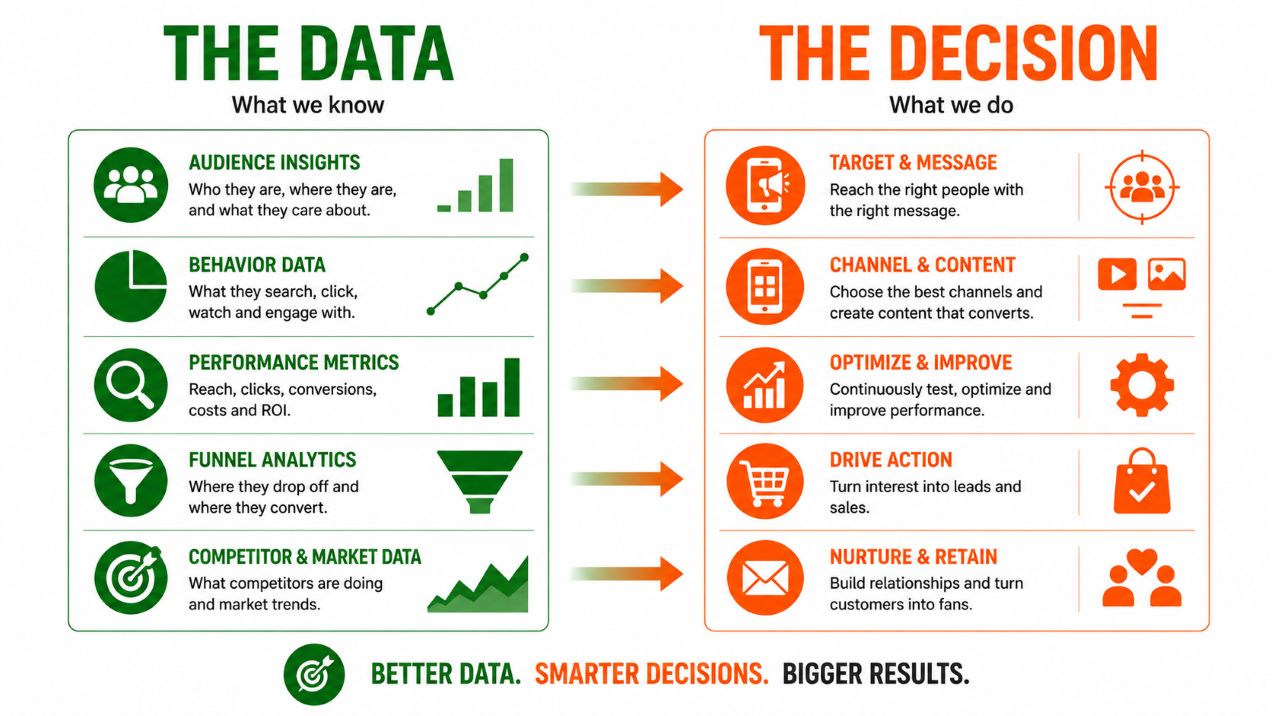
Numbers only matter if they change a decision.
| What The Data Says | What You Should Do About It |
|---|---|
| Mobile speeds rose 123% to 44.96 Mbps | Stop designing for 2G. Richer video and heavier creative now work in Nigeria |
| But only 69% of connections are broadband | Keep a lightweight fallback path, plus SMS and WhatsApp, for the rest |
| TikTok reaches 47.8M adults vs Facebook’s 38.0M | Test TikTok before assuming Meta owns Nigerian reach |
| Snapchat at 23.0M, growing 30.2% | Consider it seriously if you target under-30s. Almost nobody is bidding there |
| Instagram fell to 10.0M reach | Treat Instagram as precision, not reach. Adjust budget share accordingly |
| Only 44% of internet users touch social media | Invest in search, WhatsApp and email to reach the other 56% |
| 98.2% research products online first | Publish verifiable proof: screenshots, named clients, real numbers |
| 81.1% worry about fake content | Cite your sources publicly, exactly as this report does |
| Digital hits 84% of ad spend by 2029 | Build owned audiences now while attention is still cheap |
| Formal e-commerce under 2% of retail | Sell through WhatsApp and social commerce, not only website checkout |
| Email is ~3% of digital ad spend | Start list-building now. The channel is underpriced in Nigeria |
| Median age is 18.1 | Validate your audience assumptions against your own customer data, not a Western template |
| Google holds ~98.7% of Nigerian search | Ranking on Google is close to the entire search opportunity here. Prioritise it |
| 46% of searches are local; 76% visit within 24hrs | Claim and complete your Google Business Profile this week. It is free |
| 58% of businesses skip local SEO entirely | This is the widest open gap in Nigerian marketing right now |
| 53% abandon sites slower than 3 seconds | Test your site on mobile data, not office WiFi, then fix the largest image |
| $20.93bn in diaspora remittances (2024) | Build a buying path that works for a Nigerian in Houston at 2am |
Which Channels Your Business Type Should Prioritise
The data above is national.
Your business is not.
Here is how I would translate these numbers into a starting channel mix by business type, based on the reach figures in this report and our own campaign experience.
Treat this as a starting hypothesis to test, not a universal rule.
| Business Type | Priority 1 | Priority 2 | Priority 3 | Why |
|---|---|---|---|---|
| E-commerce & retail | TikTok / Meta Ads | SEO | 82.3% of orders are mobile; social commerce is growing fastest | |
| B2B & manufacturing | Google Search | 13.0M LinkedIn members; long consideration cycles | ||
| Local services & retail | Google Business Profile | Meta Ads | Local intent converts fastest; 85.6% research on search | |
| Real estate | Meta Ads | Video / TikTok | High-value decisions need visual trust, then conversation | |
| Hospitals & clinics | Local SEO | Reviews | Content | Medical trust is built through evidence and proximity |
| EdTech & training | SEO | Meta Ads | Buyers research heavily before committing money | |
| Fashion & beauty | TikTok | Beauty is the fastest-growing e-commerce category at 16.46% CAGR | ||
| Professional services | Google Search | SEO | High-intent search plus visible credentials | |
| Fintech & apps | SEO | In-app messaging | Content | Trust before download, retention after |
| Diaspora-facing | Google Search | Meta Ads | Intent-driven discovery plus geographic targeting |
Ready to turn these numbers into revenue?
Let’s talk about your business, your budget, and which of these insights apply to you first.
Chat With Us On WhatsAppThe Truth About Digital Marketing In Nigeria
Let me be blunt, because this is the part that actually costs businesses money.
Most businesses fail at digital marketing in Nigeria not because they lack funding.
Not because their product is bad.
Not because the market is too competitive.
They fail because they make decisions from assumptions instead of evidence.
They think “my customers are on Instagram,” when Instagram’s Nigerian reach is 10.0 million against TikTok’s 47.8 million.
They think “WhatsApp is just for chatting,” in a country where it is the single most-used platform.
They think “SEO doesn’t work in Nigeria,” while competitors quietly rank and collect the leads.
They think “email is dead,” in a market where it takes about 3% of digital ad spend and remains fully owned.
They think “mobile doesn’t matter,” while 82.3% of online orders arrive from a phone.
Every one of those assumptions is expensive.
And every one of them is answerable with data you now have.
You have just read 147 digital marketing statistics that most of your competitors will never sit down and study.
The question now is what you do with them.
You can close this tab and go back to guessing.
Or you can pick the three numbers above that most directly contradict how you currently spend money, and change that this week.
The businesses that will dominate Nigeria’s market through 2027 and beyond are the ones making decisions from evidence today.
Frequently Asked Questions
There were 109 million internet users in Nigeria in October 2025, representing 45.5% internet penetration, according to DataReportal’s Digital 2026 Nigeria report.
The Nigerian Communications Commission separately recorded 142.6 million active internet subscribers, a higher figure because it counts subscriptions rather than unique individuals.
By advertising reach, TikTok leads Nigeria at 47.8 million users aged 18 and above, ahead of Facebook at 38.0 million, YouTube at 30.5 million and Snapchat at 23.0 million.
By everyday usage, WhatsApp remains the most-used platform, named by over 95% of Nigerian internet users aged 16 and above in survey research.
Yes, but as a precision channel rather than a reach channel. Instagram’s Nigerian ad reach is 10.0 million and it declined 6.1% year on year, roughly a fifth of TikTok’s adult reach.
In our own client work, Instagram Reels still drove 71.9% of account views with 95.4% coming from non-followers, so the discovery mechanism works well even at smaller scale.
Measured digital advertising in Nigeria was reported at $340 million in 2025, representing 34.2% of a total $996 million measured advertising market.
Broader definitions including the full digital media and creator economy put the figure closer to $1.2 billion, so always check what a given estimate includes before comparing.
Nigeria’s median mobile download speed was 44.96 Mbps at the end of 2025, having risen 24.77 Mbps or 123% in twelve months.
Many Nigerian marketing articles still quote an outdated 18.91 Mbps figure showing a decline, which came from the previous year’s report and is no longer accurate.
Because researchers measure different things. Estimates for Nigeria’s 2025 e-commerce market range from $2.92 billion to $19 billion depending on whether the figure includes B2B transactions, informal social commerce, gross merchandise value or net revenue.
Before using any figure, confirm what it counts, when it was measured, and who published it.
Mobile commerce accounts for 82.3% of online orders in Nigeria, more than four-fifths of all transactions.
This is why mobile-first design is a requirement in this market rather than a preference.
It depends on your goal. WhatsApp is strongest for conversion, TikTok and Facebook for reach, Google Search for high-intent buyers, and LinkedIn for B2B.
Since Nigerian internet users engage with roughly seven platforms monthly, single-channel strategies now reach only a fraction of any given audience.
Optimise for mobile first, lead with WhatsApp for communication, display prices in naira, offer multiple payment options including transfers and pay-on-delivery, and publish verifiable proof given that 81.1% of Nigerians worry about fake content online.
Partnering with credible local voices closes the trust gap faster than paid reach alone.
Claim and fully complete your Google Business Profile. Roughly 46% of Google searches carry local intent, 76% of “near me” mobile searchers visit a business within 24 hours, and consumers are 2.7 times more likely to trust a business with a complete profile.
Add real photos of your premises and work, accurate hours, your actual phone number, and ask satisfied customers for reviews. Around 58% of businesses never optimise for local search, which is exactly why the ones that do appear above them in Maps.
Some do and some do not, which is why every statistic in this report is labelled either Nigeria-specific or global. Platform mechanics travel well: Google’s ranking systems, Core Web Vitals thresholds and local search behaviour work the same way in Lagos as in London.
Consumer behaviour, payment habits, trust barriers and platform preference do not travel. Nigerian mobile commerce sits at 82.3% of orders against a global average far below that, and Google’s share of Nigerian search is roughly 98.7% against about 85.5% in the United States.
The most reliable primary sources are DataReportal’s annual Digital Nigeria reports, the Nigerian Communications Commission’s industry statistics, PwC’s Africa Entertainment and Media Outlook, Ookla’s Speedtest Global Index, and Statista’s advertising outlook.
This report is reviewed against those sources on a fixed schedule, with the next review due in January 2027.
This report is published for educational and informational purposes only.
It is not business, financial, investment or legal advice, and it should not be relied upon as a substitute for guidance from a qualified professional.
The statistics here are compiled from third-party research organisations and reflect the latest data available at the time of publication. Market data changes continuously, and figures may be revised by their original publishers.
Where results from Greenlearners Technologies client work are cited, those are specific documented outcomes for specific clients. They are examples rather than typical results, and no similar outcome is promised or implied for any other business.
Please verify any figure against its original source before making a commercial decision.
Results shown are illustrative examples, not a complete record. A meaningful share of our client work sits under non-disclosure agreements and cannot be published, and some earlier accounts have changed hands so we no longer hold dashboard access. What appears here is what we are contractually free to share, drawn from our own platform records rather than an independent audit.
Data last verified: August 20, 2026. Next scheduled review: January 2027.
Changes in this edition: corrected mobile and fixed internet speed figures against Ookla data, corrected mobile broadband share from 94.4% to 69.0%, corrected YouTube and X growth directions, corrected Instagram and Snapchat reach figures, and replaced several secondary citations with primary platform and regulator sources.
All statistics are sourced from named research organisations and linked directly so you can verify them yourself.
Digital marketing data changes rapidly, and figures reflect the latest available data at the time of publication. Where credible sources disagree, that disagreement is stated openly rather than resolved silently.
We recommend verifying time-sensitive figures against the original source before making major financial decisions.
- DataReportal / Kepios (2025). Digital 2026: Nigeria. Published 8 November 2025, data as at October 2025. datareportal.com
- DataReportal. Notes on Data (methodology and caveats). datareportal.com/notes-on-data
- Nigerian Communications Commission. Industry Statistics and Subscriber Data. ncc.gov.ng
- GSMA Intelligence. Mobile connections data, Nigeria. gsmaintelligence.com
- Ookla. Speedtest Global Index, Nigeria. speedtest.net
- Meta. Advertising audience data, Nigeria (Facebook, Instagram, Messenger, Threads), via DataReportal. datareportal.com
- TikTok. Advertising audience data, Nigeria, via DataReportal. datareportal.com
- Google. YouTube advertising audience data, Nigeria, via DataReportal. datareportal.com
- Snap Inc. Snapchat advertising audience data, Nigeria, via DataReportal. datareportal.com
- LinkedIn. Advertising audience data, Nigeria, via DataReportal. datareportal.com
- X Corp. Advertising audience data, Nigeria, via DataReportal. datareportal.com
- PwC. Africa Entertainment & Media Outlook 2025-2029. pwc.com/ng
- Nairametrics (2025). Digital ads to dominate 84% of Nigeria’s ad spend by 2029. nairametrics.com
- Mordor Intelligence (2026). Nigeria E-commerce Market. mordorintelligence.com
- Mordor Intelligence (2026). Nigeria Digital Transformation Market. mordorintelligence.com
- Euromonitor International. Retail and E-commerce in Nigeria, 2025. euromonitor.com
- Ken Research. Nigeria Online Advertising and Digital Media Market. kenresearch.com
- Ken Research. Nigeria Digital Advertising and Social Media Economy Market. kenresearch.com
- Krestel Digital (2025). Nigeria’s Digital Marketing Data, 2025 Report. kresteldigital.com
- Krestel Digital (2026). Social Media Statistics In Nigeria, 2026 Data Report. kresteldigital.com
- Statista. Leading social media platforms in Nigeria. statista.com
- Statista. Advertising Market Outlook, Nigeria. statista.com
- Statista. Number of mobile internet users in Nigeria to 2029. statista.com
- StatCounter Global Stats. Search engine market share, Nigeria. gs.statcounter.com
- Pew Research Center (2025). Google users are less likely to click on links when an AI summary appears in the results. pewresearch.org
- Google Search Central. AI features and your website. developers.google.com
- Google Search Central. Creating helpful, reliable, people-first content. developers.google.com
- OpenAI (2026). Scaling AI for everyone. openai.com
- HubSpot. State of Marketing Report. blog.hubspot.com
- Ahrefs. Core Web Vitals study. ahrefs.com
- Oxgital. Nigerian digital advertising trends. oxgital.com
- HTTP Archive. Web Almanac 2025, Performance chapter. almanac.httparchive.org
- Google Search Central. AI Features and Your Website. developers.google.com
- Google. Think with Google, local search behaviour research. thinkwithgoogle.com
- Google Business Profile. Official product guidance and trust research. google.com/business
- BrightLocal. Local Consumer Review Survey. brightlocal.com
- Shopify. Local SEO Statistics 2026. shopify.com
- Central Bank of Nigeria / World Bank. Diaspora remittance inflow data. cbn.gov.ng
- Greenlearners Technologies (2026). Verified first-party campaign data from LearnWithPride, Study With FM and Arya Marketplace, confirmed in Google Search Console, Meta Ads Manager, Instagram Professional Dashboard and Brevo. greenlearnerstechnologies.com/
[…] See The Full Data Report → […]
[…] traced to a named source, with a full audit of the Nigerian statistics that contradict each other. See the data report → Blog · Growth Guide How To Grow Your Business With Digital Marketing In Nigeria The complete […]
[…] traced to a named source, with a full audit of the Nigerian statistics that contradict each other. See the data report → Blog · Growth Guide How To Grow Your Business With Digital Marketing In Nigeria The complete […]
[…] traced to a named source, with a full audit of the Nigerian statistics that contradict each other. See the data report → […]