



Published August 19, 2026 · Next scheduled review: January 2027
- The billboard that made me download an app
- Why most marketing in Nigeria still fails
- The market these strategies operate in
- The Greenlearners Technologies Growth Stack
- The 18 digital marketing platforms to use
- How these 17 strategies were chosen
- Which stage of marketing maturity you’re at
- What these strategies actually cost
- All 17 strategies at a glance
- The 17 strategies, with how to actually do each one
- Why one campaign doesn’t fit all of Nigeria
- Strategy combinations that compound
- 5 Nigerian businesses whose strategy decided their fate
- Best strategies by business type
- If I had to start again with ₦500,000
- Mistakes that quietly waste marketing budgets
- Frequently asked questions
- 1. Search Engine Optimization
- 2. AI Search Optimization (GEO)
- 3. Content Marketing
- 4. Pay-Per-Click Advertising
- 5. Social Media Marketing
- 6. WhatsApp Marketing
- 7. Email Marketing
- 8. Video & Short-Form Content
- 9. Influencer & Community
- 10. Conversion Rate Optimization
- 11. Local SEO
- 12. Retargeting & Remarketing
- 13. Funnels & Automation
- 14. SMS Marketing
- 15. In-App Notifications
- 16. Global Service Export
- 17. Authority Marketing
If you’re a business owner in Nigeria, or a Nigerian abroad trying to grow something back home or you’re a foreigner trying to build busineses in Nigeria or for Nigerians in the diaspora, this blog post answers one question directly: which digital marketing strategy actually works, for a business like yours, at the budget you actually have.
Most businesses don’t fail because they picked the wrong marketing strategy.
They fail because they never actually picked one.
They tried a bit of everything, for a few weeks each, and called it a strategy.
A Facebook boost here.
A flyer there.
Posted their videos dancing On Instagram.
A WhatsApp broadcast when sales got slow.
None of it connected.
None of it compounded.
This guide is different, and I want to be specific about how.
I’m Chukwuemeka Maduka, founder of Greenlearners Technologies.
Over eight years I’ve run these marketing strategies for businesses in Nigeria, the diaspora, the UK, the US, Canada, the Netherlands and beyond and I’ve included real screenshots from some of my recent results throughout this guide so you can see the results rather than take my word for them.
No serious business in Nigeria, or anywhere, survives on one marketing strategy alone.
Used together, on purpose, they compound and give you better results with less investment over time.
Let me start with a small story, because it explains the whole thing better than a definition would.
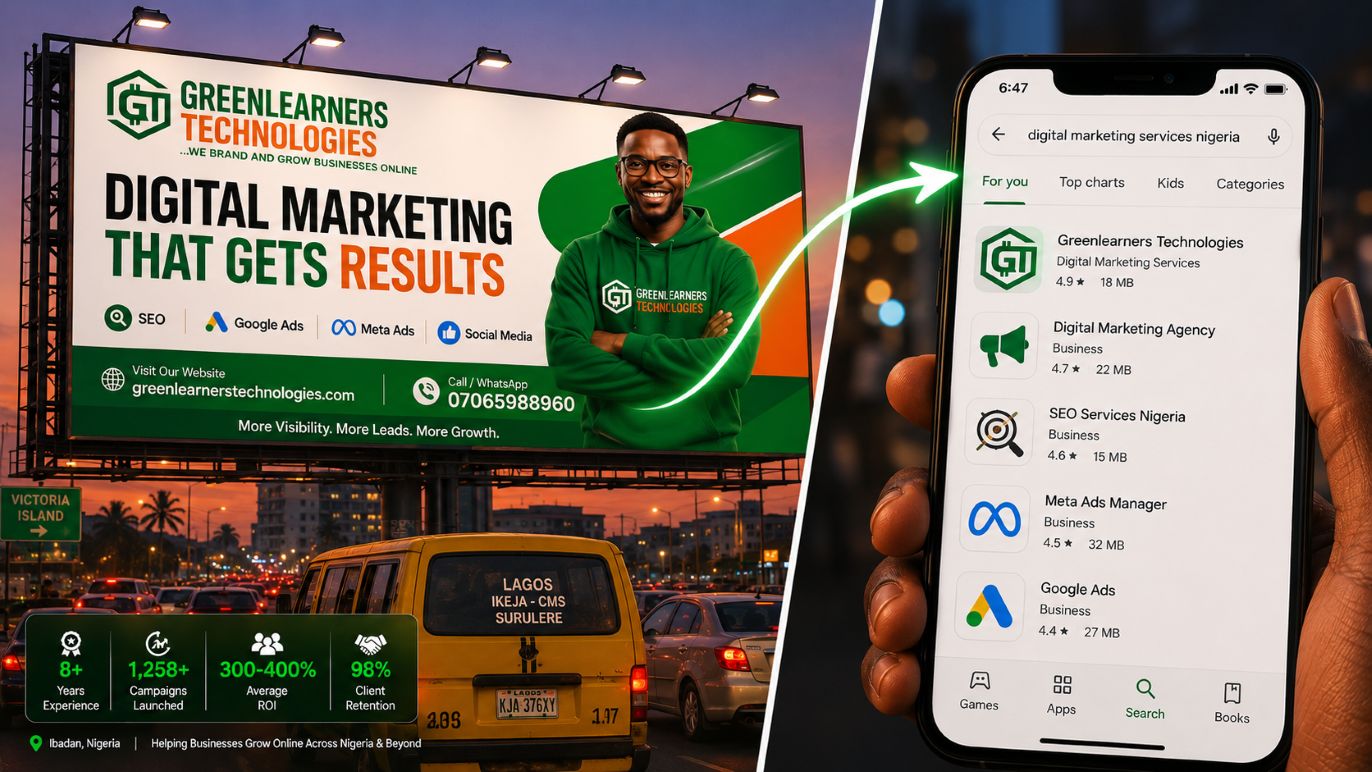
The Billboard That Made Me Download An App
A few years ago, when I was still working 9-to-5 as an SEO specialist at a company here in Ibadan, I was coming back from work one evening and saw a billboard for ALAT by Wema Bank, close to the University of Ibadan second gate.
At first I skipped it.
It looked like every other billboard out there, and I had a long day behind me.
Then came a time when I needed to know which digital bank apps in Nigeria I could actually trust with my money.
And I remembered that billboard.
So I searched for it on the Play Store, downloaded it, and I’ve been using it to this day.
Another time, riding in public transport, I saw AltBank by Sterling Bank on a large billboard.
I took note of it, checked it out online later, and downloaded that one too.
Now think carefully about what actually happened there.
Neither of those banks closed me on the billboard.
The billboard planted something.
Weeks later, when I had a real need, that seed was already there, and the search engine finished the job.
That gap between “I saw it” and “I searched for it” is where most Nigerian businesses lose money.
They run the billboard and never build the online presence that catches the search.
Or they build the website and never create the awareness that makes anyone search in the first place.
Offline marketing in Nigeria does not compete with digital marketing strategies.
It feeds them.
The billboard, the radio jingle, the friend’s recommendation, they create the moment of awareness.
The search, the Instagram check, the WhatsApp message, that’s where the sale actually closes.
Radio still works, and it works especially well outside Lagos.
In Ibadan, across much of the North, and in secondary cities nationwide, radio reaches people who aren’t scrolling Instagram all day.
Nationwide, radio remains one of Nigeria’s most widely consumed media platforms, and in many rural and semi-urban areas it is still the primary source of information.
In the South-West (Oyo, Ogun, Osun, Ondo, Ekiti), the North (Kano, Kaduna, Katsina, Kebbi, Zamfara, Sokoto, Jigawa, Yobe, Borno, Bauchi, Gombe), and key South-East and South-South markets (Imo, Anambra, Rivers, Delta, Edo, Akwa Ibom, Cross River), FM penetration and daily listenership remain high.
Pair a radio mention with one memorable instruction, “search us on Google” or “send us a message on WhatsApp”, and you can watch the enquiries land the same afternoon, especially in markets where radio drives real-world action more than social feeds.
Billboards and roll-up banners still work too.
A banner outside your shop does the same job the ALAT billboard did on me, at a fraction of the cost.
And word of mouth is the oldest offline-to-online strategy there is.
Someone recommends you to a friend, and that friend’s very next move is to search your name, check your Instagram, or ask in a WhatsApp group whether anyone has used you before.
If what they find doesn’t match the trust that recommendation created, the referral dies right there, and you never even know it happened.
Why Most Marketing In Nigeria Still Fails
Here’s something I’ve watched happen more times than I can count.
A business owner spends money on marketing.
Nothing happens.
They conclude that “marketing doesn’t work for my kind of business,” and quietly stop trying.
What actually happened, almost every time, is different: they ran a tactic, not a strategy.
A tactic is a single action.
Boost a post.
Send a broadcast.
Run an ad for one week and check the results on Friday.
A strategy is a system, a clear goal, the right channels for that goal, and enough consistency for those channels to actually compound.
And Nigerian businesses have always understood strategy, long before anyone attached the word “digital” to it.
The trader who kept her freshest tomatoes at the front of the stall was practicing product positioning, or brand positioning.
The tailor who gave a small discount to anyone who brought a friend was running a referral programme before the term existed.
What’s changed isn’t the logic of marketing.
It’s the scale.
That tailor’s referral system might reach thirty people in a good month.
The same idea, built properly into a digital referral or WhatsApp community strategy, reaches thousands, and keeps working while you sleep.
The businesses that understand this stop asking “does marketing work?” and start asking the better question: which marketing strategies, run consistently, fit where my business actually is right now?
That’s what the rest of this guide answers, strategy by strategy, with the steps to run each one.
The Market These Strategies Operate In
Every strategy in this guide depends on who is actually reachable in Nigeria, and on what device.
These are the numbers that decide which of the seventeen apply to your business.
109 million Nigerians are online, almost entirely on mobile phones, and nearly all of them are on WhatsApp.
Any marketing strategy that ignores that reality is fighting the market instead of using it.
According to DataReportal’s Digital 2026 Nigeria report, the country had 109 million internet users by late 2025, alongside 47.8 million social media identities.
The Nigerian Communications Commission recorded 179.6 million active mobile subscriptions by December 2025.
Put those two numbers side by side and the conclusion is unavoidable.
Almost every marketing strategy in this guide has to work on a small screen, on a mobile network, or it doesn’t work in Nigeria at all.
There’s one more number worth sitting with.
As of EFInA’s Access to Financial Services Survey, roughly 41.6% of Nigerian adults were still outside the formal financial system.
That financial inclusion gap helped create Nigeria’s fintech boom, and it’s exactly why so many of the case studies further down this page are fintech companies.
It also explains why investors continue to see Nigeria as one of Africa’s most promising fintech markets.
The Greenlearners Technologies Growth Stack
Before the strategies themselves, here’s the framework I use as a marketing strategist to decide which marketing strategies a business needs, and in what order.
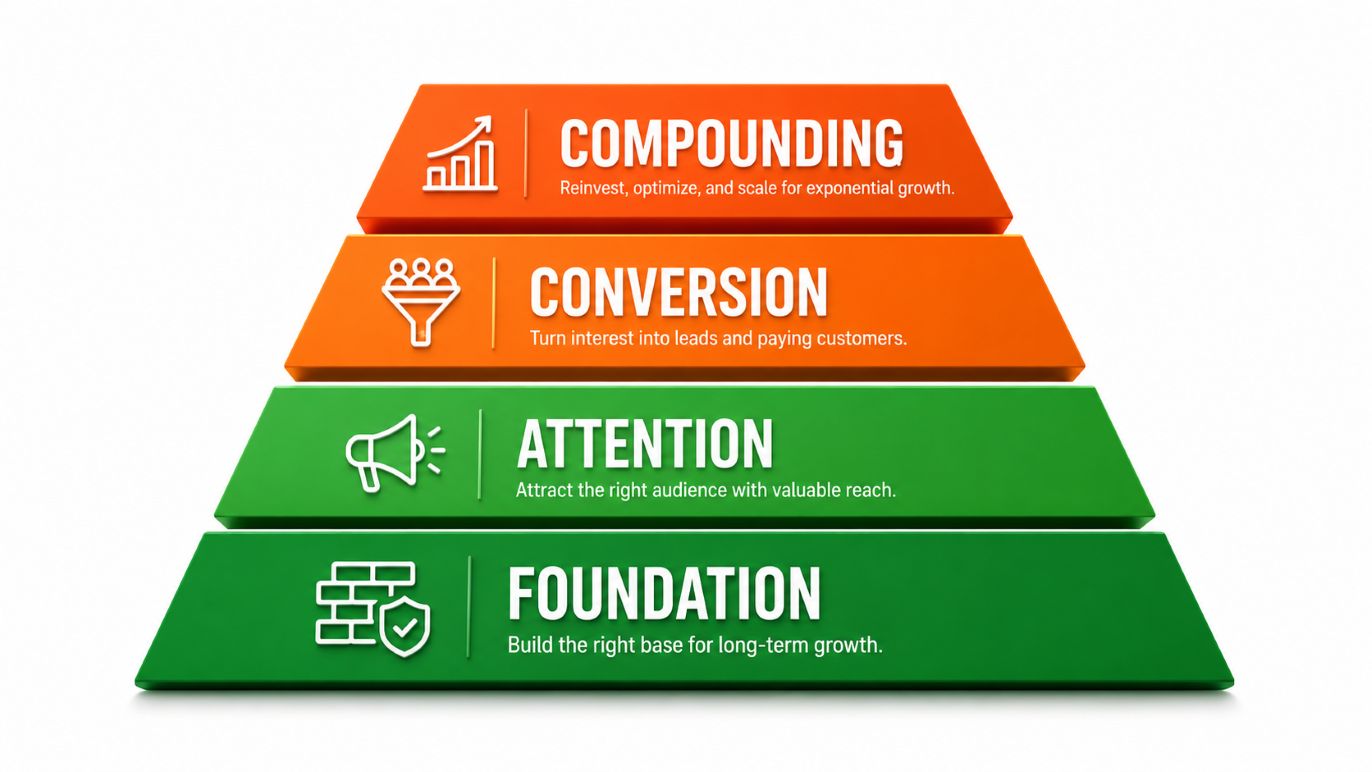
I call it the Greenlearners Technologies Growth Stack, and it has four layers.
Each layer only works properly if the one beneath it exists.
| Layer | What It Does | Strategies In This Layer |
|---|---|---|
| 1. Foundation | Makes you findable and credible when someone looks you up | Local SEO, Google Business Profile, website, WhatsApp Business |
| 2. Attention | Creates awareness among people who don’t know you yet | Social Media, Video, Influencers, Billboards, Radio, PPC |
| 3. Conversion | Turns that attention into money | CRO, WhatsApp Marketing, Retargeting, Funnels, SMS |
| 4. Compounding | Makes every month cheaper than the last | SEO, Content Marketing, GEO, Email, Automation |
Most struggling businesses I meet are running Layer 2 with no Layer 1 and no Layer 3.
They’re buying attention, sending it to a page that can’t convert, for a business that looks unfindable the moment someone checks.
That’s not a budget problem.
It’s a stack problem.
The 18 Digital Marketing Platforms Every Business Should Use
Before you choose a single strategy, there’s something more basic you need to settle.
Where do your marketing assets actually live?
This is the question almost no marketing guide answers, and getting it wrong quietly costs businesses everything they built.
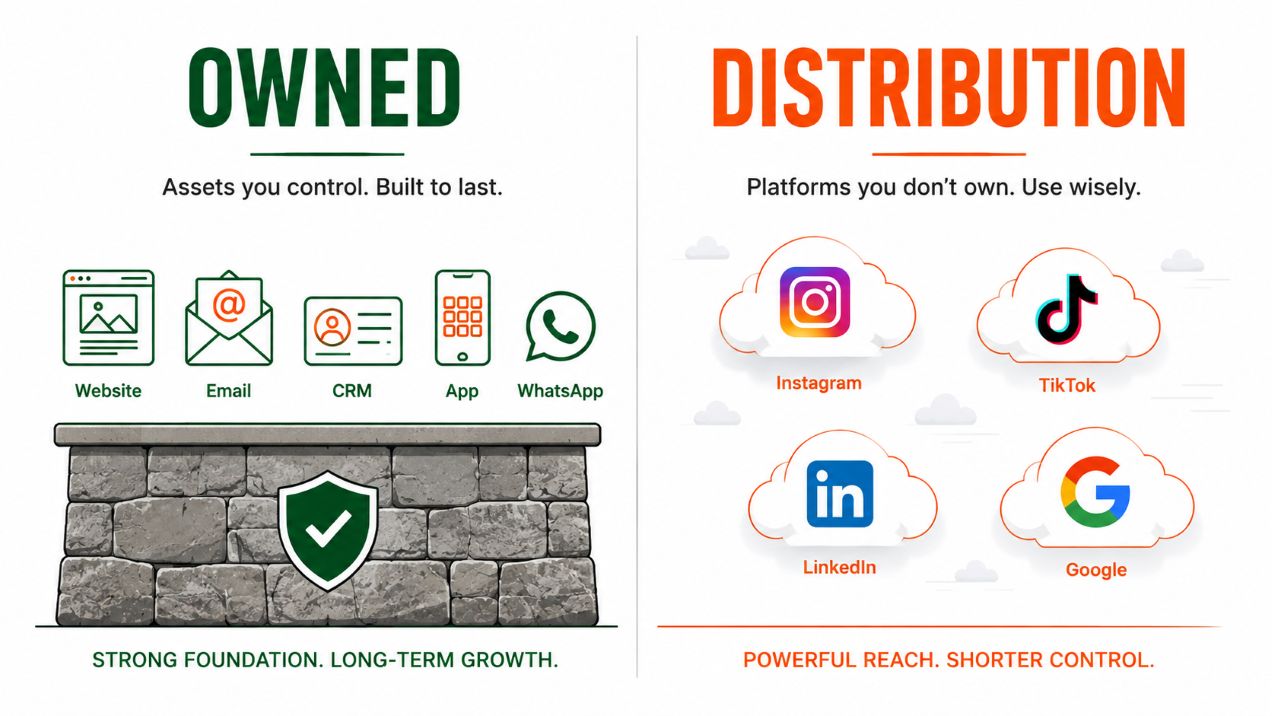
One of the biggest mistakes businesses make is confusing where they market with what they own.
Your Instagram page is not your business.
Your Facebook page is not your business.
Your TikTok account is not your business.
You are renting space from companies that can cut your reach, suspend your account, change their algorithm, or disappear entirely.
The strongest businesses use platforms they rent to build audiences they eventually move onto platforms they own.
Category 1: Owned Digital Assets
These are the platforms you control.
If Google, Meta, or TikTok vanished tomorrow, these would still belong to you.
| # | Owned Asset | Why It Matters |
|---|---|---|
| 1 | Website | Your digital headquarters, where people learn, trust, and buy |
| 2 | Blog | Builds SEO, AI visibility, and authority that compounds for years |
| 3 | Landing pages & sales funnels | Purpose-built to convert visitors into leads and customers |
| 4 | Email list | The relationship is yours, no algorithm sits between you and them |
| 5 | WhatsApp Business database | In Nigeria, often your single highest-converting owned channel |
| 6 | CRM & customer database | Purchase history and behaviour that make every future campaign smarter |
| 7 | Mobile app | Direct access to customers without paying for reach |
| 8 | Private community | WhatsApp Community, Telegram, or Discord where you set the rules |
| 9 | Digital products | Courses, templates, and tools that become reusable revenue assets |
Category 2: Distribution & Discovery Platforms
These are enormously valuable, and you should absolutely use them.
You just don’t own them.
I’d avoid calling all of these “rented,” because the relationship differs.
You build a following on Instagram, but you don’t build a following on Google Search or ChatGPT.
What they share is simple: someone else controls whether your audience sees you.
| # | Platform | Primary Role |
|---|---|---|
| 10 | Google Search | Intent-driven discovery, still the largest single source |
| 11 | Google Business Profile & Maps | Local discovery, essential for physical businesses |
| 12 | Visual discovery and product storytelling | |
| 13 | Community, marketplace, and Nigeria’s broadest ad reach | |
| 14 | TikTok | The strongest organic reach available to a new business |
| 15 | YouTube | Search-driven video, and the second-largest search engine |
| 16 | B2B authority, and where foreign buyers verify you | |
| 17 | X (Twitter) | Thought leadership and real-time reputation, strong in Nigerian tech |
| 18 | AI assistants | ChatGPT, Google AI Overviews, Perplexity, now recommending businesses directly |
Beyond these eighteen, marketplaces like Jumia, Konga, and Amazon matter for product businesses, while Reddit and Quora carry weight in specific niches.
Why This Distinction Decides Your Future
Imagine you spend five years building 100,000 Instagram followers.
Tomorrow the algorithm shifts and your reach falls by 90%.
Did you lose the audience?
Not exactly.
You lost your ability to reach them without paying.
Now imagine that over those same five years you had built 50,000 email subscribers, 20,000 WhatsApp contacts, and 8,000 paying customers in a CRM you control.
Those are business assets.
The first is borrowed attention.
This is exactly why every strategy in this guide eventually points somewhere you control.
Use the discovery platforms to earn attention, then move that attention onto assets you own, where trust compounds instead of resetting every algorithm update.
How These 17 Strategies Were Chosen
I didn’t pick these because they’re trending.
I picked them because I’ve either run them directly for clients, or verified that the data behind them holds up when you actually check it.
- Real usage. Every strategy here is one that businesses in Nigeria and abroad are running today, not a theoretical tactic from a course.
- Verifiable impact. Where I cite a statistic, I checked it against a named, dated source, not a recycled number nobody can trace.
- A place in the stack. Some strategies create attention, some convert it, some make it compound. A complete approach needs all three.
- Nigerian reality. Mobile networks, WhatsApp dominance, cash culture, regional difference, trust barriers. All of it factored in.
- Research completed August 2026, with all case study claims verified against independent press, not company marketing pages alone
- Statistics checked against DataReportal, the Nigerian Communications Commission, HubSpot’s 2026 State of Marketing Report, Wyzowl, EFInA, TechCrunch, Semafor, and Google’s own Search Central documentation
- Where a statistic couldn’t be traced to a credible named source, it was left out. Several widely-repeated retargeting and influencer ROI numbers failed this test and were deliberately excluded
- All screenshots in this guide are from live client accounts I personally managed, shown as captured
Which Stage Of Marketing Maturity You’re At
Before choosing strategies, it helps to be honest about where your business actually stands.
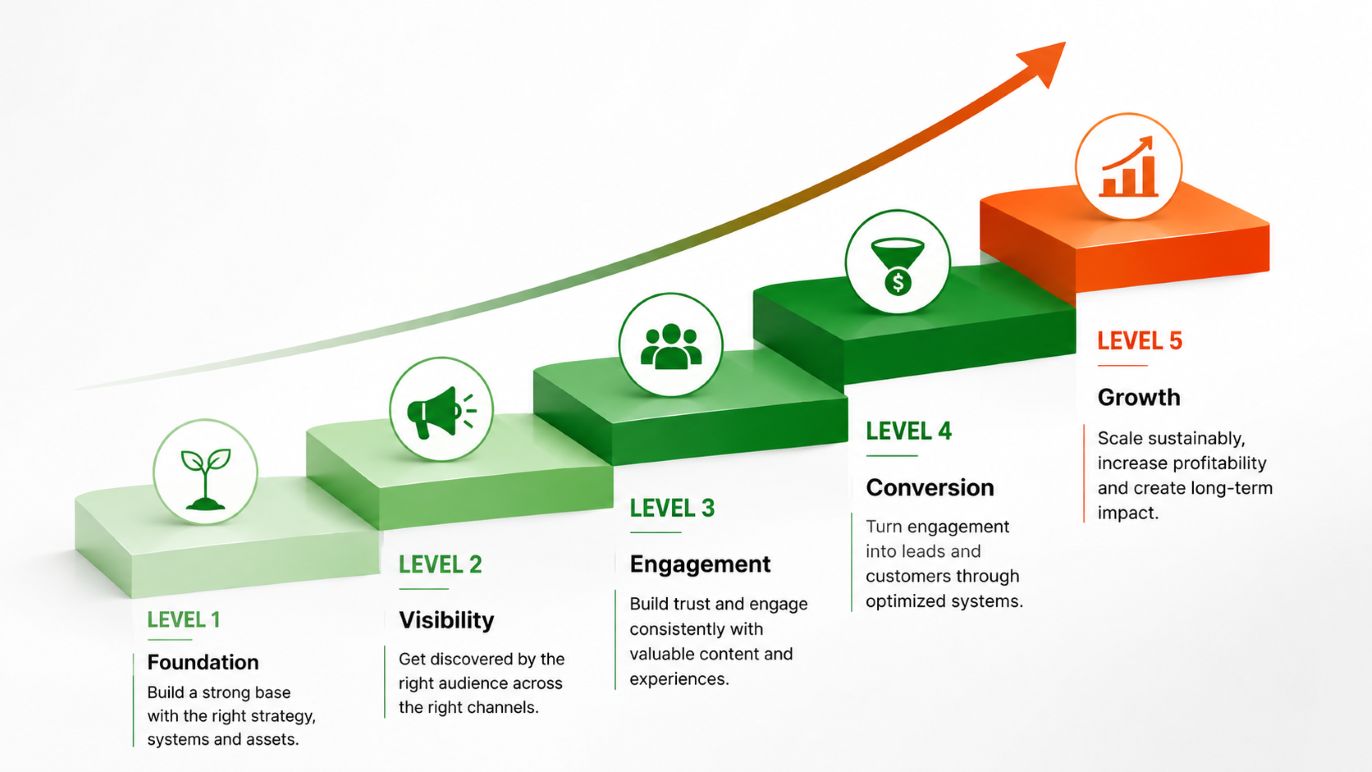
I use a simple five-level model with clients, and it usually settles the “where do I even start” question in under a minute.
| Level | Where You Are | What To Fix First |
|---|---|---|
| 1 | No real online presence, maybe a Facebook page | Google Business Profile, WhatsApp Business, a basic website |
| 2 | Active on social media, but leads are inconsistent | Content Marketing, Social Media with actual tracking |
| 3 | Getting leads, but they come and go unpredictably | SEO, Local SEO, Conversion Rate Optimization |
| 4 | Consistent leads, ready to scale spend | PPC, Retargeting, Email Marketing |
| 5 | Scaling, and you need systems instead of more effort | Automation, GEO, Influencers, Global Export |
Most Nigerian businesses I speak with sit at Level 1 or 2 when we first talk.
That’s not a criticism, it’s just useful to know, because a Level 1 business spending money on advanced retargeting is skipping the steps that would have made retargeting work.
What These Strategies Actually Cost
Marketing costs in Nigeria vary enormously by stage, from nothing for the free channels to tens of millions monthly for enterprise campaigns.
Here is what each band realistically buys.
If you want serious results and growth for your business through marketing, it is expensive.
You will invest good money, time, and hire the right team.
Ad spend is always separate from what you pay for strategy and management.
Any agency that blurs that line is worth a second look.
I’ll be direct here, because most pricing content online badly undersells what real marketing costs, and then business owners feel cheated when reality arrives.
| Business Stage | Typical Monthly Investment | What That Usually Covers |
|---|---|---|
| Small business / early startup | ₦250,000 – ₦3,500,000 | WhatsApp, Local SEO, Social Media, foundational SEO |
| Growing SME | ₦500,000 – ₦15,000,000 | SEO, PPC, Email, Content and Retargeting together |
| Enterprise / multinational | ₦1,500,000 – ₦50,000,000 | Full-funnel strategy across most or all 17 |
General Nigerian market bands as of 2026, covering strategy execution and management.
Ad spend sits on top of these figures, always.
The businesses that end up frustrated with marketing are almost always the ones who budgeted at the very bottom of one band and expected results from the top of the next one.
All 17 Marketing Strategies, At A Glance
If you want the whole picture in one view, this table summarises all seventeen strategies by cost, speed, difficulty and best use.
Scan it, pick two or three, then read those sections in full.
| # | Strategy | Speed | Cost | Difficulty | Best For |
|---|---|---|---|---|---|
| 1 | SEO | Slow (3-6 mo) | Low-Med | Medium | Long-term organic visibility |
| 2 | AI Search Optimization (GEO) | Slow-Med | Low-Med | Medium | Being cited inside AI answers |
| 3 | Content Marketing | Slow | Low-Med | Medium | Authority and trust |
| 4 | Pay-Per-Click Advertising | Fast (days) | Med-High | Medium | Immediate measurable leads |
| 5 | Social Media Marketing | Fast-Med | Low-High | Low-Med | Awareness and discovery |
| 6 | WhatsApp Marketing | Fast | Low | Low | Conversion and community |
| 7 | Email Marketing | Medium | Low | Medium | Nurture and repeat sales |
| 8 | Video & Short-Form Content | Medium | Low-Med | Medium | Engagement and reach |
| 9 | Influencer & Community | Medium | Low-High | Medium | Borrowed trust |
| 10 | Conversion Rate Optimization | Medium | Low | Med-High | More from existing traffic |
| 11 | Local SEO | Medium | Free-Low | Low | Physical and service businesses |
| 12 | Retargeting | Fast | Low-Med | Medium | Recovering lost interest |
| 13 | Funnels & Automation | Medium | Low-Med | High | Scaling without more staff |
| 14 | SMS Marketing | Fast | Low | Low | Time-sensitive offers |
| 15 | In-App Notifications | Fast | Low | Medium | Businesses with an app |
| 16 | Global Service Export | Slow-Med | Low-Med | High | Selling from Nigeria to the world |
| 17 | Authority Marketing | Slow | Low-Med | High | Being trusted before anyone searches |
“Speed” reflects typical timelines to measurable impact, not overnight promises.
Results vary by industry, budget, and execution quality.
Want these strategies built into one accountable system?
See how Greenlearners Technologies structures a real growth engagement, with a written 37% growth guarantee in 12 months.
See How We Work →The 17 Strategies, With How To Actually Do Each One
Each strategy below follows the same structure: what it is, who it suits, how to actually execute it, and proof that it works.
You are not meant to run all seventeen. Pick the two or three that match your stage and market.
Search Engine Optimization (SEO)
Our service: SEO at Greenlearners Technologies →
SEO means structuring your website and content so Google ranks you for exactly what your customers are already typing.
It’s slow to start and genuinely powerful once it lands, because unlike ads, the traffic doesn’t stop the day you stop paying.
The mistake most Nigerian businesses make is chasing keywords that sound impressive instead of keywords that signal intent to buy.
A business chasing “best fashion brand” loses to one ranking for “affordable ankara styles Lagos delivery,” because the second phrase is what someone types when their card is already in hand.
- List the exact phrases your customers use, then check them in Google Keyword Planner or Ubersuggest for real search volume.
- Build one dedicated page per core service or product, not one page listing everything.
- Fix technical basics first: mobile speed, HTTPS, clean URLs, proper title tags.
- Publish supporting content that answers the questions surrounding that purchase decision.
- Earn backlinks from real Nigerian directories, press, and partners, never bought link farms.
- Track rankings and conversions monthly in Google Search Console, and adjust what isn’t moving.
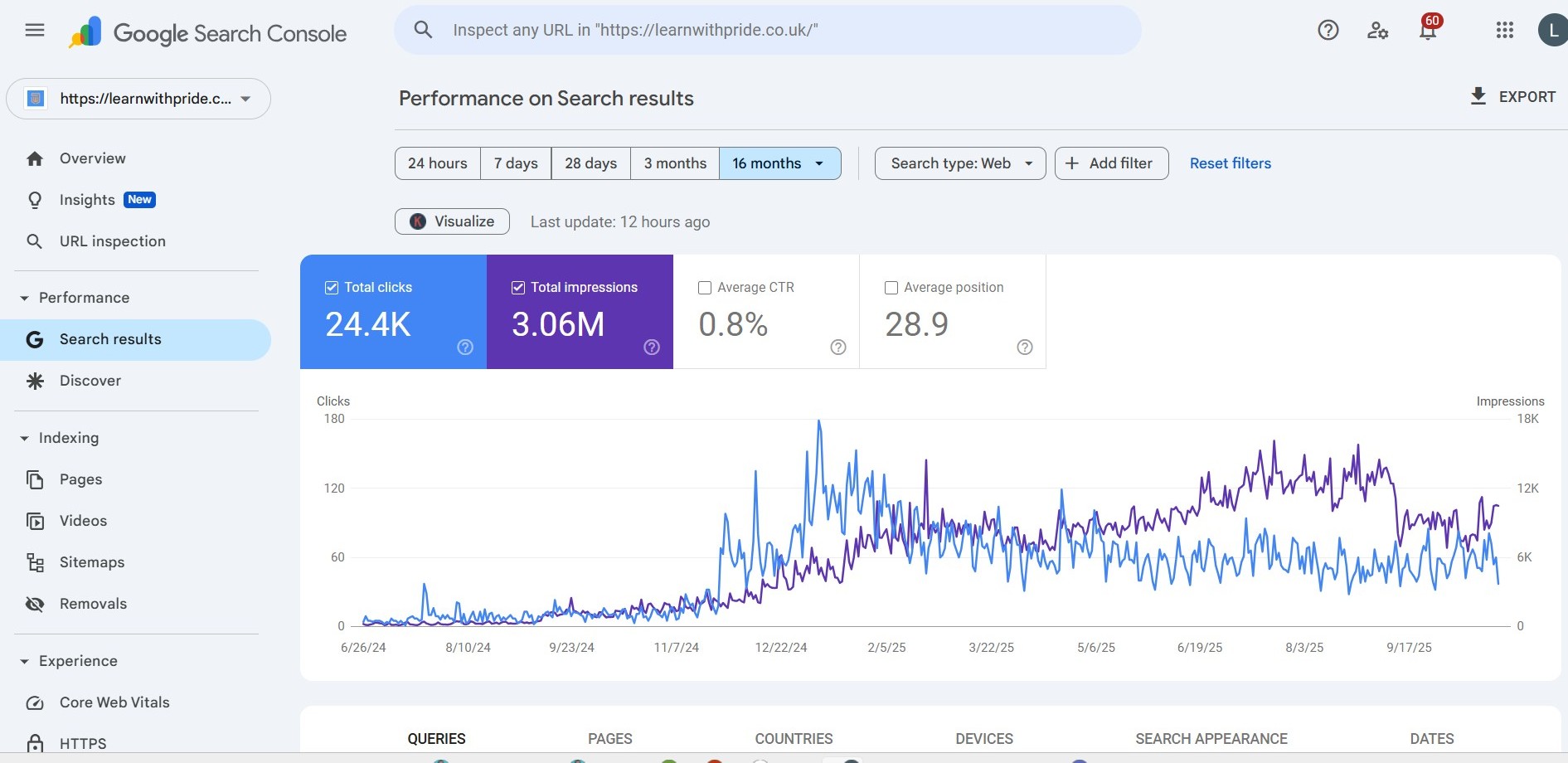
LearnWithPride (UK EdTech), managed by me: 25,900 total clicks and 3.48 million impressions over 16 months, from a starting point of 244 monthly clicks.
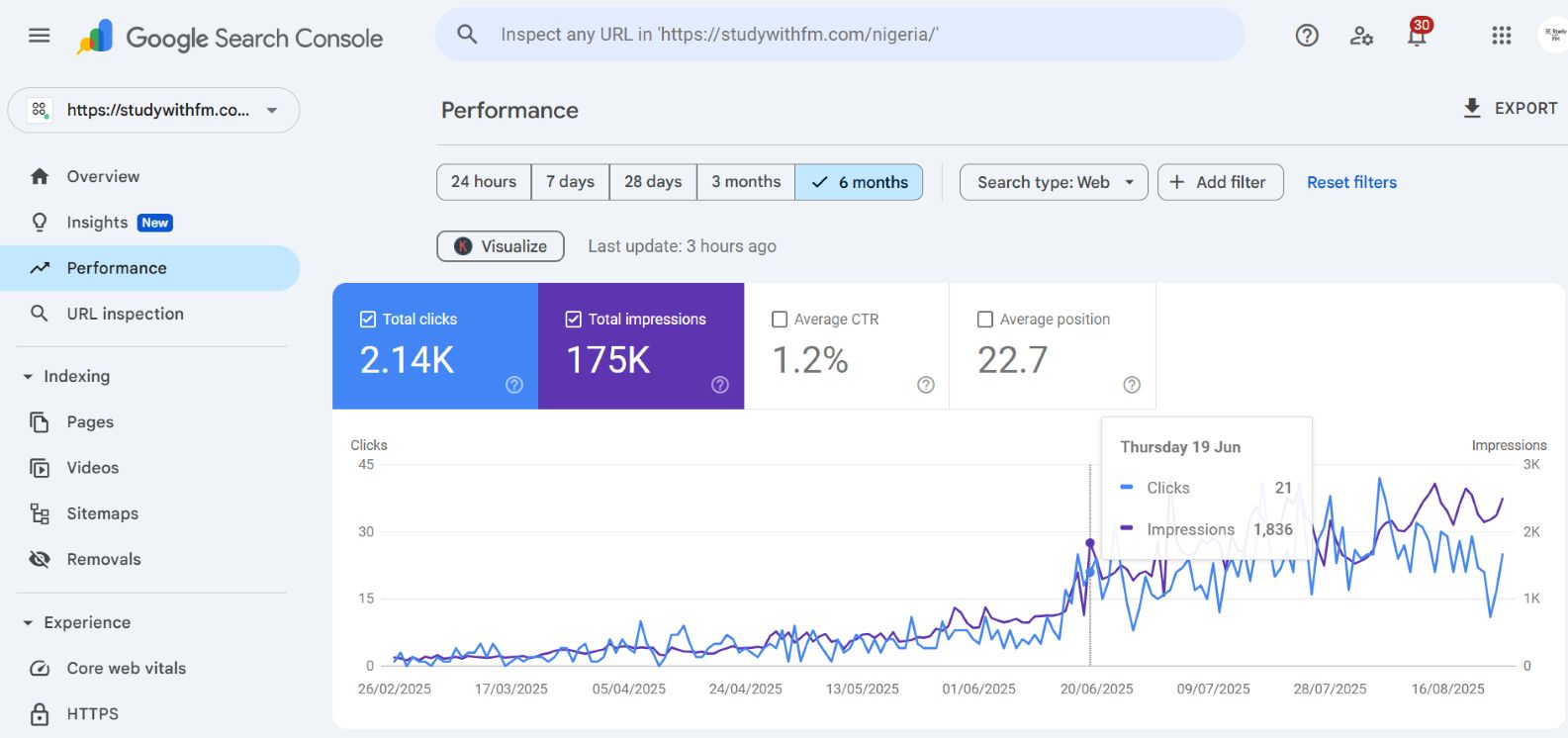
Study With FM: 2,140 clicks and 175,000 impressions within 6 months, growing from a near-flat baseline.
These are illustrative examples, not our best work.
A meaningful share of what we have delivered sits under non-disclosure agreements and cannot appear on a public page. Some of it involves campaigns and revenue considerably larger than anything shown here. Other accounts have since changed hands, so we no longer hold dashboard access even where the client would happily consent.
What is published is simply what we are contractually free to publish. Every figure cited comes from our own platform records rather than an independent audit, and we will open those dashboards on a call.
AI Search Optimization (GEO)
Our service: AI Search Optimization at Greenlearners Technologies →
Generative Engine Optimization means structuring your content so that ChatGPT, Perplexity, and Google’s AI Overviews cite your business inside their answers.
ChatGPT crossed 900 million weekly active users in February 2026, confirmed by OpenAI directly.
When someone asks an AI assistant a question about your industry, they don’t get ten blue links to choose from.
They get one answer, and it either mentions you or it doesn’t.
Google’s own guidance is refreshingly direct on this: AI Overviews draw on the same core ranking systems as normal search.
There’s no separate trick.
There’s just content specific enough for a machine to trust and quote.
- Answer each question directly in the first two sentences under every heading, before elaborating.
- Use real numbers, dates, and named sources, because AI systems favour verifiable specifics over adjectives.
- Add FAQ, Article, and Organization schema markup so machines can parse your page structure.
- Build entity clarity: consistent business name, address, and founder details everywhere online.
- Test monthly by asking ChatGPT and Perplexity your target questions, and see who they cite.
Content Marketing
Our service: Content Marketing at Greenlearners Technologies →
Content marketing means publishing genuinely useful guides and articles that answer real customer questions before they’re ready to buy, so that when they finally are, you’re the name they already trust.
The content that performs best is never the content that sounds most impressive.
It’s the content that answers the exact question someone typed into Google at 11pm, worried about a decision they had to make in the morning.
- Write down the ten questions customers ask you most on calls and in DMs. That’s your first ten articles.
- Answer each one more completely than anyone currently ranking for it.
- Publish consistently, even if that means twice a month rather than weekly.
- Link every article to the service page it naturally supports.
- Update your best-performing pieces every six months instead of only publishing new ones.
Pay-Per-Click Advertising (Google & Meta Ads)
Our services: Google Ads · Meta Ads
Paid advertising puts you at the top of Google or inside someone’s Instagram feed immediately, and you only pay when they act.
It’s the fastest way to reach someone who is searching to buy right now, instead of waiting months for rankings to build.
The mistake that burns the most budget in Nigeria is running ads before the page they point to can convert.
Traffic without a converting page is just an expensive way to watch a number rise on a dashboard.
- Build and test the landing page first. Only then turn on spend.
- Install the Meta Pixel and Google conversion tracking before the first naira is spent, not after.
- Start with a small daily budget across 2-3 audiences to find what responds.
- Turn Advantage+ placements and Audience Network off for lead campaigns in Nigeria, they inflate cheap, low-quality clicks.
- Leave campaigns untouched for at least 7 days before judging, then scale only what’s converting.
- Route leads to WhatsApp rather than a contact form wherever the offer allows it.
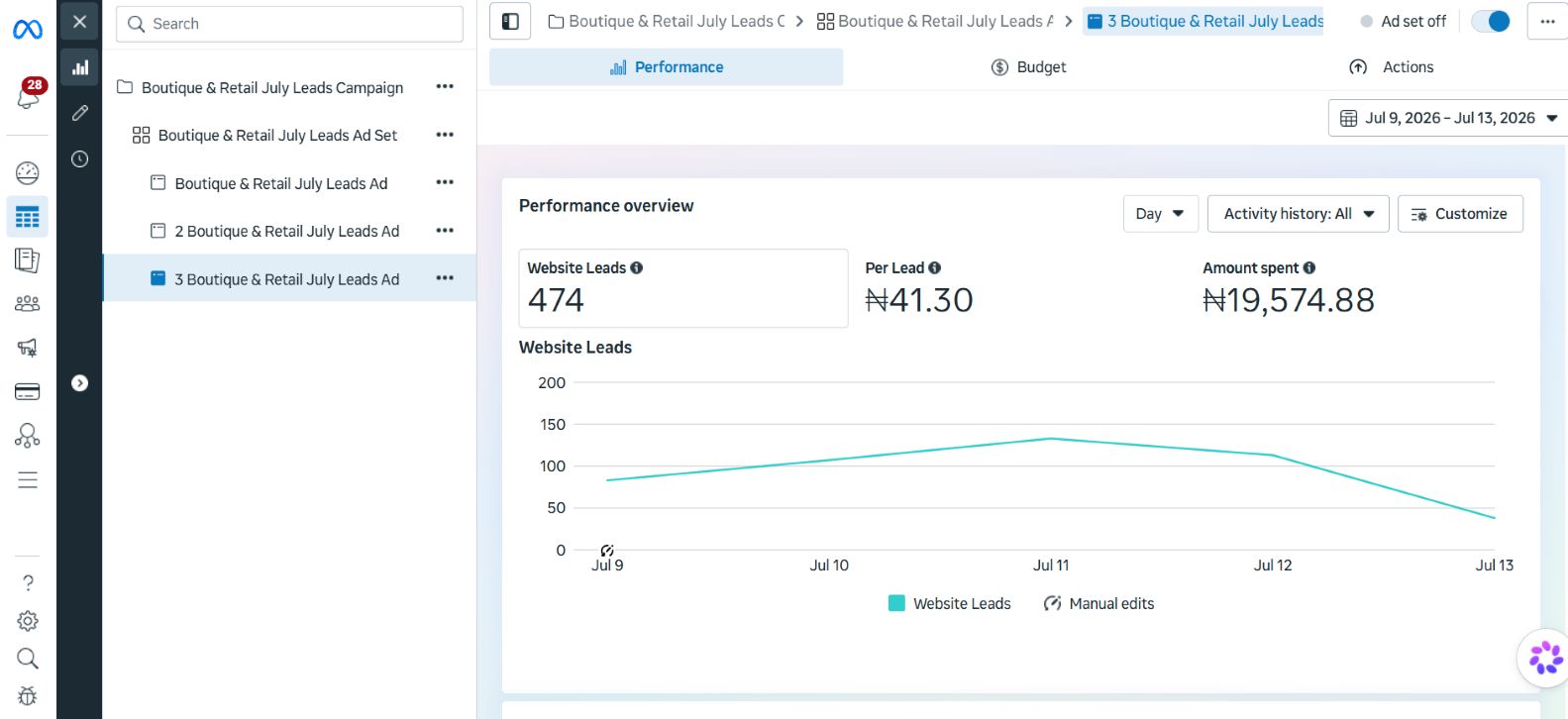
Arya Marketplace test campaign I ran for just 5 days: 474 website leads at ₦41.30 per lead, from ₦19,574.88 in total ad spend.
Social Media Marketing
Our service: Social Media Marketing at Greenlearners Technologies →
Social media marketing covers organic content and paid promotion across Instagram, Facebook, TikTok, and X, where 47.8 million Nigerians already spend real hours every day.
Its real strength is discovery, putting you in front of people who weren’t looking for you but fit exactly who you serve.
The mistake I see constantly is measuring success by likes instead of by enquiries.
A post can perform beautifully in engagement and produce zero naira, and if you’re not tracking that, you’ll repeat it every month.
- Pick the one or two platforms where your buyers actually are, not all six.
- Post consistently in a fixed rhythm your team can sustain for six months.
- Put a clear call to action on every third post, not every post.
- Use trackable links or a dedicated WhatsApp number so you know what social actually produced.
- Reinvest behind whatever organic content already performed, rather than boosting randomly.
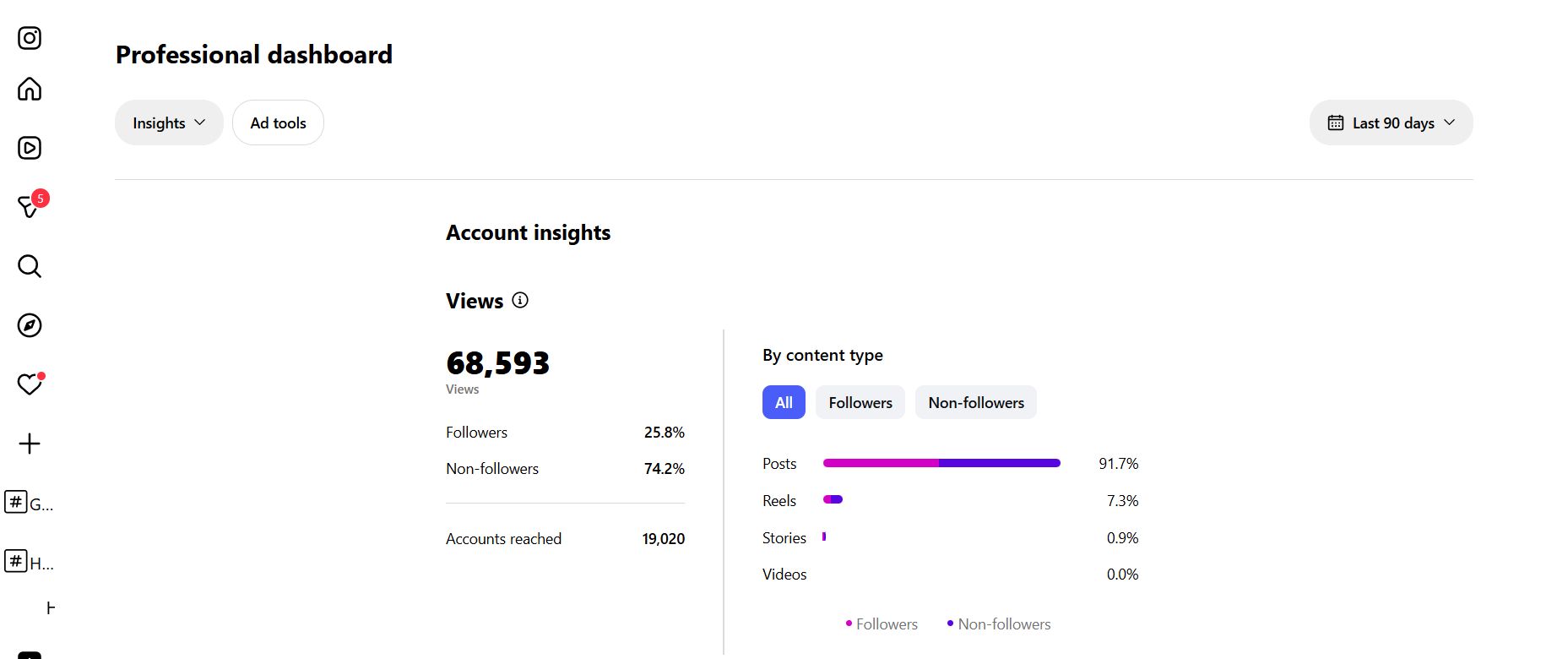
LearnWithPride Instagram over 90 days: 68,593 views and 19,020 accounts reached, with 74.2% of views coming from non-followers.
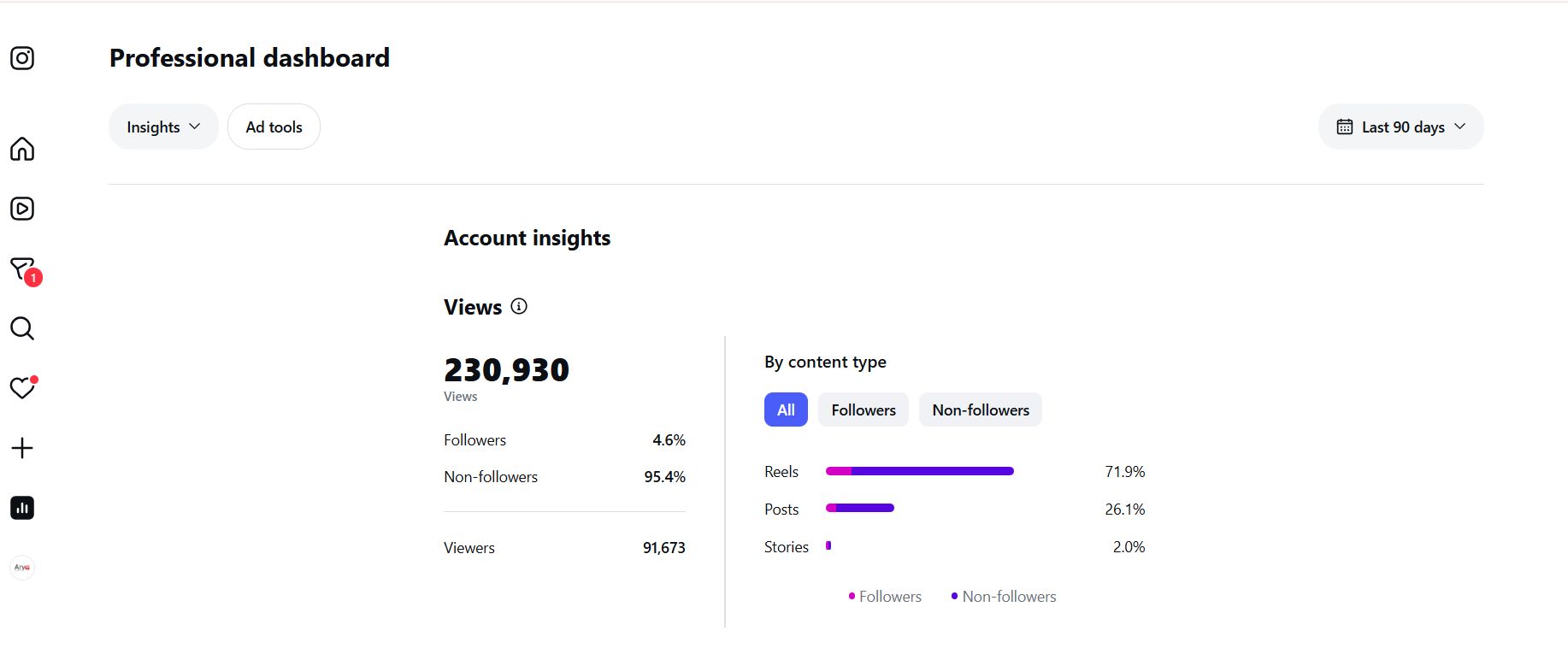
Arya Marketplace Instagram, a current engagement: 230,930 views and 91,673 viewers in 90 days, with 95.4% from non-followers and Reels driving 71.9% of all views.
WhatsApp Marketing & Community Building
Our service: WhatsApp Marketing at Greenlearners Technologies →
WhatsApp marketing means building structured communities, broadcast lists, and click-to-chat funnels on the app that roughly 95% of Nigerian internet users open every single day.
In this market that isn’t an add-on channel.
It’s frequently the primary one.
Across our client work, click-to-WhatsApp consistently beats cold checkout pages, because it moves the conversation somewhere the customer already trusts and already checks.
- Set up WhatsApp Business properly: catalogue, away messages, quick replies, business hours.
- Put a click-to-chat link on your website, your bio, and every ad you run.
- Build a community or broadcast list rather than a group where everyone can post chaos.
- Post on a fixed daily schedule, mixing value, social proof, and offers in roughly a 3:1 ratio.
- Reply within minutes during business hours. Speed is the whole advantage of this channel.
Arya Marketplace’s WhatsApp community grew past 5,000 verified wholesale buyers using exactly this structure, built as the primary conversion path rather than something bolted on at the end.
Email Marketing & Automation
Our service: Email Marketing at Greenlearners Technologies →
Email marketing means automated sequences that nurture a lead over weeks, not a single blast sent when sales get slow.
Per HubSpot’s 2026 State of Marketing Report, email ties with organic social as the second most-used marketing channel, and 22% of marketers rank it in their top five for ROI.
It also remains one of the only channels you genuinely own.
Your list doesn’t vanish because an algorithm changed overnight.
- Give people a real reason to subscribe: a checklist, a discount, a genuinely useful guide.
- Write a 5-email welcome sequence once, and let it run for every new subscriber forever.
- Segment by behaviour, buyers and non-buyers should never receive identical emails.
- Send consistently, weekly or fortnightly, not only when you have something to sell.
- Track opens and clicks per campaign, then cut the subject line styles that underperform.
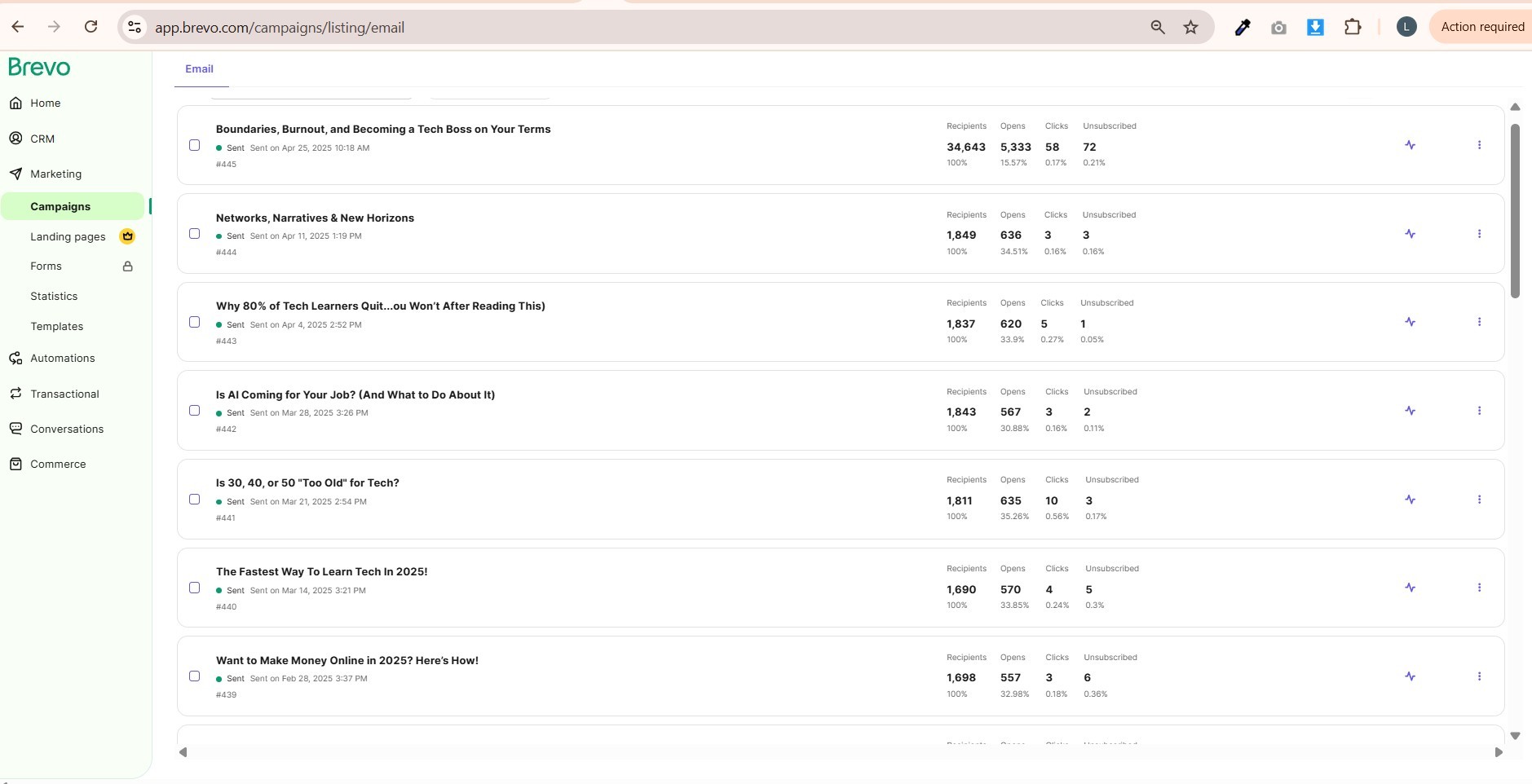
LearnWithPride email campaigns I managed: one send reaching 34,643 recipients, with regular campaigns holding 30-35% open rates, well above typical industry averages.
Video & Short-Form Content Marketing
Our service: Video Marketing at Greenlearners Technologies →
Video marketing covers short-form content on TikTok, Reels, and YouTube Shorts, currently the highest-reach format available to almost any business.
Wyzowl’s annual video research found that 85% of people say they’ve been convinced to buy something after watching a video about it.
And in our own Arya Marketplace work, Reels drove 71.9% of all Instagram views despite being a minority of posts published.
The mistake is over-producing.
A phone-shot video answering a real customer question honestly will beat an expensive ad that says nothing specific, nearly every time.
- Film answers to the questions customers actually ask, one question per video.
- Hook in the first two seconds, state the problem before offering the solution.
- Add captions, because a large share of Nigerian viewers watch on mute in public.
- Post the same video to Reels, TikTok, and Shorts, don’t create three separate things.
- Publish consistently for 60 days before judging performance, the algorithms need the volume.
Influencer & Community Marketing
Influencer marketing means partnering with someone who already holds your customer’s trust, so a portion of that trust transfers to you.
This works unusually well in Nigeria, because word of mouth has always carried more weight here than polished advertising.
Digital influencers are simply that same instinct, running at scale.
The mistake is chasing follower counts.
A micro-influencer with 8,000 genuinely engaged followers in your exact niche will out-convert a celebrity with a million followers who has no connection to what you sell.
- Shortlist creators whose audience matches your buyer, not creators you personally admire.
- Check comment quality, not follower count. Real conversations beat big numbers.
- Start with one paid test post before signing any long-term arrangement.
- Give them a unique discount code or link so attribution is unambiguous.
- Repurpose the best-performing influencer content as paid ads, with permission.
Conversion Rate Optimization (CRO)
Our service: Conversion Rate Optimization at Greenlearners Technologies →
CRO means systematically testing your pages so more of the traffic you already have turns into money.
This is the strategy most businesses skip, because it isn’t as exciting as launching a new campaign.
That’s exactly why it’s often the highest-return work on this entire list.
Improving your conversion rate makes every other strategy here more profitable, without spending one extra naira on traffic.
I’ve built many high-converting sales funnels, landing pages, and websites over the years, and the pattern is remarkably consistent: the winning version is almost never the prettiest one.
It’s the clearest one.
- Install Microsoft Clarity or Hotjar, both free tiers work, and watch real session recordings.
- Find the exact step where people drop off, then form one hypothesis about why.
- Change one element at a time: headline, button text, form length, or price framing.
- Run each test until you have enough traffic to trust the result, not until you like the result.
- Cut form fields ruthlessly. Every extra field costs you conversions.
- Make the mobile experience the priority version, since that’s where most Nigerian traffic lives.
Local SEO & Google Business Profile
Our service: Local SEO at Greenlearners Technologies →
Local SEO means optimising your Google Business Profile and location pages so you appear when someone nearby searches for what you sell.
For any business with a physical location or a service area, a clinic, a restaurant, a repair shop, a school, this is frequently the single highest-return strategy available, and it costs nothing to start.
- Claim and fully complete your Google Business Profile, every single field.
- Add at least ten real photos of your premises, team, and work, not stock images.
- Ask every satisfied customer for a review, in person, on the day they’re happiest.
- Reply to every review, positive and negative, within 48 hours.
- Post updates weekly. Google visibly favours profiles that show ongoing activity.
- Keep your name, address, and phone number identical everywhere online.
Retargeting & Remarketing
Retargeting means showing ads specifically to people who visited your site or engaged with your content but didn’t buy.
Most visitors, in any industry anywhere, don’t convert on a first visit.
Retargeting keeps you in front of the ones who were genuinely interested, instead of losing them the moment they close the tab.
I’ll be honest about something here.
You’ll find wildly different percentage claims about retargeting across marketing blogs, most of them contradicting each other and untraceable to any real source, so I’ve left them out.
What’s reliably true needs no inflated number: warm traffic converts more easily than cold traffic.
- Install the Meta Pixel and Google tag on every page before you need them.
- Build separate audiences: all visitors, product viewers, cart abandoners, past buyers.
- Show each audience a different message, matched to how far they actually got.
- Cap frequency so the same person isn’t seeing your ad fifteen times a week.
- Exclude people who already bought, unless you’re deliberately upselling them.
Sales Funnels & Marketing Automation
Our services: Funnel & Web Development · Business Growth Consulting
Marketing automation means building a repeatable path that carries a stranger from first contact to paying customer without you personally managing every step.
This is what lets a small Nigerian team compete with a much bigger one.
The system does the follow-up work no human team does consistently at scale, especially at 11pm on a Sunday.
- Map the real journey your best customers already take, from first touch to payment.
- Build a dedicated landing page for one offer, with one action available on it.
- Connect the form to an automated email or WhatsApp sequence that triggers instantly.
- Add automatic follow-up for people who start but don’t finish.
- Review drop-off points monthly, and fix the single worst step before touching anything else.
SMS Marketing
Our service: SMS Marketing at Greenlearners Technologies →
SMS means short, direct text messages for time-sensitive offers, reminders, and updates, reaching customers even with no internet connection at all.
This matters far more in Nigeria than most marketing content admits.
Data can be unreliable in places where WhatsApp won’t load, but a plain SMS almost always gets through, which is exactly why banks still use it for everything that matters.
- Collect numbers with clear permission at checkout or signup, never buy a list.
- Use a registered sender ID so your business name shows instead of a random number.
- Keep messages under 160 characters with one clear action.
- Reserve SMS for genuine urgency: order updates, appointment reminders, closing offers.
- Send during daylight hours, and never more than a few times a month.
In-App Notifications
In-app notifications mean targeted messages inside your own app, to users who already downloaded it but need a reason to come back.
This only applies once you have an app, which is why it sits near the end of this list.
But for fintechs, ecommerce platforms, and EdTech businesses, it’s one of the highest-return channels available, because the audience already trusted you enough to install something.
- Segment users by behaviour: new, active, dormant, and high-value.
- Trigger notifications on actions, not on a calendar, abandoned baskets, unfinished signups.
- Personalise with the user’s name and the specific thing they left behind.
- Cap to a few per week maximum, or people disable the channel permanently.
- Track re-open and completion rates per notification type, then kill the weak ones.
Global Service Export & Diaspora Marketing
This is the strategy almost nobody writes about, and it’s the one I personally live.
I run a marketing agency from Nigeria and sell services to clients in the UK, the US, and Canada.
The results screenshots in this guide from LearnWithPride and Study With FM are exactly that, Nigerian work, delivered to businesses abroad, earning in foreign currency.
Nigeria’s diaspora sent home $20.93 billion in 2024 alone, according to CBN figures, and that money increasingly flows into businesses back home rather than only to families.
Meanwhile, Nigerian talent in tech, design, marketing, writing, and development is selling globally at rates that transform a local business’s economics.
If you sell anything digital, your market is not your street.
It’s every timezone with a payment method.
- Position for the market you want. Your website should speak to a UK or US buyer’s concerns, not only Nigerian ones.
- Target international keywords in your SEO, not just “in Nigeria” variations.
- Build authority on LinkedIn, where most foreign B2B buyers actually verify you before responding.
- Set up compliant international payment rails early: Payoneer, Wise, Grey, or direct USD accounts.
- Show proof in the buyer’s own context, publish case studies from clients in their region.
- Price in the client’s currency, and be explicit about timezone overlap in every proposal.
- For diaspora-facing offers, run Meta Ads targeting Nigerians in the UK, US, and Canada specifically.
Authority Marketing: Being Trusted Before Anyone Searches
If you ask me where marketing is heading, I don’t think the answer is more SEO, more ads, or even more AI.
I think it’s building authority before anyone ever searches for your business.
Twenty years ago, people discovered businesses through Google, and Google created the demand.
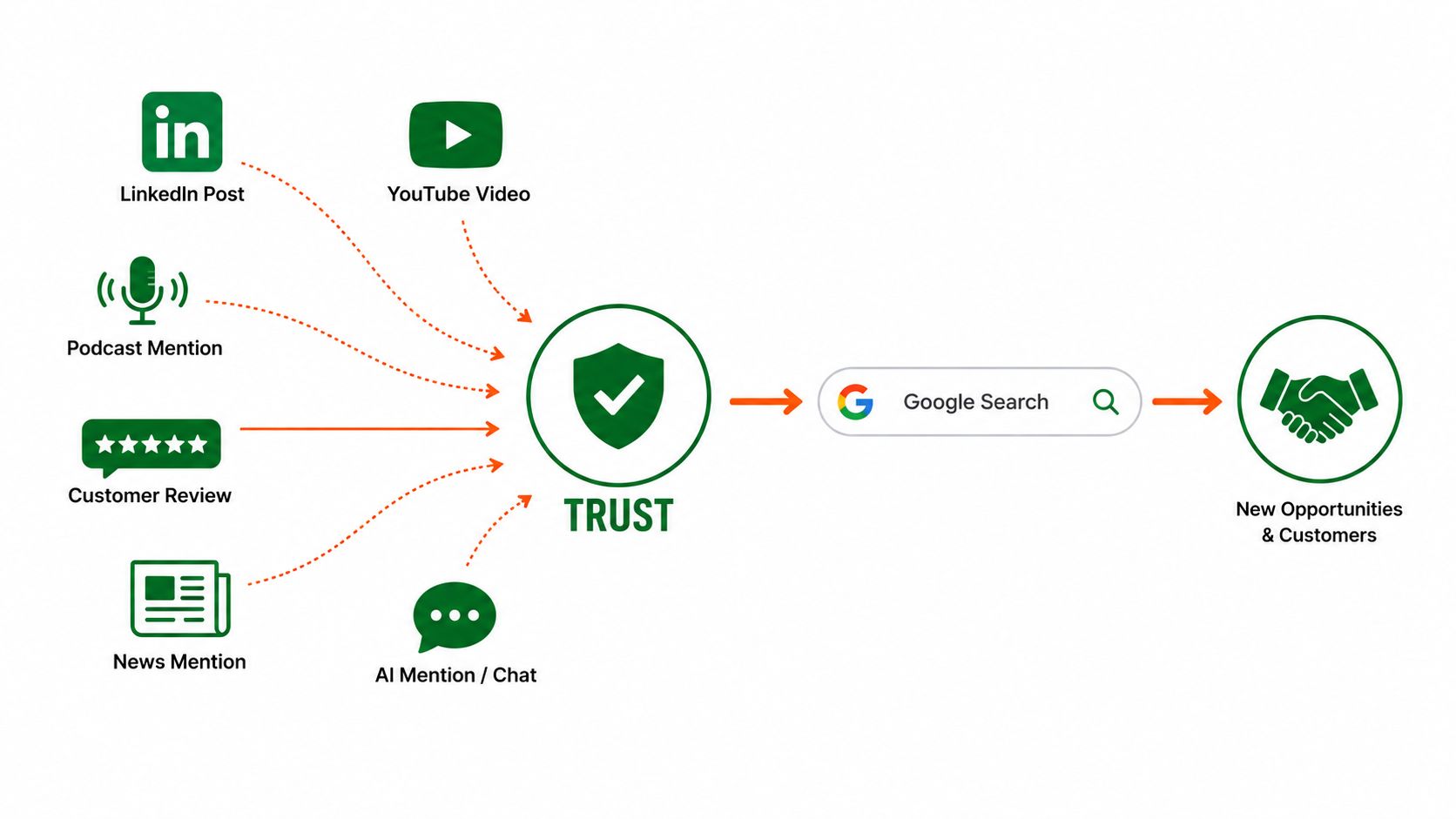
Today they discover you on LinkedIn, YouTube, TikTok, X, a WhatsApp community, a podcast, or because someone shared your work.
Then, when they finally need what you sell, they search your name.
The search engine no longer creates the demand.
It simply confirms trust that was built somewhere else.
The data on this is now hard to ignore.
Pew Research Center tracked 68,879 real Google searches and found that when an AI summary appears, users click through to a website just 8% of the time, against 15% without one.
Roughly 26% of users end their browsing session entirely.
Meanwhile Bain & Company found that 85% of B2B buyers purchase from a vendor list they had already formed before doing any search at all.
Read that again, because it reframes everything.
By the time someone searches, the decision is often already mostly made.
Think about how you personally choose a business today.
Someone recommends a company, and you don’t buy immediately.
You Google them, check the website, look at LinkedIn, read reviews, maybe watch a video, maybe ask ChatGPT.
By the time you make contact, dozens of scattered trust signals have already shaped your decision.
That is authority marketing.
It isn’t about being famous.
It’s about being consistently credible everywhere someone might look.
One clarification worth making, because plenty of marketers get this wrong.
Google’s E-E-A-T framework, Experience, Expertise, Authoritativeness and Trust, is not a direct ranking factor, and Google has said so plainly.
There is no E-E-A-T score inside the algorithm.
It’s a description of the qualities Google’s systems are built to reward, measured through signals it can actually detect: credible links, real author identity, accurate content, and consistent reputation.
The practical implication is the same either way.
Build genuine authority, and the measurable signals follow.
And this is where audience quality beats audience size decisively.
One million engaged people who trust you and generate $50 million in revenue is a better business than 100 million visitors who generate $100,000.
Traffic is a number.
A returning, engaged audience is an asset.
- Publish work that demonstrates real expertise, with your name and face attached, not anonymous company content.
- Build a genuine presence on the one or two platforms where your buyers already spend time, and stay consistent for years, not weeks.
- Earn mentions, citations, interviews, and backlinks from credible publications in your industry.
- Collect public reviews and testimonials relentlessly, because third-party proof outweighs anything you say about yourself.
- Speak on podcasts, webinars, panels, and industry events, then republish those appearances on your owned assets.
- Keep your business name, founder profile, and core message identical across every single platform, so both people and machines resolve you as one clear entity.
- Publish original research, case studies, and frameworks that other people naturally cite, since being quoted is the strongest authority signal available.
Why One Campaign Doesn’t Fit All Of Nigeria
This is the section I most wish someone had written for me when I started.
Nigeria is not one market.
Marketing strategies that perform beautifully in Lekki can fall completely flat in Kano, and not because the creative was bad.
Because the buying psychology is different.
Here’s what I’ve observed across client work and market data.
Treat these as broad patterns to test, not stereotypes to obey, because there are always exceptions inside every region.
Lagos & the South-West
Fast-moving, convenience-driven, and the most digitally saturated market in the country.
App adoption and card payments are normal here, and buyers will pay a premium for speed.
This is also the most expensive and most competitive place to advertise, because everyone is bidding for the same attention.
What tends to work: Instagram and TikTok, influencer partnerships, fast delivery promises, Meta Ads with tight targeting.
Abuja & the Federal Capital
A different buyer entirely.
Higher concentration of civil servants, corporate professionals, and institutional decision-makers, which means longer consideration periods and a much stronger response to visible professionalism and credentials.
What tends to work: LinkedIn, Google Ads on high-intent searches, formal case studies, referrals through professional networks.
The South-East: Onitsha, Aba, Nnewi
Nigeria’s trading heartland, where relationships and reputation carry more weight than any advertisement.
Buying decisions here are frequently informed by trade networks and long-standing supplier relationships, and wholesale margin conversations matter more than brand storytelling.
What tends to work: WhatsApp groups, referral incentives, bulk and wholesale framing, trust built through consistent delivery rather than paid reach.
The North: Kano, Kaduna, Sokoto
Radio remains genuinely powerful here in a way most Lagos marketers underestimate.
Language matters enormously, Hausa-language creative routinely outperforms English in these markets.
Cash and agent banking still dominate in many areas, and relationship-building precedes purchase over a longer timeline.
What tends to work: Radio, community and agent networks, Hausa-language content, USSD-friendly and offline-capable payment options.
Port Harcourt & the South-South
Strong oil-and-gas corporate economy sitting alongside a large SME market, which means two very different buyers in one city.
B2B here often mirrors Abuja’s professionalism-first pattern, while consumer buying looks closer to Lagos.
What tends to work: Segmented campaigns, LinkedIn for the corporate side, Instagram and WhatsApp for consumer.
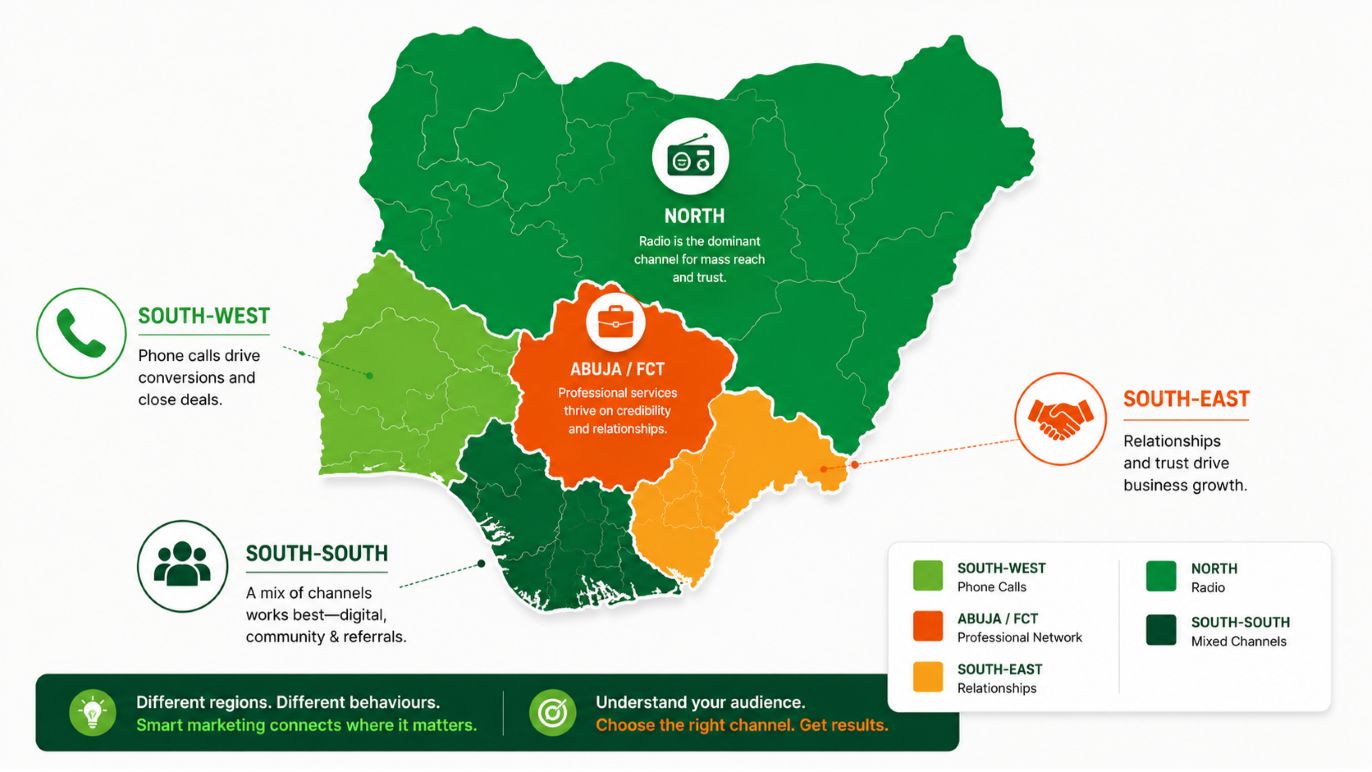
The practical takeaway is simple: never scale a campaign nationally until you’ve tested it in at least two regions.
The version that wins in Lagos frequently needs different language, different proof, and a different payment option before it works in Kano.
Strategy Combinations That Compound
No serious business in Nigeria survives on one marketing strategy alone.
The strongest results almost always come from pairing marketing strategies deliberately, and here’s what that looks like in practice.
| Combination | Why It Works |
|---|---|
| SEO + Content Marketing | Content gives SEO something worth ranking. SEO gives content someone to find it. |
| PPC + Conversion Rate Optimization | CRO makes every naira of ad spend go further before you spend more. |
| WhatsApp + Retargeting | Retargeting brings them back. WhatsApp is where the sale actually happens. |
| Email + Automation | Automation is the engine. Email is its most reliable fuel. |
| Local SEO + Reviews | Reviews build the trust that makes a local listing worth clicking. |
| Billboard or Radio + WhatsApp/SMS | Offline creates awareness. One memorable instruction converts it. |
| Video + Influencer Marketing | Borrowed audience, native format, and content you can reuse as paid ads. |
Notice the pattern in every single pairing.
One strategy creates attention, the other converts it.
Most businesses build only half of that pair, then wonder why the results feel random.
5 Nigerian Businesses Whose Strategy Decided Their Fate
Theory is cheap.
Here are five real Nigerian businesses whose marketing strategies decided whether they won or disappeared, all verified against independent reporting rather than their own press pages.
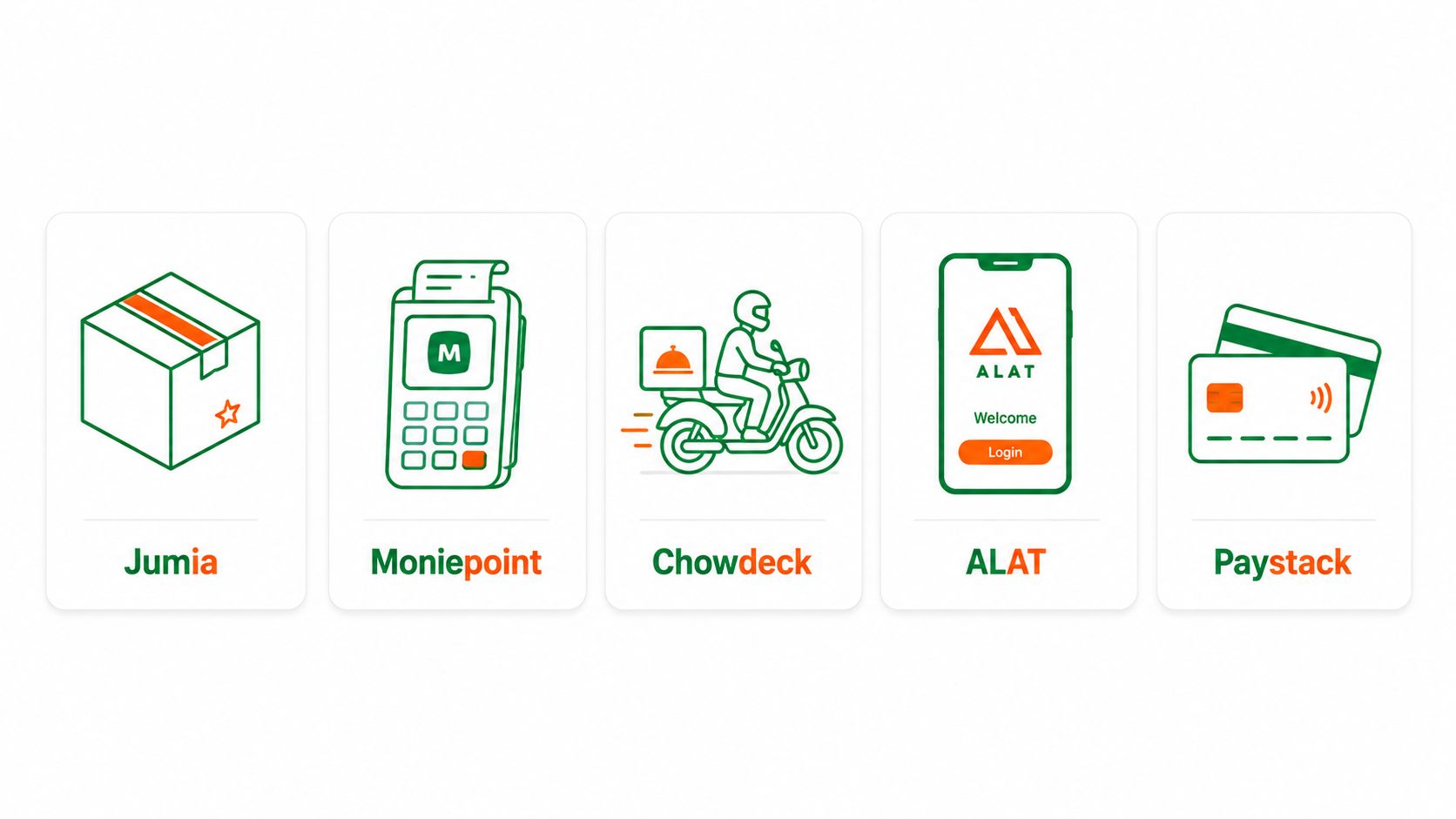
1. Jumia: Pay-On-Delivery Broke The Trust Barrier
When Jumia launched in 2012, Nigerians simply did not trust online shopping.
Why would you enter card details for goods that might never arrive, from a company you’d never heard of?
Jumia’s answer was pay-on-delivery, and it was expensive.
It meant absorbing returns, failed deliveries, and rejected orders at scale.
Financially it hurt for years.
Strategically, it was the single decision that made Nigerian ecommerce possible, because it removed the exact fear stopping the purchase.
Today almost every Nigerian has ordered something online at least once, and that behavioural shift traces directly back to that choice.
Its rival Konga, founded the same year by Sim Shagaya, chose differently: an omnichannel strategy with physical stores and 80% in-house logistics through Kxpress, over 400 delivery vehicles.
Operationally it was arguably the better-run business.
But it couldn’t out-fund a competitor backed by Rocket Internet’s continuous capital.
Konga was sold to Zinox in 2018 in what Shagaya himself later called painful and tragic, while Jumia listed on the New York Stock Exchange in 2019.
The lesson: solving the trust barrier beat optimising the operation.
2. Moniepoint: Distribution As Marketing
Moniepoint began in 2015 as TeamApt, founded by Tosin Eniolorunda and Felix Ike, building software for banks rather than selling to consumers.
The pivot came from a genuinely field-level insight.
When the team went to Sangotedo market in Lagos to understand what agents actually needed, every single agent named the same problem: reconciliation.
Not branding.
Not an app.
Reconciliation.
So Moniepoint built for that, and then did something most fintechs avoided: it built physical field teams across Nigerian cities and trading zones.
Not engineers, but business development staff who could visit a merchant, diagnose a problem, and train someone in person.
That’s expensive and slow.
It’s also almost impossible to copy.
A merchant trained and supported by a Moniepoint rep doesn’t switch providers over a small price difference.
The strategy was validated during Nigeria’s 2023 cash crisis.
While ATMs went dark and bank queues stretched around buildings, Moniepoint’s agent network kept cash and transactions moving.
In October 2024 it raised $110 million and crossed a $1 billion valuation, and by October 2025 it closed a $250 million Series C.
The lesson: in Nigeria, distribution and physical trust are marketing.
3. Chowdeck: Winning One City Before Touching The Next
I’ve been in Ibadan since 2019, and I watched Chowdeck arrive here and spread like wildfire.
So this one I saw happen around me.
Founded in October 2021, Chowdeck did the opposite of what most funded startups do.
Instead of launching everywhere at once, it concentrated on Lagos, and even within Lagos, on specific high-density neighbourhoods, optimising delivery times before widening the map.
That discipline showed up in the operating rule its CEO Femi Aluko described publicly: a city should become profitable, typically in three to four months, before the next one opens.
Then came partnerships.
In August 2024, Chowdeck signed an exclusive delivery deal with Chicken Republic covering Lagos and Ibadan, which is precisely when I noticed it everywhere here.
An earlier Shoprite partnership had already extended it into groceries.
The numbers followed.
Revenue grew 1,200% between 2022 and 2023.
The value of meals delivered grew more than sixfold in 2024.
By its $9 million Series A in August 2025, Chowdeck was serving 1.5 million customers across 11 cities with 20,000+ riders, averaging 30-minute deliveries, and it was profitable, which is rare in food delivery anywhere on earth.
The lesson: depth in one market beats shallow presence in ten.
4. ALAT By Wema: The First-Mover Bet
In May 2017, Wema Bank launched ALAT, Africa’s first fully digital bank, built branchless from the ground up.
At the time roughly 40% of Nigerian adults were unbanked or underbanked per EFInA’s research, and most banks were still spending heavily on physical branches.
Wema, unable to fund a large branch expansion, took the opposite bet entirely.
ALAT attracted more than 175,000 customers and over ₦1.1 billion in deposits within six months, and won World Finance’s Best Digital Bank award for 2017.
And that first-mover positioning is exactly how a billboard near UI’s second gate turned into an app I still use today.
The strategy reached me through offline media and closed through search, which is the entire point of this guide.
5. Paystack: Solving A Nigerian Problem Completely
In 2015, Shola Akinlade and Ezra Olubi set out to fix something every Nigerian business owner already knew intimately: accepting payments online here was slow, unreliable, and painful.
They didn’t import Stripe’s American playbook.
They built for how Nigerian businesses actually operated, the banks Nigerians actually used, the failure points Nigerian merchants actually hit.
In 2016 Paystack became the first Nigerian startup accepted into Y Combinator.
By 2020, over 60,000 businesses were using it, processing more than half of all online payments in Nigeria.
That October, Stripe acquired it for a reported $200 million-plus, on total funding of only around $12 million.
The lesson: Paystack didn’t win by being a cheaper Stripe.
It won by understanding one specific market more deeply than anyone else building in it.
That principle sits underneath every strategy in this guide.
Best Strategies By Business Type
No two industries in Nigeria need the same marketing strategies.
Here’s what I’d actually recommend, based on businesses I’ve worked with and studied closely.
| Business Type | Top 3 Strategies | Why |
|---|---|---|
| Fintech & apps | SEO, In-App Notifications, Content | Trust before download, retention after |
| Ecommerce stores | Social Media, Retargeting, WhatsApp | Discovery, cart recovery, direct closing |
| Restaurants & food | Local SEO, Video, WhatsApp | People search “near me” and buy with their eyes |
| EdTech & training | SEO, Content, Email | Buyers research heavily before committing |
| Real estate | Video, Meta Ads, WhatsApp | High-value decisions need visual trust then conversation |
| Hospitals & clinics | Local SEO, Reviews, Content | Medical trust is built through evidence and proximity |
| Law firms & professional services | Google Ads, SEO, LinkedIn | High-intent search plus visible credentials |
| Manufacturers & B2B | LinkedIn, SEO, Email | Long cycles, multiple decision-makers |
| Fashion & beauty | Instagram, Influencers, WhatsApp | Visual-first discovery, social proof closes |
| Digital agencies & freelancers | Content, LinkedIn, Global Export | Authority sells the service, export multiplies the rate |
If your business isn’t listed, match by buyer behaviour rather than industry label.
A law firm and a private clinic both sell trust to a cautious buyer, so their strategy mix looks more alike than either would expect.
If I Had To Start Again With ₦500,000
I get asked this often enough that it deserves a straight answer.
If I were starting a new business in Nigeria today with ₦500,000, here’s exactly what I’d do, in order.
Notice what’s absent: no expensive rebrand, no premium office, no six-platform social presence.
Just the strategies that produce evidence fast enough to justify the next naira.
Mistakes That Quietly Waste Marketing Budgets
Most wasted Nigerian marketing budget is lost to a handful of recurring, avoidable errors rather than to bad luck.
These are the ones I see most often.
- Running one strategy in isolation. SEO with no converting page, or ads with no retargeting, leaves real money behind every month.
- Switching strategies too early. SEO and content need months. Quitting at week six is the single most common reason businesses conclude “it doesn’t work.”
- No tracking connecting activity to revenue. If you can’t name which strategy produced your last five customers, you’re guessing rather than managing.
- Copying a foreign playbook wholesale. A funnel built for US buyers routinely underperforms here, because payment habits, trust barriers, and network reliability are genuinely different.
- Treating all of Nigeria as one market. The campaign that wins in Lagos may need different language, proof, and payment options entirely before it works in Kano.
The businesses that win aren’t the ones who found secret marketing strategies nobody else knows.
They’re the ones who picked the right two or three for their actual stage, and stayed consistent long enough for them to compound.
Want help choosing and executing the right strategies?
A real conversation about your stage, your budget, and which of these 17 come first for your business.
Chat With Us On WhatsAppIf you’ve read this far, you’re not skimming another listicle.
You’re trying to build something that actually works.
So here’s the closing thought I’d want you to keep.
Pick two marketing strategies from this guide that fit where your business genuinely is right now.
Run them properly, long enough to actually judge them, before adding a third.
That single discipline separates marketing that compounds from marketing that just burns money.
Frequently Asked Questions
For most small businesses, WhatsApp marketing, local SEO through Google Business Profile, and organic social media are the strongest starting points, because they’re low-cost and produce results fast enough to learn from.
Paid advertising and SEO become far more valuable once you have a page that actually converts the traffic they send.
Two to three, executed consistently, almost always outperform five or six run half-heartedly.
Start with the ones matching your current maturity level and budget, then add more only once the first are producing measurable results.
Pay-per-click advertising, WhatsApp marketing, SMS, and retargeting can produce measurable results within days.
SEO, content marketing, and AI search optimization take three to six months but produce compounding results that get cheaper over time.
Often not without adjustment.
Lagos rewards speed, app adoption, and influencer-led discovery, while Northern markets frequently respond better to radio, Hausa-language creative, agent networks, and longer relationship-building before purchase.
Test any campaign in at least two regions before scaling it nationally.
Yes, and it’s one of the most under-used strategies available.
I run a marketing agency from Nigeria serving clients in the UK, US, and Canada.
It requires positioning for the buyer’s market rather than yours, targeting international keywords, building LinkedIn authority, and setting up compliant international payment rails early.
Yes.
Google’s own guidance confirms AI-generated answers draw on the same core ranking systems as traditional search.
Strong SEO fundamentals remain the foundation for both rankings and AI citations, so treating AI optimization as a replacement rather than an extension is a mistake.
Small businesses typically invest ₦250,000 to ₦3,500,000 monthly, growing SMEs ₦500,000 to ₦15,000,000, and enterprise campaigns ₦1,500,000 to ₦50,000,000.
Always separate management fees from actual ad spend, and be sceptical of quotes far below these bands.
Absolutely, but rarely on its own.
Billboards, radio, and word of mouth create awareness extremely effectively, particularly outside Lagos.
The conversion almost always happens online afterwards, through a search, an Instagram check, or a WhatsApp message, which is why the two need to be planned together.
A tactic is a single action, like boosting one post.
A strategy is a coordinated system with a clear goal, the right channels, and consistent execution over time.
Most marketing disappointment comes from running isolated tactics while expecting the results a real strategy would produce.
Authority marketing means building visible credibility across search, social, reviews, and AI assistants so people already trust you before they ever look you up.
It matters more now because Pew Research found users click a website on only 8% of searches when an AI summary appears, and Bain found 85% of B2B buyers buy from a shortlist formed before they searched at all.
Owned assets are things you control: your website, blog, email list, WhatsApp database, CRM, app, and private community.
Distribution platforms like Instagram, Facebook, TikTok, LinkedIn, and Google give you reach but can change your visibility at any time, which is why the goal is always to move borrowed attention onto assets you own.
A marketing strategist diagnoses where your business actually is, selects the right combination of strategies for that stage and budget, sequences them in the correct order, and holds the whole system accountable to revenue rather than activity.
The value isn’t in running one channel well.
It’s in knowing which channels to run at all, and which to ignore for now.
This guide is published for educational and informational purposes only.
It is not business, financial, investment or legal advice, and it should not be relied upon as a substitute for guidance from a qualified professional who understands your specific circumstances.
No result described here is promised or guaranteed.
Marketing outcomes depend on your product, market, budget, timing, execution and competitive conditions. Two businesses running identical strategies routinely get very different results.
Where results from Greenlearners Technologies client work are cited, including specific campaign figures and screenshots, those are documented outcomes for specific clients under specific conditions. They are examples rather than typical results, and no similar outcome is implied for any other business.
Budget ranges are general Nigerian market observations at the time of writing and will change with market conditions. Please verify current pricing and any third-party figure before making a commercial decision.
- DataReportal (2026). Digital 2026: Nigeria. datareportal.com
- Nigerian Communications Commission (2025). Industry Statistics, Active Subscriptions. ncc.gov.ng
- OpenAI (2026). Scaling AI for everyone. openai.com
- Google Search Central (2026). Optimizing your website for generative AI features on Google Search. developers.google.com
- HubSpot (2026). State of Marketing Report. hubspot.com
- Wyzowl (2026). State of Video Marketing Report.
- Premium Times (2025). Wema at 80: How ALAT changed the face of banking in Africa. premiumtimesng.com
- World Finance (2018). Wema Bank is shaping the future with launch of pioneering ALAT. worldfinance.com
- World Finance (2019). Leading Nigerian banking into the digital age. worldfinance.com
- BusinessDay NG (2018). ALAT by Wema is Africa’s best digital bank. businessday.ng
- The Alternative Bank (2026). Official website, Sterling Bank’s digital banking platform. altbank.ng
- SimplVest (2025). Jumia Vs Konga Rivalry: How It Started And How It Is Going. simplvest.com
- WeeTracker (2024). The Konga-Jumia Merger That Never Happened. weetracker.com
- Rest of World (2020). Jumia was destined to dominate ecommerce in Africa. restofworld.org
- TechCrunch (2020). Stripe acquires Nigeria’s Paystack for $200M+. techcrunch.com
- Moniepoint (2026). How Moniepoint Became King. moniepoint.com
- Monocle (2025). How Moniepoint opened the door to digital banking for Nigerian citizens. monocle.com
- Marketing Analytics Africa (2026). Case Study: Moniepoint and the Reinvention of African SME Banking. marketinganalytics.africa
- Business Elites Africa (2024). How Moniepoint’s 5 Key Strategies Pushed it to $1 Billion Fintech. businesselitesafrica.com
- TechCrunch (2025). Profitable Nigerian food delivery Chowdeck lands $9M from Novastar, Y Combinator. techcrunch.com
- Semafor (2024). Nigeria’s Chowdeck hopes to prove food delivery doubters wrong. semafor.com
- TechCrunch (2024). Nigeria’s YC-backed Chowdeck hopes to scale food delivery with $2.5M funding. techcrunch.com
- BusinessDay NG (2025). Chowdeck gets $9m funding boost for Nigeria, Ghana expansion. businessday.ng
- Pew Research Center (2025). Google users are less likely to click on links when an AI summary appears in the results. pewresearch.org
- Bain & Company (2025). Losing Control: Why B2B Buyers Decide Before They Search. bain.com
- Google Search Central. Creating helpful, reliable, people-first content (E-E-A-T). developers.google.com
- Google (2025). Search Quality Rater Guidelines. E-E-A-T is an evaluation framework for human raters, not a direct ranking factor.
- SparkToro / Datos (2026). Zero-Click Search Study. sparktoro.com
- EFInA. Access to Financial Services in Nigeria Survey. efina.org.ng
- Greenlearners Technologies (2026). Verified client campaign data from LearnWithPride, Study With FM, and Arya Marketplace. greenlearnerstechnologies.com/
[…] You can read more on how we structure this across different types of businesses in our full marketing strategy breakdown. […]
[…] You can read more on how we structure this across different types of businesses in our full marketing strategy breakdown. […]
[…] published seventeen marketing strategies in our national guide to growing a business in Nigeria. Below is how the ones that matter most behave differently once you apply them inside […]
[…] Our full national breakdown of how to execute each one sits in the guide to marketing strategies that work in Nigeria. […]